
Hair repair shampoo
Colourants, heat styling tools, perming, straightening, chlorine from pools and even sunlight takes its toll on hair. The longer the hair, the more time over which the damage is done, yet to grow it long and lustrous, this somehow needs to be reversed!Surfactants used to clean the hair can strip important oils, exposing it to further dryness – so just how do you formulate a hair repair shampoo, to not only protect it from more daily damage, but also fix some of the damage that is done? Read on to find out…1: Choose mild surfactants
To clean effectively, your shampoo needs to have an anionic surfactant as its primary surfactant; this will be one of your most important formulation decisions. The mildest, yet high foaming anionic surfactants for hair repair shampoos include:
- Amino acid based surfactants: you will recognize these with INCI designations containing the term ‘sarcosinate’, such as Sodium Cocoyl Sarcosinate or Sodium Lauroyl Sarcosinate; or starting with ‘sodium cocoyl’ and ending with ‘amino acids’, such as Sodium Cocoyl Apple Amino Acids. Amino acid-based surfactants provide a nice dense foam and are usually reasonably priced, but not exactly cheap. For hair repair shampoos you would typically use 5-6%w/w active input in your formula.
- Fatty acid taurides, such as Sodium Cocoyl Methyl Taurate; and fatty acid isethionates, such as Sodium Cocoyl Isethionate; can also be used in place of the amino acid surfactants because of their premium yet gentle cleansing. They do tend to carry a higher price tag, although you may get away with using less too. These materials are ideal in salon quality products, and for hair repair shampoos an input of 3-5%w/w active input would normally be more than enough to generate a beautiful dense foam and powerful clean.
2: Pair your primary surfactants with a superfatting agent
A hair repair shampoo formula will need an amphoteric material, such as Cocamidopropyl Betaine at 4 – 7%w/w active content – it is essential in all high performing shampoos. In addition to this, you will need a good superfatting agent in your hair repair shampoo formula. A superfatting agent provides a conditioning coating to the hair without leaving residue and is a non-ionic surfactant itself. There are dozens of superfatting agents available to boost the functionality of your shampoo formulas – for hair repair shampoos, choose those which are especially conditioning such as:
- PEG-oils or glycerides: you will recognize these with INCI designations such as Olive Oil PEG-7 Esters or PEG-60 Almond Glycerides;
- Polyglycerols or PEG-glycerols: these are recognized with INCI designations like Polyglyceryl-3 Caprate or PEG-7 Glyceryl Cocoate.
Your superfatting agents should be used at 3-5%w/w active content.
3: Hydrolysed proteins are essential
If you are formulating a hair repair shampoo, a hydrolysed protein is essential. Since hair is a protein, and damaged hair can be likened to a tiled roof that is missing tiles, has broken and cracked tiles, or tiles lifted and ready to fall; hydrolysed proteins are like replacement tiles that come along and fill the gaps of your damaged roof to leave it protected, smoother and looking great. While you need a mild yet effective clean with conditioning superfatting agents to leave the hair feeling soft, there is no repair without hydrolysed proteins.
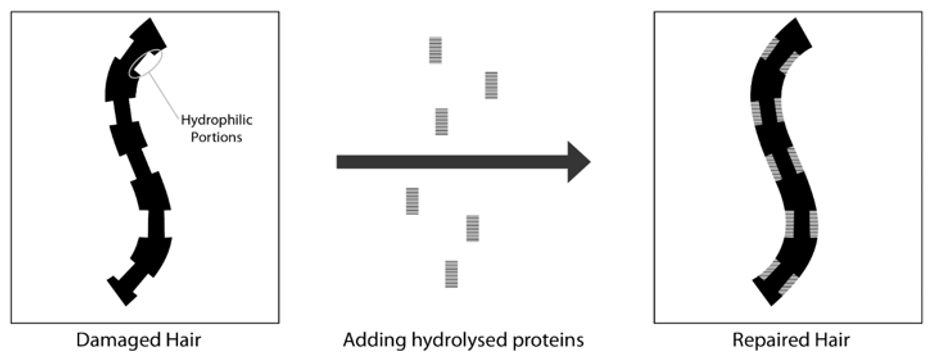
You’ll know hydrolysed proteins because they use that term in their INCI name; there a dozens to choose from, all with different molecular weights. Some tips to help you choose the best hydrolysed protein:
- if a vegan friendly formula is important, make sure you are using a plant sourced hydrolysed protein.
- low molecular weight hydrolysed proteins can penetrate within the cuticle of the hair for structural integrity and strength.
- high molecular weight hydrolysed proteins are best to fill in ‘gaps’ where damage exists on the outside of the hair shaft.
The actual input will depend on the material you choose, as hydrolysed proteins come in different concentrations and molecular weights. Refer to supplier data specific to the material you are selecting and use the upper recommended input for the best repair performance.

4: Add a polyquaternium agent if your budget allows
If your formula needs to be budget conscious, you may need to skip a polyquaternium agent – while they are not expensive on their own, with everything else in the formula you might need to pick and choose what you include or leave out. Polyquaternium materials are great to add positive charge back to damaged hair – but since most hair repair shampoos would be paired with a highly cationic conditioner, your user would be getting a good dose of positive charge added at the conditioning step anyway.
Polyquaternium agents can add a beautiful slip and soft feeling to your hair repair shampoo if your budget allows. Since these materials can vary so greatly, check supplier details specific to the polyquaternium you are choosing for the best input rates, and use the mid-high input for hair repair shampoo formulations.
5: Other important ingredients
Other ingredients that can be great additions to your hair repair shampoo include:
- glycerin – to boost foam and humectant properties;
- active ingredients – look for efficacy data specific to shampoo formulas to ensure you get the desired results;
- herbal extracts – if glycerin based, there may not be efficacy data, but consumers love to see natural extracts added to formulas so they can be important for marketing purposes;
- fragrance or essential oils – shampoos need to smell great. Remember to always profile your target market to select the right aroma to enhance enjoyment of the hair repair shampoo formula.
And of course, you’ll need to make sure your final formula is pH balanced for your surfactants and other ingredients used, as well as the scalp. Ideally, a pH of around 6 – 6.5 is ideal for most systems; although remember to check compatibilities of all ingredients especially preservatives, to make sure this pH is suitable.
Finally, preservative selection: make sure your preservative is effective to protect your formula with its high nutritive and functional load. It must also suit the high surfactant content. Shampoos are a wash off product so use the higher side of the recommended (and regulatory permitted) input as it is not restricted by leave on limits.
Well… there you have it! The essential tips on how to formulate a hair repair shampoo. Now its over to you to create the shampoo formulations that will repair those damaged locks to leave them lustrous and glossy.
Happy formulating!
Recent Trends in Home Care Products: Navigating Sustainability and Aff...
Innospec sustainable and innovative “Blue Ocean” formulations to meet...

AI and surfactants
AI Formulators are coming are you ready?

Skin rejuvenating properties of a powerful blend of Gardenia jasminoid...
The popularity of vitamin C Serums for effective skin care
Navigating the sensory gap in metaverse personal care

What trends in testing for beauty