Detergents Regulation (EC) No 648/2004 (1), which establishes common rules to enable detergents and surfactants to be sold and used across the EU, while providing a high degree of protection to the environment and human health. The regulation came into effect in 2005 and has been updated several times since its introduction to harmonise the rules for placing detergents and surfactants for detergents on the EU market.
The Detergents Regulation is currently undergoing a major revision, which was undertaken with the following goals:
- Alignment with the objectives of the European Union, in terms of sustainability and digital transition: Specific provisions were introduced to take into account the sustainability of detergents and make sure that the information provided on these products would also be available digitally.
- Addressing market developments: The market for detergents has evolved significantly since the original regulation was adopted. New products, such as microbial cleaners, have emerged, necessitating updated regulatory guidelines.
- Simplifying regulations: The revision seeks to reduce legislative overlap with other EU regulations and to simplify compliance for manufacturers.
Furthermore, the Commission President’s guidelines for the period of 2025 – 2029 are setting the ground to boost the competitiveness of the EU industry and strengthen the EU internal market. In this regard, the Commission will publish several communications to simplify the implementation of EU legislations, to ensure that the legislations are fit for small and medium-sized enterprises (SMEs) and cut the administrative burden necessary to comply with EU legislation. The Trilogues are an opportunity to bring the Detergents Regulation in line with the Commission’s ambition, lifting administrative burdens for SMEs, but also supporting innovation and competitiveness for the whole detergents sector.

The Commission’s legislative proposal (2) for a revision of the Detergents Regulation was published in April 2023, the European Parliament’s text (3) was concluded in February 2024 and Council’s General Approach (4) in June 2024. The European elections and, consequently, the confirmation of new members of the Parliament and Commission delayed the start of the interinstitutional negotiation process for several months. However, the trilogue discussions have just started and are expected to bring clarity to the provisions included in the future regulation.
Specific topics are expected to be debated. These include amongst others:
Biodegradability
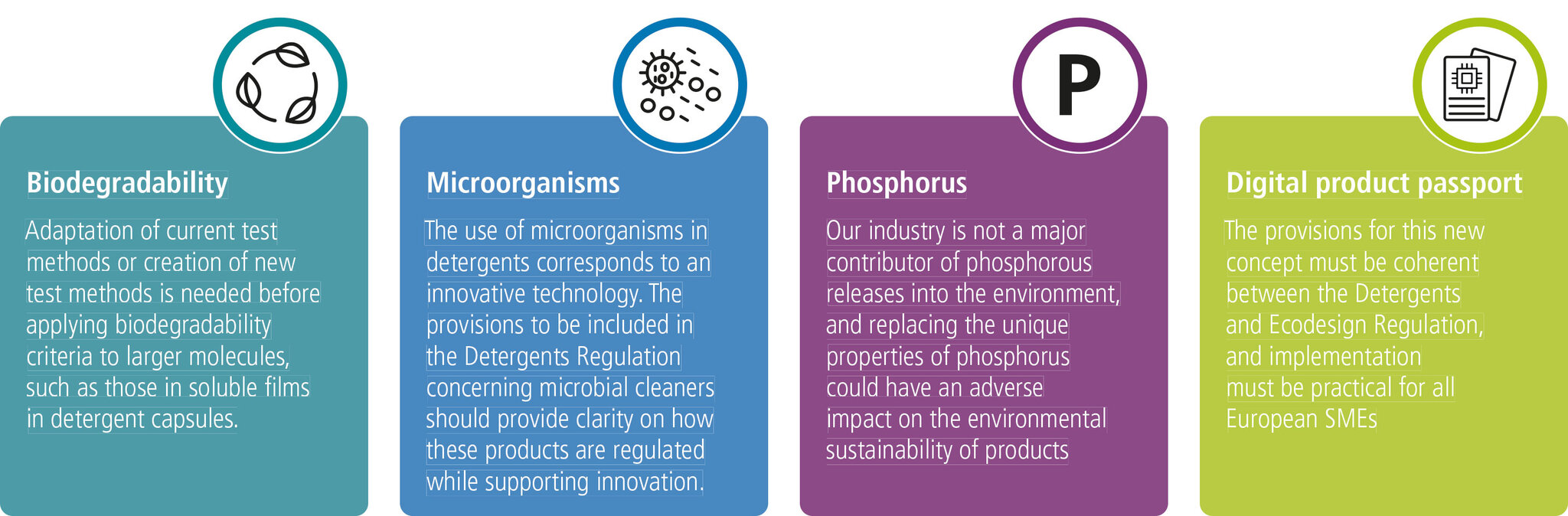
The revised regulation places a strong emphasis on the biodegradability of detergent components. While the European Commission maintained the already existing biodegradability criteria for surfactants, the proposals from the European Parliament and Council aim for other types of ingredients to be biodegradable. The specific criteria for biodegradability and the timeline for their implementation are key points of discussion.
While the industry supports the aim to achieve biodegradability for detergents, it would however be premature to introduce biodegradability requirements for all ingredients, as feasibility analysis and impact assessment need to be performed first, so that product performance would be ensured. A decrease in the performance of a detergent would indeed have consequences in terms of sustainability: for example, if end-users needed to rewash their clothes or plates several times to achieve the same level of cleanliness, this would result in an increase of water and energy consumption.
Furthermore, the scientific test methods and criteria would need to be adapted to evaluate the biodegradability of the newly considered ingredients, as existing biodegradability criteria and test methods for surfactants are not well suited for more sophisticated ingredients such as polymers. These adaptations would need to be based on scientific data, literature and research, which would need to be aggregated and evaluated to establish new proper criteria and methods.
- Phosphorus content
The Impact Assessment established by the European Commission concluded that the currently existing phosphorus limits for consumer laundry detergents and consumer automatic dishwasher detergents were sufficient to limit the risk of phosphorus release in the environment, which might lead to eutrophication in aquatic conditions. While the proposals made by the Commission and the Council did not extend the scope of the phosphorus limits, the Parliament’s proposal introduces new phosphorus content limits for a series of consumer products but also industrial and institutional (I&I) products.As the I&I detergents sector was proven not to be a major contributor of phosphorus releases in surface waters (according to a publication by UBA (5), the German Environmental Agency), the detergents industry recommends not to extend any new phosphorus limits to industrial and institutional cleaning products. Those products are essential to ensure cleanliness and hygiene in hospitals, public spaces, the HORECA sector, food production, etc. The I&I products are expected to have a high performance in a short time, and phosphorus is a key ingredient enabling these processes. Limiting phosphorus content in I&I products would therefore have huge repercussions for these sectors, both in terms of product efficiency and in terms of sustainability.
- Digital Product Passport
Initially created under the scope of the Ecodesign for Sustainable Products Regulation (ESPR), the digital product passport (DPP) aims to facilitate access to information for relevant stakeholders and is playing a part in the digitalisation transition planned by the European Commission. While corresponding to a digital tool, the DPP would be accessible through the presence of a data carrier present on the packaging, which could be scanned to access the relevant information. Although the DPP is originally under the scope of ESPR, it is also planned for specific provisions on the DPP for detergents to be integrated in the Detergents Regulation revision. It is therefore essential to ensure consistency between the two pieces of legislations, both in terms of provisions and in terms of timing for implementation, so that the DPP can be created in an effective manner. Conflicting requirements should be avoided at all costs, to reduce uncertainty and limit legislative overlap between EU regulations.
Furthermore, while ESPR mentions that the DPP could be created at a model, a batch or an item level, it remains essential for the detergents industry that the digital product passport would be developed at a model level only. Since the detergents sector represents an industry of fast-moving goods, where multiple production batches are generated, an implementation of the digital product passport at a model level is the only manner for the industry to implement the DPP while not generating more packaging scrapping than necessary. A change of DPP indeed imposes a change of packaging due to the data carrier being present on that product’s packaging. The model, defined as a group of detergents having the same manufacturer and the same specific composition, will allow for the detergents industry to guarantee proper access to information while avoiding packaging scrapping and unnecessary costs for the industry.
- Microbial cleaners
The use of microbial cleaning products is a growing trend in the detergence industry. Microorganisms used in detergents harness natural processes to break down dirt. They can be highly efficient, often requiring only small amounts in the microbial cleaner to deliver their benefits, both in terms of performance and sustainability. The revised regulation aims to provide clear guidelines for these products, ensuring their safety and efficacy. Microbial cleaners were indicated to have to pass specific tests in the proposals from the Commission and Parliament.The Council’s General Approach, however, proposes a holistic approach to evaluate the safety of microbial cleaners: it introduces a risk assessment as the basis for allowing products on the market and suggests a future risk assessment methodology to be created for microorganisms used in detergent products.
The detergents industry recognises that the development of innovative products, namely microbial cleaners, requires the provisions of the Detergents Regulation to be adapted. As such, the creation of a harmonised legislative framework to clarify the way microorganisms are regulated in detergent products is supported by the industry.
The European Commission has recently proposed a series of actions to boost biotechnology and biomanufacturing (6) in the EU, to ensure competitiveness of the European market. The future risk assessment linked to microbial cleaners would be a way to ensure the safety of these products, while supporting biotechnology in the EU by not imposing overly restrictive limits to the format in which these products can be sold or in the types of applications where they can be used.
The negotiations on the revision of the Detergents Regulation are anticipated to be concluded in the second quarter of 2025 and the new legislation entering into force by early 2026. A.I.S.E. and our members remain committed to continue the dialogue with the Council, Commission, and European Parliament, and ensure that this revision will lead to a future-proof regulation that fosters innovation, boosts consumer safety and sustainability, whilst supporting a stronger internal market.
Read more about A.I.S.E.’s engagement on www.aise.eu
- European Parliament, Council of the European Union. Regulation (EC) No 648/2004 of the European Parliament and of the Council of 31 March 2004 on detergents (Text with EEA relevance) [Internet]. 2004 [cited 2025 Feb 10]. Available from: https://eur-lex.europa.eu/legal-content/en/ALL/?uri=CELEX%3A32004R0648
- European Commission. COM(2023)217 – Proposal for a regulation of the European Parliament and of the Council on detergents and surfactants, amending Regulation (EU) 2019/1020 and repealing Regulation (EC) No 648/2004 [Internet]. 2023 [cited 2025 Feb 10]. Available from: https://single-market-economy.ec.europa.eu/publications/com2023217-proposal-regulation-detergents-and-surfactants_en
- European Parliament. P9_TA(2024)0091 – European Parliament legislative resolution of 27 February 2024 on the proposal for a regulation of the European Parliament and of the Council on detergents and surfactants, amending Regulation (EU) 2019/1020 and repealing Regulation (EC) No 648/2004 (COM(2023)0217 – C9-0154/2023 – 2023/0124(COD)) [Internet]. 2024 [cited 2025 Feb 10]. Available from: https://www.europarl.europa.eu/doceo/document/TA-9-2024-0091_EN.pdf
- Council of the European Union. Interinstitutional File: 2023/0124(COD) – Proposal for a Regulation of the European Parliament and of the Council on detergents and surfactants, amending Regulation (EU) 2019/1020 and repealing Regulation (EC) No 648/2004 – Mandate for negotiations with the European Parliament [Internet]. 2024 [cited 2025 Feb 10]. Available from: https://www.consilium.europa.eu/media/dhlfmbkq/st11205en24.pdf
- Mensch F, Abschlussbericht U, Mehlhart G, Bulach K, Moch M, Blepp. Relevanz der gewerblichen Textil-und Geschirrreinigung am Eintrag von Phosphat und anderen Phosphorverbindungen (P) in das Abwasser [Internet]. Dessau-Roßlau: Umweltbundesamt; 2021 [cited 2025 Feb 10]. Available from: https://www.umweltbundesamt.de/sites/default/files/medien/5750/publikationen/2021-06-24_texte_98-2021_gewerbliche_phosphateintraege.pdf
- European Commission. Commission takes action to boost biotechnology and biomanufacturing in the EU [Internet]. 2024 [cited 2025 Feb 10]. Available from: https://ec.europa.eu/commission/presscorner/detail/en/ip_24_1570
- A.I.S.E. A Year in Review – A.I.S.E.’s activities in 2023-2024 [Internet]. 2024 [cited 2025 Feb 10]. Available from: https://aise.eu/app/uploads/A-year-in-review_-A.I.S.Es-activities-in-2023-2024-compressesd.pdf
Waterless Beauty: Hype or Sustainable Revolution?

C3 Reduct®: A Reductive Metabolite of Curcumin for Oral Hygiene
Consumer Perspective: Putting Consumer Experience at the Heart of Wate...
Advancements in skin microbiome that are redefining cosmetics

Adapting Skincare for Climate Change
Understanding cosmetic claims for hair care products: What you need to...

Body Cosmetic Care: Increasingly Similar to Facial Care
A word with Piera Pericu