Historically, the use of anionic and cationic surfactants in a formulation was a practice that was shunned. Mixed anionic/cationic surfactant systems were evaluated were evaluated back in 1981(1, 2).The notion that stable, clear and foaming aqueous combinations of anionic / cationic surfactants could be made using specific surfactants and specified combinations 2005(3, 4, 5, 6).
Systems having two types of surfactant (binary systems) have been studied (1). This article expands to systems having three types of surfactants so-called ternary systems.
1. Brassicamidopropyl Dimethylamine (Procondition 22, 100% a.m.),
2. Behentrimonium Chloride (Quartamin AB, 80% a.m.),
3. Cocamidopropyl Betaine (Probetaina CAPB, 30% a.m.),
4. Cetrimonium Chloride (Sunquart CT29, 29% a.m.),
5. Decyl Glucoside (DG Surfactant, 50% a.m.),
6. Disodium Lauryl Sulfosuccinate (Cosphactant MES 30, 30% a.m.),
7. Dihydrogenated Tallowoylethyl Hydroxyethylmonium Methosulfate (and) Ditallowoylethyl Hydroxyethylmonium Methosulfate (Tetranyl AT-7590, 90% a.m.),
8. Sodium Hydroxypropylsulfonate
9. Laurylglucoside Crosspolymer (Poly SugaNate 160P NC, 40% a.m.),
10. Sodium Cocoyl Glycinate (Miami SCG, 25%),
11. Sodium Laureth-2 Sulfate (Mathless, 70% a.m.),
12. Sodium Laurylglucosides Hydroxypropylsulfonate (SugaNate 160NC, 40% a.m.).
CTC – Cetrimonium Chloride
DLSS – Disodium Lauryl Sulfosuccinate
PSN – Sodium Hydroxypropylsulfonate Laurylglucoside Crosspolymer
SCG – Sodium Cocoyl Glycinate
SLES – Sodium Laureth-2 Sulfate
SN – Sodium Laurylglucosides Hydroxypropylsulfonate
Solutions were prepared at different concentrations of surfactants. Mixing ratios are expressed as weight percentages. The room where all tests were carried out was set at 65% RH and 20±0.1°C.
Appearance
Visual inspection was performed placing surfactant aqueous mixtures in transparent 100mL borosilicate glass beakers, which were then placed in a well illuminated room to check for possible formation of precipitates. Samples were rechecked after 24 hours, in case new precipitates would have appeared.
Viscosity
Viscosity measurements were carried out on a digital Brookfield LVT viscometer with appropriate thermostating (±0.1°C), and using the spindle #64. Three different speeds were used for each sample: 6, 30 and 60 rpm.
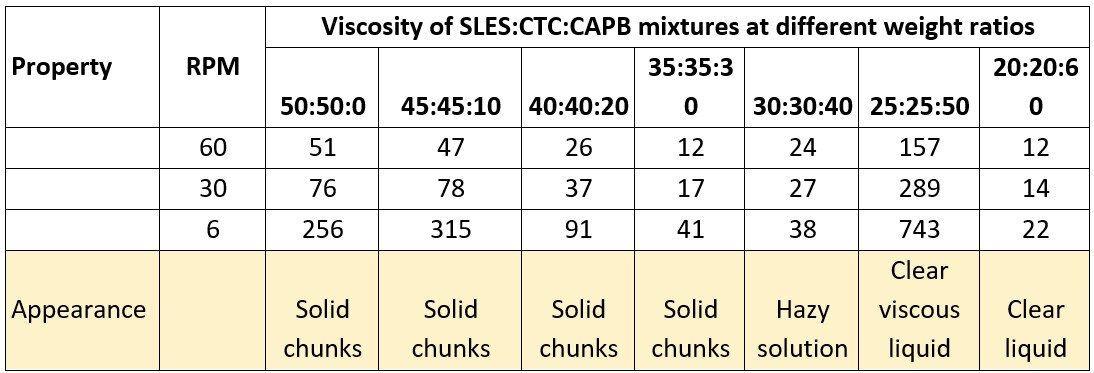
Ternary systems of anionic-cationic-amphoteric surfactants were also studied. In the first part SLES was chosen as the anionic surfactant, while CTC and CAPB were the cationic and amphoteric surfactants, respectively. Table 1 shows viscosity and appearance results when mixing all the surfactants at different ratios.
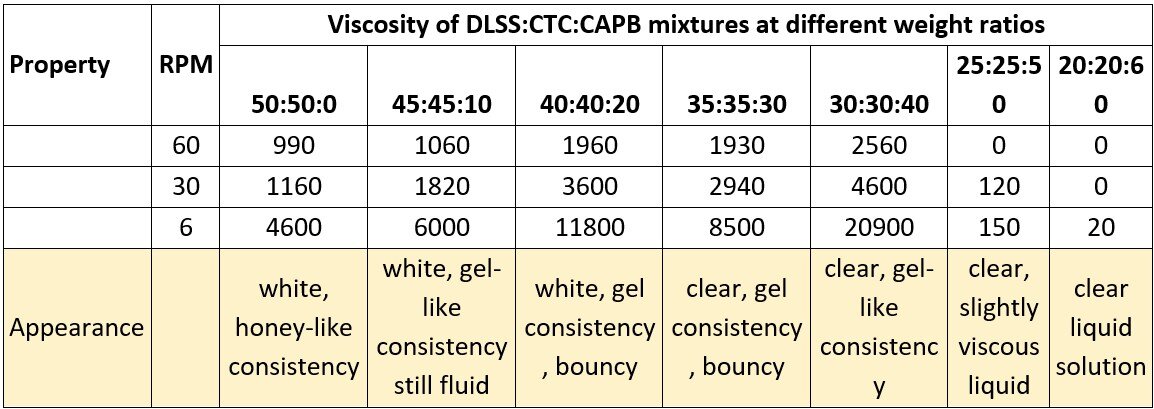
The same evaluation was done, replacing SLES by DLSS. The results are shown in Table 2.
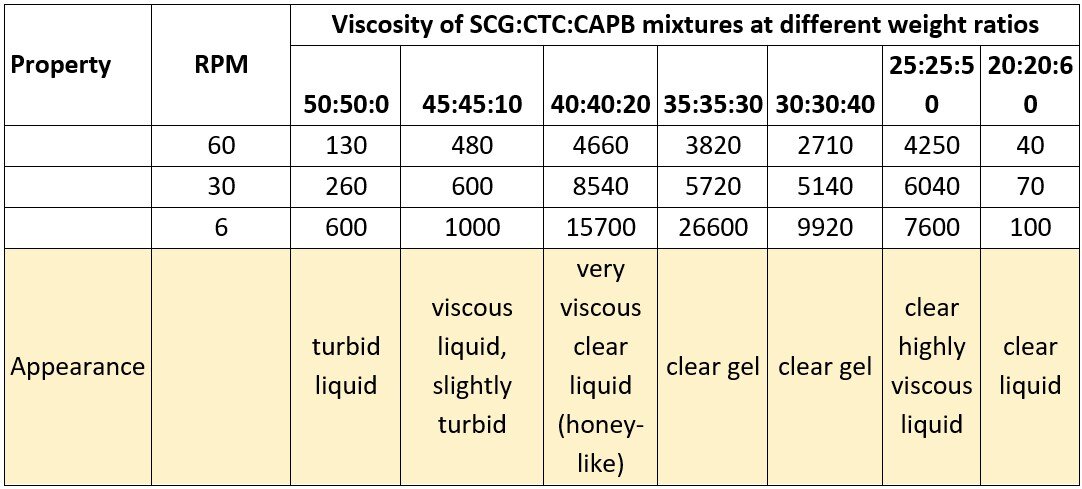
Another anionic surfactant tested was SCG. The results of that test are shown in Table 3.
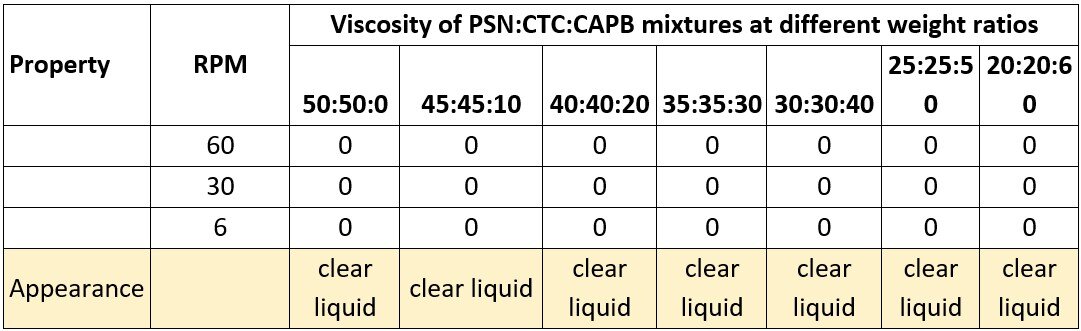
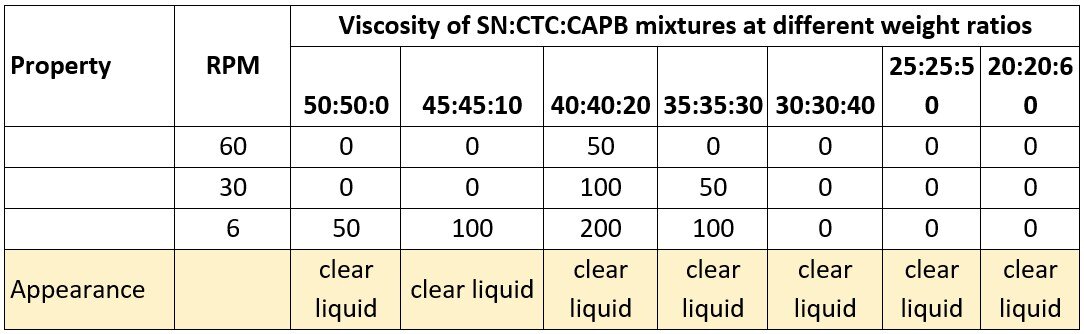
As in our previous tests, both glucoside anionic surfactants show almost no viscosity response both when mixing them only with CTC, and when CAPB was added after (Tables 4 and 5). This can also be explained by the bulky polar head group present in both surfactants.
- Rosen MJ, Hua XY (1982) Surface concentrations and molecular interactions in binary mixtures of surfactants. J Colloid Interface Sci 86:164 https://www.semanticscholar.org/paper/Surface-concentrations-and-molecular-interactions-Rosen-Hua/d482fa16cc69e5314175d41d8a68293431e285c4
- Lucassen-Reynders, E. H., Lucassen, J. and Giles, D. (1981). Surface and Bulk Properties of Mixed Anionic/Cationic Surfactant Systems. Journal of Colloid and Interface Science, 81(1), 1-8. https://doi.org/10.1016/0021-9797(81)90312-X
- Rosen MJ, Hua XY (1982) Synergism in binary mixtures of surfactants: II. Some experimental data. J Am Oil Chem Soc 59:582 https://link.springer.com/article/10.1007/BF02636329
- O’Lenick, A. J. (2005). Anionic/Cationic Complexes. Cosmetics & Toiletries, 120(11), 63-64. https://www.scientificspectator.com/documents/surfactant%20spectator/surfactant%20interaction/2005%20Anionic%20Cationic%20Complex.pdf
- O’Lenick, T. (2016). Anionic/cationic interactions. H&PC Today – Household and Personal Care Today, 11(4), 32-35. https://www.teknoscienze.com/Contents/Riviste/Sfogliatore/HPC4_2016/files/assets/basic-html/index.html#34
- Stellner KL, Scamehorn JF (1986) Surfactant precipitation in aqueous solutions containing mixtures of anionic and nonionic surfactants. J Am Oil Chem Soc 63:566 https://beamreach.org/data/091/science/processing/erica/surfactants/nonionic%20surfactants.pdf
- Yin, H., Lin, Y. and Huang, J. (2009). Microstructures and rheological dynamics of viscoelastic solutions in a catanionic surfactant system. Journal of Colloid and Interface Science, 338, 177–183. https://pubmed.ncbi.nlm.nih.gov/19560154/
- Yin, H., Idit, Yli; Y. Inbal, Tzafir, I and Salama Paul (2023) Compatibility Investigation of Cationic Surfactants with Anionic Species Cosmetics 2023, 10(2), 45; https://doi.org/10.3390/cosmetics10020045
Waterless Beauty: Hype or Sustainable Revolution?
C3 Reduct®: A Reductive Metabolite of Curcumin for Oral Hygiene
Consumer Perspective: Putting Consumer Experience at the Heart of Wate...
Advancements in skin microbiome that are redefining cosmetics
Adapting Skincare for Climate Change
Understanding cosmetic claims for hair care products: What you need to...
Body Cosmetic Care: Increasingly Similar to Facial Care
A word with Piera Pericu