Cosmetic brands have increasingly driven a strong marketing push toward more ‘green’ and natural cosmetic formulations in response to demand by consumers. The perception is that natural ingredients mean a safer and generally milder product, but this not necessarily the case. When it comes to green versus synthetic surfactants, which make the better choice for your cosmetic formulations, and how do you make the right surfactant selection?
What is a green or synthetic surfactant?
Before we can compare these materials, let’s first clarify the term ‘surfactants’. Chemically speaking, surfactants cover a vast category of cosmetic ingredients, from emulsifiers to solubilisers, as well as superfatting agents and foaming ingredients. For the purposes of comparison in this article, I will be focusing specifically on cosmetic ingredients that are selected for their cleansing and foaming properties, for example, those materials that are particularly selected for their functional applications in shampoos and body wash.
When it comes to what is classified as green or natural, I will be using the classification of wholly naturally derived and permitted for use by natural and organic certifiers (for example, COSMOS). This includes surfactants that are solely of natural origin using only approved processing such as alkylation, esterification, condensation, hydrolysis and hydrogenation. Common examples include sodium cocoyl glutamate, coco-glucoside and decyl glucoside.
It does not include processing steps such as alkoxylation, methylation, ethoxylation, propoxylation and sulphonation. Common examples include sodium lauryl sulfate, sodium laureth sulfate, disodium lauryl sulfosuccinate, sodium cocoyl isethionate, sodium methyl cocoyl taurate, sodium lauryl sarcosinate and cocoamidopropyl betaine. It also includes any surfactant with PEG in the INCI name.
What about traditionally saponified carboxylate soaps?
Before the commercialisation of commonly used surfactant materials used today, soaps and cleansing liquids were created using traditional saponification methods. This involved the use of natural plant oils saponified by mixing with sodium or potassium hydroxide. While carboxylate soaps can be certified as natural, their final pH is extremely high – usually above 9.5, making them very harsh on the skin and hair. They also form scum in the presence of hard water; and while they foam and clean well, they are not elegant foaming formula inclusions, and can’t be neutralised to a more skin friendly pH without splitting into their fatty acid and carboxylate salt components. These do not make good modern surfactant ingredient choices and therefore won’t be considered in my comparisons.
Green vs. synthetic surfactants: which foam better?
Contrary to consumer perception, a lot of foam does not always mean great cleansing. Foam is created from excess ‘free’ surfactant that is available to trap air, which really comes from adding more surfactant with a high foaming profile than is needed for an effective clean. Since consumers consider foam as a mark of quality of a cleansing product, the ability of a surfactant to create copious foam means a happy consumer.
All of the surfactants listed in this article will create a good foam profile, especially when used in high inputs. However, the amount needed in a cosmetic formula to create that high foam will impact the budget of the finished product. In general, synthetic anionic surfactants such as alkyl sulfates, alkyl ether sulfates and even alkyl sarcosinates tend to have a better foam profile for their price based on input.
Green vs. synthetic surfactants: which thicken better?
Foaming formulas must have some viscosity to enable easy dispensing and suitable application during use. Surfactants such as sodium lauryl sulfate and sodium methyl cocoyl taurate are especially easy to thicken with salt and can often thicken when used in combination with cocoamidopropyl betaine. Sodium laureth sulfate and sodium cocoyl isethionate may have some salt responsiveness, and therefore some thickening abilities, while sodium lauryl or cocoyl sarcosinate will rarely thicken easily.
Sulfosuccinates, acyl glutamates and glucosides will not thicken with salt or by combinations with other surfactants at all. When using these materials, you must use gums or polymers to build viscosity. Natural gums can be used to help thicken natural or green surfactant formulations, however they can make a finished formula look gloopy. They are generally the only choice to thicken natural foaming formulas but often take extra time in formulation development to get the balance of viscosity versus gloop just right. They can also add to processing time and method validation during scale up to ensure homogenous distribution and viscosity build.
Green vs. synthetic surfactants: which clean better?
The ability of a surfactant to clean is impacted by its charge type and strength. The stronger the anionic charge, in general, the better the ability to clean.
- When the surfactant used is ionic, the hydrocarbon tails adsorb to the soil and the surface being cleaned. The polar head groups face into the solution from both the surface and the soil, providing an electrostatic barrier to effectively ‘lift’ the soil from the surface.
- When the surfactant is nonionic, the same process occurs except a ‘disjointing pressure’ helps force the soil away from the surface. Surfactant molecules readily fill gaps between the soil and surface as a result of spreading pressure.
Electrostatic repulsions are always stronger than disjointing pressure, which is why anionic surfactants clean so well – their charge ensures very effective lifting of even stubborn soils. The selection here often comes down to budget: you can get a lot more cleaning power from an alkyl sulfate, isethionate or taurate, with the sulfates of course being the cheapest. Glucosides make the worst cleaning choice, especially when used alone, because they work with disjointing pressure only. A lot of glucoside is often needed to get anywhere near the same sort of cleaning power as an anionic surfactant, making them costly for a good clean.
Green vs. synthetic surfactants: which perform better in hard water?
Of all surfactants listed, alkyl sulfates are typically the only materials impacted by hard water. They are most commonly used because they provide exceptional foaming and cleansing from a relatively small input, are cheap, and are easy to thicken. However, they will need a chelating agent to counter hard water areas, as they are impacted greatly by the presence of calcium and magnesium ions.
The other surfactants listed are not impacted by hard water, but cost more to get the same foaming and cleansing results.
Green vs. synthetic surfactants: which are more mild?
The mildness of a foaming cosmetic formula is judged by two considerations: how it actually impacts the hair or skin; and how soft it feels after wash off.
- anionic surfactants have higher irritancy profiles than others, so using a combination of surfactant materials (e.g. anionic + amphoteric + non-ionic) helps give good cleaning and reduced irritancy, even when using normally very irritating surfactants. Alkyl sulfates are by far the most irritating if considered alone, but when combined with other surfactants and used in small inputs, are not necessarily more irritating in a balanced finished formula.
- non-ionic surfactants will not generally cause irritation to the skin, but may not necessarily feel soft on wash off. Acyl glucosides are considered non-irritating but may need a superfatting agent added to the foaming formula to improve the after-feel.
- superfatting agents really help improve skin feel on wash off; while they are a surfactant chemically speaking, they aren’t great for foaming and cleaning so haven’t been part of other comparisons in this article. Polyquaternium materials (synthetic) can also help make a foaming formula feel softer, but aren’t surfactants.
Green vs. synthetic surfactants: which cost more?
While exact costs depend on suppliers and quantities purchased, generally speaking, based on input required to get a desirable foam and expected clean, alkyl sulfates make the most cost-effective choice. Next on the list would be alkyl ether sulfates and most acyl sarcosinates. Glutamates and sulfosuccinates would generally follow in cost comparisons based on input required.
While alkyl polyglucosides are usually relatively competitively priced per kilo, the comparatively high input required to achieve the required foam and clean makes them a less economical choice overall.
Finally, the more elegant feeling, foaming and high performing isethionates and taurates may cost more per kilo even when inputs are considered, however if you have ever formulated with them, you will understand why they suit premium salon cleansing formulations and hold their place as a fantastic foaming formula solution, even though not completely natural.
To help you understand how to make selections, here is a summary table of key features such as foaming, mildness and cleansing power, as well as if they are affected by hard water.
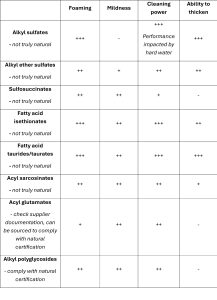
Key:
– not good
+ passable
++ good
+++ excellent
Biodesigned Care: How Biotechnology is Redefining the Future of Person...
More than a Rinse Aid Evolution: A Naturally Derived Surfactant Blend...
Sustainability Trends in Household and Professional Laundry

Delivering a healthy and resilient Europe through innovative, safe and...
Hishda Mohamed
What Does the Future of Cleaning Look Like?

Jule Lexa Völzke
The Next Trend Isn’t a Trend, It’s a Behavioral Signal