


Tony J. Abboud and Erin Schmidt, Core Biogenesis Strasbourg, France
ABSTRACT
Growth factors are signalling proteins of interest in cosmetic science, although their incorporation into topical formulations presents challenges associated with stability, delivery, scalability, and manufacturing (1).
Plant molecular farming combined with biomimetic delivery technologies offers a new approach to address these limitations.
This article examines the potential role of oleosomes in protein production, formulation compatibility and scalable production, and considers the broader application of plant-produced biomimetic proteins in cosmetic formulations.
An independent placebo-controlled evaluation of an oleosome FGF-2 scalp formulation is presented as a brief case study illustrating the potential application of the technology in scalp and hair care.
KEYWORDS:
Growth factors; FGF-2; oleosomes; plant molecular farming; biotechnology; hair density
INTRODUCTION
The cosmetic industry is experiencing a transition from traditional ingredient technologies toward biologically inspired solutions designed to interact more closely with skin and hair physiology.
Historically, cosmetic innovation has focused on ingredients that provide hydration, protection, conditioning, or improvement in visible appearance. More recently, advances in biotechnology have enabled the development of biomimetic ingredients designed to support biological pathways associated with healthy-looking skin and hair.
Among these technologies, growth factors have received significant scientific attention due to their role as endogenous signalling proteins involved in cell-to-cell communication.
However, translating growth factor research into practical cosmetic applications requires overcoming several formulation and manufacturing challenges, particularly maintaining protein integrity and ensuring effective delivery within topical systems (1).
GROWTH FACTORS AS BIOLOGICAL SIGNALLING MOLECULES
Growth factors are proteins naturally produced by the body that regulate cellular communication. They participate in processes including proliferation, extracellular matrix regulation, tissue maintenance, and repair mechanisms.
Fibroblast Growth Factor-2 (FGF-2) is a multifunctional signalling molecule involved in several pathways relevant to skin and hair biology.
Within the scalp environment, FGF-2 interacts with fibroblast growth factor receptors (FGFRs) expressed by cells including dermal papilla cells and keratinocytes as depicted in figure 1. These interactions influence mechanisms associated with follicular activity, including (3) :
- dermal papilla cell signalling,
- follicle cycle regulation,
- extracellular matrix production,
- microenvironment support.
Hair thinning is increasingly understood as a multifactorial process involving several biological mechanisms rather than one isolated pathway.
These include:
- alteration of the hair growth cycle,
- reduced dermal papilla signalling,
- microvascular changes,
- progressive weakening of hair fibres,
- changes within the scalp barrier environment.
A biomimetic signalling approach may therefore provide opportunities to address several parameters associated with scalp and hair quality.
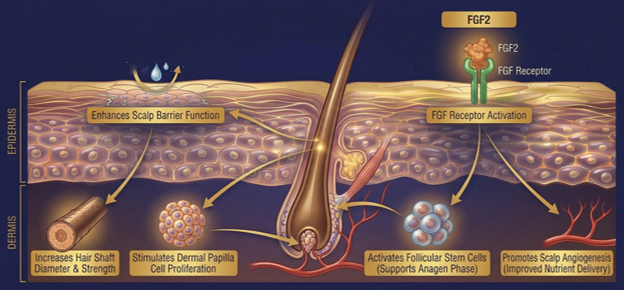
Figure 1. Biological pathways influenced by FGF-2 signalling in the scalp environment.
HARNESSING GROWTH FACTORS IN COSMETIC APPLICATIONS
Growth factors are biologically active proteins, and their efficacy depends on their stability and delivery system as well as their concentration.
These proteins are complex molecules whose three-dimensional structures must be maintained to preserve activity. Environmental factors including temperature, oxidation, and formulation conditions may affect stability.
Challenges include:
- maintaining protein stability,
- preventing degradation,
- achieving compatibility within cosmetic formulations,
- creating scalable and sustainable production methods.
Therefore, successful cosmetic application depends not only on the active protein itself but also on the production and delivery system. Arguably, one of the most important determinants of efficacy is how the growth factor is delivered.
PLANT BIOFACTORIES AND OLEOSOME TECHNOLOGY
Plant molecular farming uses plants as biological systems for producing recombinant proteins.
As an example of this approach, the following section describes a plant-based oleosome technology developed for the production and delivery of growth factors.
Oleosomes are naturally occurring lipid storage organelles found in seeds. Their biological function is to protect and store lipids during seed development and germination.
When applied to cosmetic biotechnology, oleosomes provide several potential advantages (2):
- protection of sensitive proteins,
- improved stability,
- compatibility with lipid-rich biological barriers,
- natural plant-derived encapsulation.
Unlike traditional encapsulation methods where an active ingredient is produced and later incorporated into a carrier system, this approach creates a direct fusion between the growth factor and oleosome during production.
This integrated system is designed to improve stability while supporting sustainable and scalable production.
Illustrative Case Study: Application in Scalp and Hair Care
As an example of the potential application of the technology, an independent randomized, blind, placebo-controlled evaluated a scalp serum containing 2.0% oleosome-FGF-2 active ingredient against a placebo formulation (4) (5)
Forty female volunteers experiencing telogen effluvium applied the formulations twice daily to their scalp for 84 days. Evaluated parameters included hair density, anagen/telogen ratio, hair shaft thickness, and scalp parameters.
In the active group, measured hair density increased by 33.6% from baseline at day 28, 32.7% at day 56, and 33.5% at day 84, compared with changes of 7.2%, 6.5%, and 7.0%, respectively of the placebo group. Changes from the baseline were also observed in anagen/telogen ratio and hair shaft thickness.
These findings provide an initial illustration of the potential of cosmetic application of oleosome-delivered FGF-2.
DISCUSSION
The results demonstrate the potential of combining biomimetic signalling molecules with plant-derived delivery systems for cosmetic applications.
The observed improvements across several parameters suggest that growth factor technologies may support a more holistic approach to scalp care by targeting multiple biological pathways associated with hair quality.
Beyond hair applications, advances in protein stability and sustainable production may expand the use of biomimetic growth factors across broader cosmetic categories including skin barrier support, healthy ageing, and longevity-focused formulations.
CONCLUSION
Growth factors represent an emerging class of cosmetic ingredients inspired by biological signalling mechanisms. However, successful implementation requires technologies capable of addressing protein stability, delivery, and sustainable production.
Plant molecular farming combined with oleosome delivery provides a new approach for producing and protecting biomimetic growth factors.
Case study findings of biotech scalp active FGF-2 technology measurable improvements in hair density, growth cycle parameters, and hair fibre characteristics, supporting further exploration of plant-produced growth factors within next-generation cosmetic applications.
REFERENCES
- Eskens O, Amin S. Challenges and effective routes for formulating and delivery of epidermal growth factors in skin care. Int J Cosmet Sci. 2021 Apr;43(2):123-130. doi: 10.1111/ics.12685. Epub 2021 Jan 15. PMID: 33354795. https://pubmed.ncbi.nlm.nih.gov/33354795/
- Mallillin MC, Pajimna RMB, Zhao S, Salami M, Loebenberg R, Davies NM. Oleosome delivery systems: enhancing stability and therapeutic potential of natural products and xenobiotics. Pharmaceutics. 2025 Oct 7;17(10):1303. doi: 10.3390/pharmaceutics17101303. PMID: 41155940; PMCID: PMC12566702. https://pmc.ncbi.nlm.nih.gov/articles/PMC12566702
- Wang J, Wang L, Gao S, Li X. Recent advances in the role of fibroblast growth factors in hair follicle growth. Biomolecules. 2025 Aug 20;15(8):1198. doi: 10.3390/biom15081198. PMID: 40867641; PMCID: PMC12384696. https://pmc.ncbi.nlm.nih.gov/articles/PMC12384696/
- Bucchia M, Burastero S, Baldi M. Final report: Evaluation of the efficacy of a cosmetic product in reducing hair loss: A randomized, blind, placebo-controlled study. AbiCh Lifeanalytics. Italy. 2026. Report No. REL/0504/2026.
- Schmidt E., Abboud T. Clinical trial validates oleosome-FGF-2 improves hair density in 28 days. SOFW Journal. June 2026. https://sofw.com/en/sofw-journal/articles-en/48-personal-care/5963-clinical-trial-validates-oleosome-fgf-2-improves-hair-density-in-28-days?highlight=WyJjb3JlIiwiYmlvZ2VuZXNpcyIsImNvcmUgYmlvZ2VuZXNpcyJd
AUTHORS:
 Tony J. Abboud is Chief Commercial Officer at Core Biogenesis, with nearly 20 years of experience across biotechnology, beauty and medical devices. He specializes in translating scientific innovation into commercially relevant technologies. At Core Biogenesis, Tony leads the commercial development and global expansion of the company’s plant molecular farming platform and oleosome-fused biomimetic growth factor technologies, working at the intersection of biotechnology, cosmetic science and next-generation skincare and scalp care.
 Erin Schmidt works with Core Biogenesis at the intersection of biotechnology, cosmetic science and scientific communication. Her work focuses on translating complex scientific research into accessible, industry-relevant insights, with particular emphasis on plant-derived biotechnology, biomimetic growth factors and their applications in next-generation skincare and scalp care. She has co-authored technical articles examining emerging biotechnology approaches for the cosmetics industry.


