Earlier this year, the Utah Department of Transportation (UDOT) needed to slide a 1.1 million-pound bridge into the southbound lane of I-15(1). The crews needed to keep everything “slippery and moving” to ensure that the bridge would inch toward its final location with the proper spacing on each side. Their secret ingredient? Dish soap. In combination with the hydraulics system, crews generously applied dish soap to Teflon pads as an ingenious way to reduce friction and ensure a smooth move. This slippery function of dish soap is enabled on a molecular level by surfactants, the chemical backbone of most soaps and detergents.
Surfactants, or “surface active agents” in the most empirical sense, are compounds that reduce the surface tension between two substances, enabling the molecules to disperse(2). The history of surfactants dates back thousands of years to ancient uses where soaps were made from natural sources like plant ashes and animal fats(3). In fact, a historical Sumerian tablet from 2500 B.C. describes the oldest known procedure for man-made surfactants. This tablet could be considered the first formulation batch sheet, giving detailed instructions for quantities of oil and wood ash that needed to be mixed prior to heating. This particular soap formula was intended to wash textiles; however, Sumerians also utilized soaps for medicinal purposes. Over time, soap evolved to include a wide variety of raw materials and innovations, transitioning from craft shop production to industrial manufacture.
In the industrial age, scientists began to develop synthetic surfactants, which led to the commercial-scale production of detergents and emulsifiers. Since then, the market for surfactants has grown to a more than $40 billion industry(4), with even more potential to grow in the coming years. Ongoing research and advancement have expanded surfactant applications across various industries, leading to the development of more effective and specialized surfactants tailored for diverse uses. Modern applications of surfactants range from self-assembling nanostructures for drug delivery to key agents in the clean-up of contaminated environmental sites (2).
The phrase “like oil and water” is used to describe two entities that do not mix well or have conflicting characteristics. However, surfactants turn this phrase on its head because they possess both hydrophilic (water-attracting) and hydrophobic (water-repelling) groups. This unique structure allows surfactants to interact at interfaces, lowering the surface tension between different phases, like oil and water, allowing them to mix.
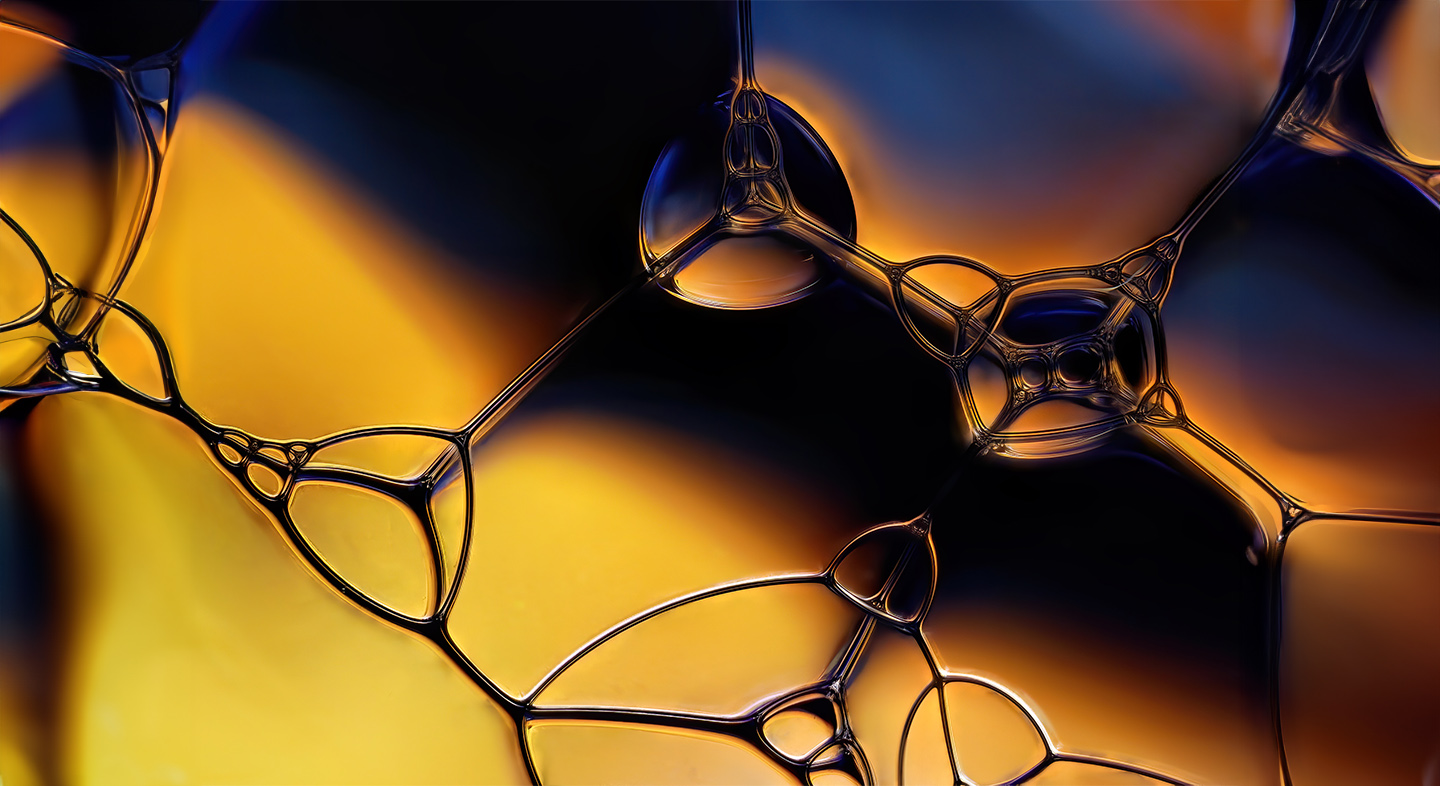
The easiest way to describe the structure of a surfactant in an aqueous solution is by the “tadpole model.” Imagine a hydrophilic and lipophobic “head” with a hydrophobic and lipophilic “tail” in the shape of a tadpole. Variations on the size and charge of these groups can dictate the function of the surfactant, with the charge of the head group typically dictating the overall charge (2). At low concentrations, surfactants migrate to the edges of the aqueous solution but, as the concentration increases, the edges are filled and they begin to assemble into spheres called micelles. Micelles are dynamic assemblies formed by the hydrophobic surfactant tails turning inward to avoid contact with water and the hydrophilic heads facing outward to create the spherical exterior layer. Surfactant molecules organize themselves in this arrangement when they reach a specific concentration known as the critical micelle concentration (CMC)(2). Think of these micelles as tiny bubbles in the solution that range in size from 50 to 100 surfactant molecules per micelle.
Understanding micelle formation is crucial across surfactant applications and is often a key piece of formulation optimization. Micelles are not fixed in their formation and remain in a state of flux – their shape and size are determined by the way the surfactants are packed (6). If the surfactant heads are charged, they are kept apart by electrostatic repulsion, which means they will be packed more loosely. Surfactants that are not charged (or non-ionic) will pack more densely together. The addition of salt can increase the viscosity, or thickness, of a formula by reducing electrostatic repulsion between the hydrophilic heads; however, too much salt can dramatically reduce viscosity, causing the formula to fall apart. This is why many formulators create a salt curve to understand what the maximum possible viscosity is for the intended product and provide a range of salt needed to reach the desired viscosity. In addition to ionic strength and surfactant concentration, micelle stability and behavior are also determined by other factors, such as temperature, pH, and the presence of other additives.
Though often overlooked outside the chemical world, surfactants play a fundamental role in product development and modern manufacturing processes. Beyond controlling viscosity and foaming potential, surfactants are responsible for stabilizing mixtures and enhancing the efficiency of chemical reactions. Understanding these variations aids in selecting the appropriate surfactants for specific purposes, contributing significantly to the quality, consistency, and functionality of manufactured goods. Table 1 shows the different types, properties, and uses of surfactants.
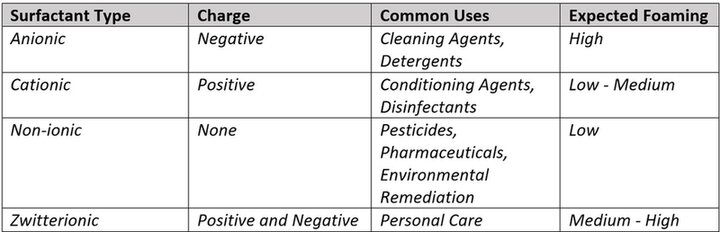
Imagine a long list of household chores: dishwashing, floor cleaning, toilet bowl disinfecting, bathroom tile scrubbing, and loads of laundry. All these activities rely on these bubble-building powerhouses to effectively disperse oils, grime, and dirt. Their unique molecular structure enables them to surround and lift soil from surfaces or fabrics, preventing its redeposition during rinsing. Hydrophobic tails eagerly attach to grease and grime, while the hydrophilic heads cozy up to water. This partnership not only breaks down the mess but also helps lift it off surfaces, suspending it in the cleaning solution and making it easy to rinse away. Now, the real marvel? Formulations blend different types of surfactants strategically, like a recipe for the perfect potion. For example, anionic surfactants excel at cutting through grease, cationic surfactants add a soft touch, non-ionic surfactants can be used with sensitive materials, and zwitterionic surfactants bring balance, ensuring a cleaning concoction targets specific surfaces and stains.6 It’s this alchemy of surfactant combinations that gives cleaning products their unique powers to handle different messes easily and effectively.
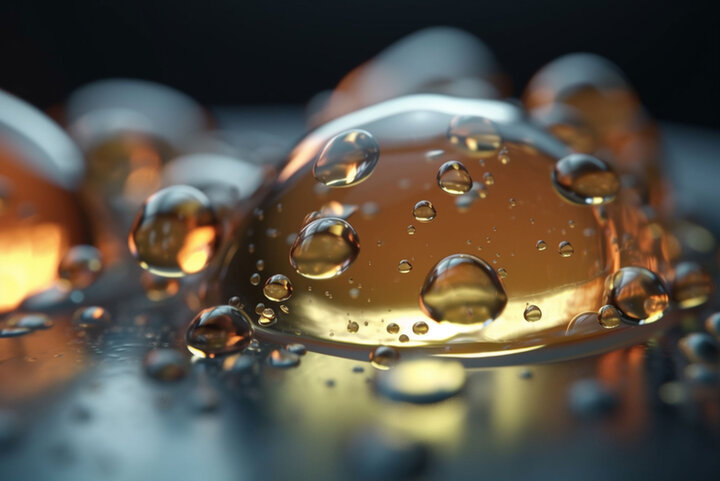
Stepping out of the cleaning space, surfactants play a critical role in a number of other areas. For instance, surfactants aid in metal cleaning and degreasing processes and control surface tension during soldering, which is necessary in mechanical manufacturing and electronics production(8). As previously shown in the example of salad dressing, surfactants contribute significantly to the food and beverage industries, serving as emulsifiers in dairy products, enhancing textures in baked goods, and acting as foaming agents in beer(5). They also assist in pesticide formulations for agriculture by improving the dispersion of agricultural chemicals and reducing the amount of pesticide needed. Now, how does this same substance that scrubs bathtubs and bubbles beer also save lives? Surfactants are sometimes used in pharmaceutical formulations for drug delivery, stability, and efficacy. In oral medications, surfactants like polysorbates are utilized to improve the solubility of drugs that are not necessarily water-soluble(9) by creating micellar solutions that enhance absorption in the gastrointestinal tract. Additionally, in inhalable medications, lung surfactants like dipalmitoylphosphatidylcholine (DPPC)(10) are used to improve the distribution of drugs in the lungs for effective delivery.
While the selection of surfactants is guided by considerations like stability, compatibility with food components, and compliance with rigorous regulations, it is clear that these compounds can play a number of roles across various domains.
The future of surfactants lies in innovative developments that prioritize sustainability and enhanced functionality, and immense strides have been made to develop surfactants that are made from renewable raw materials and biodegradable. Technological advancements are directing a spotlight toward optimized formulations that cater to specific needs, including tailoring surfactant structures at a molecular level to enhance their performance in various applications. Through precision engineering, scientists are creating surfactants with improved abilities to disperse oil, stabilize emulsions, and efficiently interact with different surfaces. Additionally, the design of surfactants is being optimized for specific environmental conditions, ensuring effectiveness across a range of temperatures, pH levels, and salinities.
These bubbles of ingenuity are generally responsible for keeping the world clean, tackling messes from top to bottom, but technological strides in surfactant design and application demonstrate a promising future for customized surfactants to play a pivotal role across diverse industries.
References and notes
- https://www.stgeorgeutah.com/news/archive/2022/07/18/agl-udot-moves-million-pound-bridge-in-cedar-city-with-dish-soap-and-a-bit-of-elbow-grease/
- Schramm, Laurier & Stasiuk, Elaine & Marangoni, Gerrard. (2003). Surfactants and their Applications. Annu. Rep. Prog. Chem., Sect. C: Phys. Chem. 99. 3-48. 10.1039/B208499F
- Falbe, J. (2012) Surfactants in consumer products: Theory, technology, and application. Berlin: Springer-Verlag.
- https://www.fortunebusinessinsights.com/surfactants-market-102385
- Iva Kralova & Johan Sjöblom (2009) Surfactants Used in Food Industry: A Review, Journal of Dispersion Science and Technology, 30:9, 1363-1383
- https://colonialchem.com/wp-content/uploads/2020/11/surfactants-101-4-30-20.pdf
- Kohli R. Microbial Cleaning for Removal of Surface Contamination. Developments in Surface Contamination and Cleaning. 2013:139–61.
- Zhang, L., Wang, S., Wang, T. et al. Polishing mechanisms of various surfactants in chemical mechanical polishing relevant to cobalt interconnects. Int J Adv Manuf Technol 128, 5425–5436 (2023).
- Vanti, G. Recent strategies in nanodelivery systems for natural products: a review. Environ Chem Lett 19, 4311–4326 (2021)
- Bernhard, W (November 2016). “Lung surfactant: Function and composition in the context of development and respiratory physiology”. Annals of Anatomy. 208: 146–150.
Recent Trends in Home Care Products: Navigating Sustainability and Aff...
Innospec sustainable and innovative “Blue Ocean” formulations to meet...

AI and surfactants
AI Formulators are coming are you ready?
Skin rejuvenating properties of a powerful blend of Gardenia jasminoid...
The popularity of vitamin C Serums for effective skin care
Navigating the sensory gap in metaverse personal care

What trends in testing for beauty