Introduction: Beauty’s inclusivity reckoning
The beauty industry has long relied on outdated ideals, catering primarily to a narrow segment of consumers while sidelining the rest. For decades, inclusivity was treated as an afterthought – something to be addressed when convenient, not as a core business strategy. That approach no longer flies.
Consumers today are highly aware, vocal, and quick to call out brands that fail to meet their expectations. It’s not enough to expand a shade range or feature a diverse model lineup in an ad campaign.
Inclusivity must be deeply embedded in product development, brand messaging, and consumer experience. And in a digital-first world, AI and AR are becoming essential tools in making beauty more accessible, personalized, and representative of real people.
What inclusivity is NOT: Common “fails” in the industry
Many beauty brands today are making efforts toward inclusivity, but true progress requires more than surface-level changes. Today’s consumers, particularly those who have long felt overlooked by the industry, seek more than symbolic gestures. They value brands that embed inclusivity into every aspect of their business, from product development through marketing to customer engagement.
The shift toward genuine inclusivity is an opportunity, not just a challenge.
When done right, it fosters loyalty, builds trust, and expands a brand’s reach to a more diverse customer base. Inclusivity is not about meeting a quota – it’s about ensuring that every consumer, regardless of skin tone, age, gender, or ability, can find products that make them feel seen and valued.
And there’s the difference between performative and genuine inclusivity.
True inclusivity means developing products that work for a wide spectrum of consumers, not just adding a handful of new shades. It means ensuring accessibility, not just in marketing materials but in actual product formulation, availability, and usability. It means listening to consumer feedback and improving instead of reacting defensively when gaps are pointed out.
When brands fail to take these steps, their efforts come across as disingenuous.
Here’s how these shortcomings typically manifest:
- A few token shades for deeper skin tones, but many for lighter ones: Brands launch 50+ foundation shades, yet the majority cluster around mid-tones, leaving consumers with very light or very deep skin tones with little to no viable options. This is not inclusivity, it’s an illusion of diversity.
- Darker shades that fail to account for undertones: Having deep shades doesn’t automatically mean they are usable. Many brands ignore the complexity of undertones, leading to darker shades that appear too ashy, red, or orange, rendering them unwearable for those they’re supposedly designed for.
- Marketing vs. reality: A campaign featuring diverse models might make a brand appear inclusive at first glance, but when the actual product lineup fails to cater to that diversity, it exposes the marketing ploy. Consumers are no longer falling for it. Representation in advertising must be backed by true product accessibility.
- One-off diverse campaigns without ongoing efforts: Some brands roll out a single “diversity” campaign, only to return to their old ways once the marketing buzz fades. Inclusivity isn’t a seasonal trend; it’s an ongoing responsibility. If inclusivity isn’t embedded into a long-term strategy, consumers will see through the performative gestures.
- Some products are inclusive, but many fall short: A brand might introduce a single inclusive product line while the rest of its portfolio remains outdated and exclusionary. True inclusivity requires a holistic approach, not selective representation.
- Brands react defensively to criticism instead of using feedback to improve: When consumers point out inclusivity gaps, the right response is acknowledgment and action – not excuses, defensiveness, or dismissing the issue altogether. Brands that refuse to listen will inevitably lose customer trust and relevance.
The beauty industry has long relied on these surface-level attempts at inclusivity, but consumers are savvier than ever.
Too often, foundation shades in major beauty lines cluster around mid-tones, leaving very fair and very deep tones underserved. Simply adding a few extra shades without considering undertones, formulation quality, or widespread availability doesn’t solve the problem – it just highlights a lack of genuine commitment. True inclusivity requires a fundamental shift, not a superficial fix.
Why inclusivity matters more than ever
Brands that fail to prioritize inclusivity will lose customers – plain and simple.
Because inclusivity isn’t just a trend – it’s an expectation. Consumers are no longer willing to compromise, and brands that fail to prioritize real inclusivity will lose relevance, market share, and consumer trust.
The numbers make it clear:
- 50% of consumers favor brands that actively promote diversity and inclusivity. (1)
- 76% say personalization is a major factor in purchasing decisions. (2)
- Inclusive beauty brands are growing 1.5x faster than their less inclusive competitors. (3)
These statistics represent people who have long been ignored by the industry.
- 53% of Black consumers struggle to find makeup that matches their skin tone – a reality that highlights deep flaws in product development. (4)
- 72% of young men now incorporate makeup into their grooming routine, yet many beauty brands still market overwhelmingly to women, reinforcing outdated stereotypes. (5)
- 7 in 10 women over 40 say they are more likely to buy from brands that reflect different ages in their campaigns, yet mature beauty remains underrepresented in both products and marketing. (6)
- 95% of people with disabilities feel there aren’t enough accessible beauty brands, signaling a major gap in inclusive product design and retail experiences. (7)
What does this mean for brands?
Well, the industry can no longer afford to treat inclusivity as a “nice to have.” It’s a business imperative. Beauty consumers today are savvy, vocal, connected, and more empowered than ever before. If a brand fails to cater to diverse needs, consumers won’t hesitate to call them out – or move on to a competitor that does.
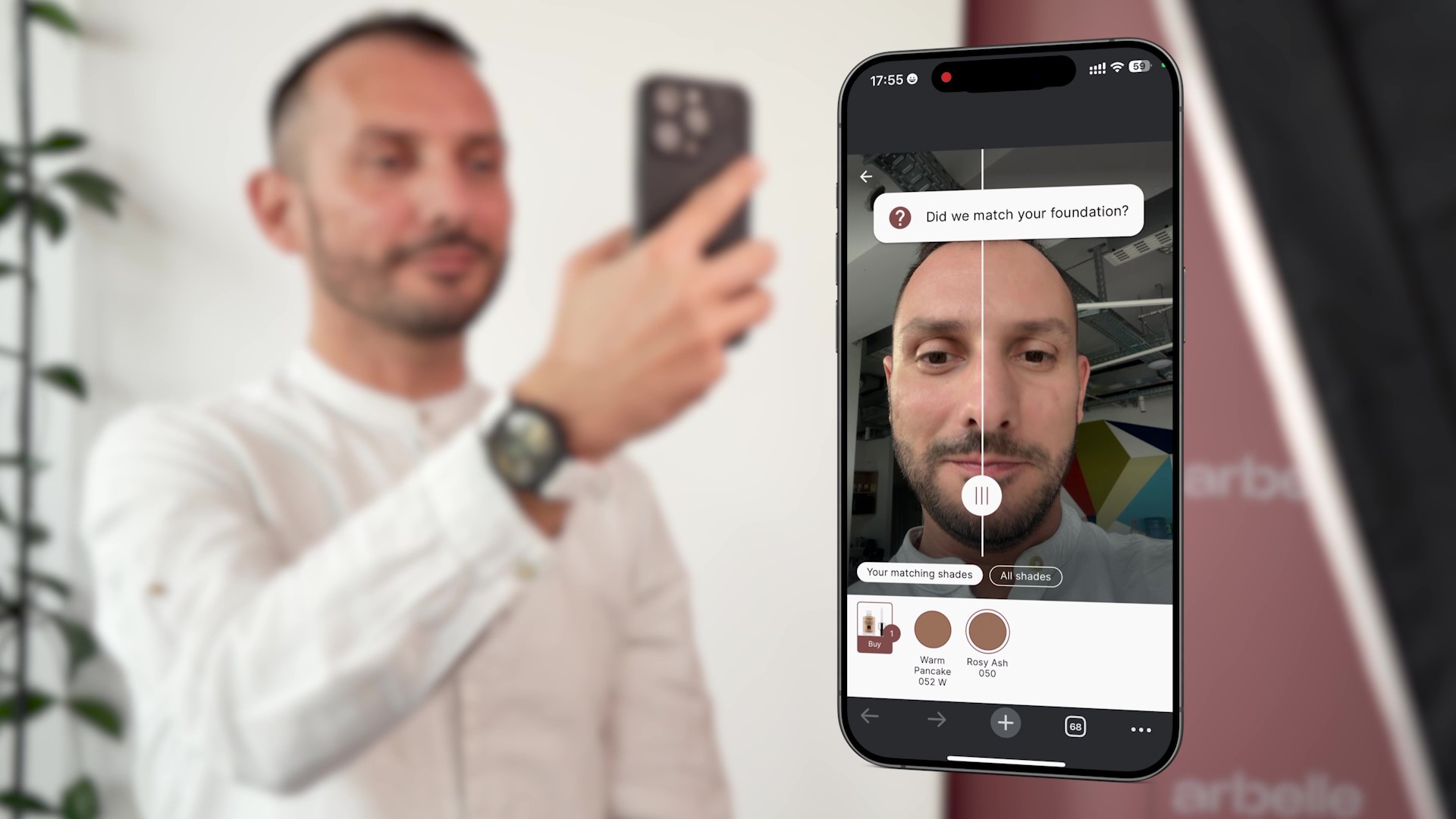
Figure 1. Man trying on foundation virtually via Shade Finder and getting personalized foundation recommendations based on skin tone.
How beauty AI and AR are driving inclusivity
For too long, beauty has been dictated by rigid, exclusionary standards. Consumers who didn’t fit the narrow mold – whether due to skin tone, gender, age, or ability – were often left guessing when choosing products, relying on trial and error, or simply excluded altogether.
Technology is changing that. AI and AR are not just enhancements; they are critical in bridging the inclusivity gap, ensuring that beauty is truly for everyone. These tools remove the guesswork, eliminate human bias, and empower consumers to find products that genuinely work for them.
Here are a few examples.
- Virtual try-on technology removes the fear of buying the wrong product, especially for those who’ve historically struggled to find matches. By enabling users to see how different shades and finishes look on their actual face before purchasing, these tools reduce waste, increase confidence, and cater to a diverse range of needs. But for virtual try-ons to truly drive long-term success, realism and authenticity are key. The right virtual try-on doesn’t just encourage an initial purchase – it fosters trust and retention by ensuring customers see an accurate, reliable representation of how a product will look on them in real life.
- AI-powered foundation shade finders analyze individual skin tones with precision, considering undertones and variations that human-based shade matching often gets wrong. Instead of relying on subjective quizzes or a makeup artist’s personal judgment, AI ensures that shade recommendations are unbiased, accurate, and inclusive. Some advanced tools, like Arbelle’s Shade Finder, take inclusivity a step further by incorporating one of the largest skin tone ranges available. This ensures that consumers across the entire spectrum – especially those who have historically struggled to find a match – can discover foundation shades tailored to their unique complexion rather than settling for limited options.
- Personalized look recommenders go beyond foundation matching. They consider multiple factors – tone, eye color, hair color, seasonal variations, and even personal preferences – to provide tailored recommendations. This is particularly impactful for consumers who feel left out by mainstream beauty norms, allowing them to explore products that truly suit their individuality.
Consumers are embracing these technological advancements at an unprecedented rate, demonstrating that inclusivity and personalization are not fleeting trends but fundamental expectations.
And the impact is undeniable. Consumers are significantly more likely to buy when they can confidently visualize a product on themselves – 59% say they are more likely to purchase if they can try products through AR. (8) This technology eliminates uncertainty, making beauty more accessible to those who previously had to rely on guesswork.
Furthermore, as the beauty industry becomes increasingly digital, AI-driven recommendations are proving to be essential in tailoring beauty to each individual. With 83% of beauty consumers conducting over half of their purchases online (9), the ability to provide personalized, interactive shopping experiences has never been more critical. Consumers now expect brands to offer tools that help them explore and select products with confidence, rather than relying on in-store testing or guesswork.
This means that brands investing in these technologies are not just enhancing convenience but actively shaping the future of inclusive and accessible beauty.
The beauty industry has spent decades making consumers feel like they had to fit into a narrow mold. AI and AR now allow brands to shift that perspective, giving consumers the power to explore, experiment, and choose what works for them.
The future of beauty isn’t about forcing people into predefined standards – it’s about meeting them where they are and providing them with the tools to make beauty their own.
The path forward for beauty brands
So, where does the industry go from here?
It starts with real, systemic change. Brands that want to lead the inclusivity movement must incorporate it at every level.
- Engage in real conversations with consumers instead of just broadcasting marketing messages. Inclusivity efforts must be guided by the very people they aim to serve. This means listening to consumers and incorporating their feedback into product decisions.
- Adopt a thoughtful and holistic product development strategy ensuring inclusivity is a fundamental part of R&D from the start, rather than added as an afterthought. A truly inclusive approach means considering diverse perspectives throughout formulation, testing, and packaging, accounting for undertones, skin concerns, cultural beauty preferences, and accessibility needs.
- Provide inclusive and user-friendly tools for makeup exploration that allow consumers to explore beauty products in a way that is personalized, accessible, and empowering. Virtual try-ons, AI-powered shade matchers, and smart recommendations remove uncertainty and frustration, making it easier for customers to find the right products. By embracing these technologies, brands can foster trust, enhance the shopping experience, and ensure that every individual feels seen and catered to.
- Commit to continuous improvement, recognizing that inclusivity isn’t a one-time achievement but an ongoing effort. The landscape of beauty is always evolving, and brands must keep pace by consistently reassessing and expanding their inclusivity initiatives.
The brands that act will lead
We’ve reached a point where inclusivity isn’t a selling point – it’s the standard. The brands that recognize this and take action will thrive. The ones that don’t? They’ll fade into irrelevance. Beauty consumers are watching, and they expect more than just words. Now is the time for brands to deliver.
- Stern C. Mintel Director on impactful inclusivity and diversity trends in cosmetics, PBC [Internet]. Cosmetics Design; 2023 Jun [cited 2025 Mar 5]. Available from https://www.cosmeticsdesign.com/Article/2023/06/26/Mintel-Director-on-impactful-inclusivity-and-diversity-trends-in-cosmetics-PBC/?utm_source=copyright&utm_medium=OnSite&utm_campaign=copyright
- Arora N, Ensslen D, Fiedler L, Liu WW, Robinson K, Stein E, and Schüler G. The value of getting personalization right—or wrong—is multiplying [Internet]. McKinsey & Company; 2021 Nov [cited 2025 Mar 4]. Available from https://www.mckinsey.com/capabilities/growth-marketing-and-sales/our-insights/the-value-of-getting-personalization-right-or-wrong-is-multiplying.
- Inclusive Beauty Brands Grow 1.5X Faster than Less Inclusive Brands, According to Research from Circana and SeeMe Index [Internet]. Circana; 2024 Sep [cited 2025 Mar 6]. Available from https://www.circana.com/intelligence/press-releases/2024/inclusive-beauty-brands-grow-1-5x-faster-than-less-inclusive-brands-according-to-research-from-circana-and-seeme-index/.
- White Boehm J. US Diversity and Inclusivity in Beauty Report 2023 [Internet]. Mintel; 2023 Apr [cited 2025 Mar 5]. Available from https://store.mintel.com/report/us-diversity-and-inclusivity-in-beauty-market-report.
- Stern C. 72% of US male consumers between 18 and 34 use makeup, says Mintel survey [Internet]. Cosmetics Design; 2024 Apr [cited 2025 Mar 6]. Available from https://www.cosmeticsdesign.com/Article/2024/04/04/72-of-US-male-consumers-between-18-and-34-use-makeup-says-Mintel-survey/.
- Thayer C. Mirror/Mirror: AARP Survey of Women’s Reflections on Beauty, Age, and Media™ [Internet]. AARP; 2018 Oct [cited 2025 Mar 4]. Available from https://www.aarp.org/pri/topics/aging-experience/demographics/womens-reflections-beauty-age-media/.
- Davison E. How do disabled people really feel about the beauty industry? [Internet]. Fashioneyesta; 2023 Dec [cited 2025 Mar 4]. Available from https://fashioneyesta.com/how-do-disabled-people-really-feel-about-the-beauty-industry/.
- Camera IQ. 2022 Is The Year of Mobile Augmented Reality, According to Camera IQ’s Industry Report [Internet]. PRWeb; 2022 Feb [cited 2025 Mar 4]. Available from https://www.prweb.com/releases/2022-is-the-year-of-mobile-augmented-reality-according-to-camera-iq-s-industry-report-848171344.html.
- Personalisation is a necessity, not a luxury. How can beauty achieve it? [Internet]. Vogue Business; 2024 Oct [cited 2025 Mar 4]. Available from https://www.voguebusiness.com/story/beauty/personalisation-in-beauty-is-a-necessity-not-a-luxury-how-can-brands-achieve-it.
The rise of biotech in the cosmetic industry
A wonderland of beauty that spans generations
The Role of Inclusivity in Home Care Product Design

Screening Antioxidant Ingredients Using Quantum Mechanics and Machine...

From Fermented Food to Precision Fermentation for Cosmetic Active Ingr...

Skinification in Perfume: The world of Fine Fragrance is shifting