The baseline has moved
For a decade, K-beauty defined the frontier of the category. It led the world on texture, on format and on speed to market, with cushion compacts, essences, sheet masks and layered routines that the rest of the industry spent years catching up to. That leadership was real and earned. Even so, the ground has shifted: science-backed credibility has moved from a differentiator to a baseline. Being clever about texture is no longer enough on its own.
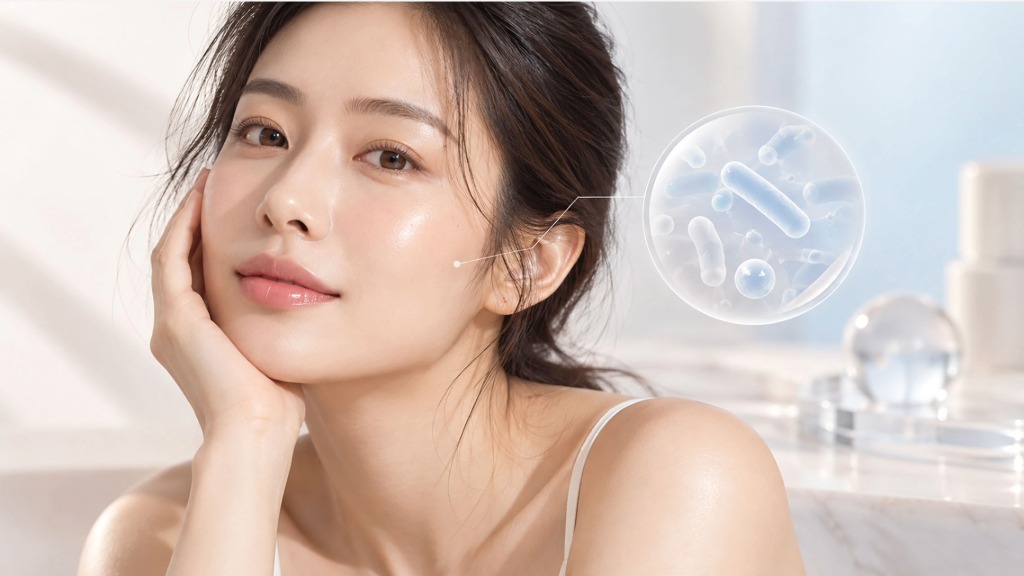
Two forces now sit underneath the products that win. The first is biotech-led ingredient storytelling: fermentation, precision-engineered actives, bio-identical molecules. The premium consumer increasingly wants to know how an ingredient was made and what it does at the cellular level. The second, and my focus here, is microbiome-first formulation. As claims around barrier health, sensitivity and skin longevity come to dominate, a product that quietly disrupts the skin’s microbial community starts to look like a legacy formulation.
A few numbers set the scene. Humans carry roughly as many microbial cells as human ones, close to a one-to-one ratio (1). More striking is the genetic picture: the gut microbiome alone carries on the order of 150 times more genes than our own genome, effectively a second genome (2), and unlike the first, it is one we can influence. It is also deeply personal: more than 80% of people can be re-identified from their gut microbial profile a year later (3), and skin communities are similarly individual. Formulating as if that layer did not exist means overlooking one of the most personal and most responsive parts of the skin.
A signal, not a trend
The reason to take this seriously is that three independent curves are pointing the same way. First, the science is compounding. Microbiome-related publications rose steeply between 2013 and 2023, and across every major research region, so this is not a single-market fad. A claim is only ever as strong as the literature beneath it, and that literature is now both deep and global.
Second, the market is moving. In Europe, the share of soap, bath and shower launches referencing the microbiome nearly tripled, from 1.1% in 2019-20 to 3.0% in 2023-24; in Asia-Pacific, skincare launches pairing the microbiome with a barrier claim rose from essentially zero to around 8% in four years (4). Two regions moving in the same direction is a signal rather than noise, and for a Korean brand the home and export markets are pulling together.
Third, consumers are already searching for the science. Global Google searches for “microbiome” have doubled in five years, and searches for “skin + microbiome” rose almost 177% year on year (5). A great deal of the category education is happening in the search bar, so the opportunity is simply to meet that curiosity with something credible.
Why now
So why is this happening now rather than a decade ago? The answer is unglamorous: the tools got cheap. The cost of sequencing a genome collapsed from around $100 million to under $1,000, faster than Moore’s law (6). The Human Microbiome Project made the microbiome comprehensively surveyable for the first time (7), and the cost of the 16S sequencing the field relies on has fallen more than tenfold since 2015. Analysing the microbiome has gone from a moonshot to a routine lab exercise, and that is what makes testable, substantiated claims possible today.
The barrier is the microbiome’s clearest job
Why should any of this matter for skin? Because the microbiome is the barrier’s most important ally rather than a passive passenger, and it works in three registers:
- Physically: commensals such as Staphylococcus epidermidis contribute to barrier structure, for example by producing enzymes that help generate ceramides and by reinforcing the tight junctions between skin cells
- Chemically: microbial metabolites such as free fatty acids and lactic acid work alongside the skin’s own processes to maintain its acidic surface pH, on average just below 5, which the barrier’s enzymes depend on.
- Immunologically: skin and its microbes train and depend on one another (8).
“Protect the barrier” and “respect the microbiome” are converging into a single instruction, a picture far richer than the old brick-and-mortar model. A balanced microbiome is increasingly tied to skin health in general, not the barrier alone, and consumers already make that connection: in China, 92% of acne-prone consumers agree that microbiome health positively affects their skin barrier (4). The education job is half done.
There is no single microbiome
There is also no single “microbiome.” Composition varies dramatically by body site. Sebaceous zones such as the forehead are dominated by Cutibacterium; moist zones like the armpit by Staphylococcus and Corynebacterium; dry sites like the forearm are far more mixed. There are roughly a thousand species across the skin, at about a million bacteria per square centimetre (9). Every product category therefore sits on a different ecosystem, so there is no such thing as one “microbiome product,” and a claim and its test have to be matched to a specific area.
The question that matters
If I could give formulators one framework, it would be this distinction. At one end sit non-modulating claims, such as “microbiome-gentle,” meaning a product that simply does not disrupt the community. That is a cosmetic claim, defensible in Europe, and shippable today. At the other end sit modulating claims, for products that actively shift, rebalance or restore the microbiome. Those carry a far higher evidence bar, and they are the frontier. For several of these breakthrough claims the science has yet to reach consensus; even defining an ideal direction for the microbiome remains unsettled.
Regulators are beginning to draw the same line. In the EU, cosmetic claims are governed by Article 20 of Regulation 1223/2009 and the common criteria of Commission Regulation 655/2013 (10). Against that framework, language such as “friendly,” “maintains” or “supports” is broadly defensible, whereas a claim like “enhances diversity” is far harder to substantiate, not least because higher diversity is not always a marker of healthier skin.
China has gone further and formalised the modulating end: its voluntary but increasingly influential group standard T/ZGKSL 002-2023 sets out how to evaluate the efficacy of skin-microecology-modulating cosmetics, the higher-evidence claims that edge into borderline territory (11). Non-modulating claims, which show only that a product does not disrupt the community, can be substantiated more cheaply and make the safer floor for a formula meant to travel across markets.
Proof is now the price of entry
One constraint shapes all of this. Substantiation has never been optional; under cosmetic regulation, claims have always had to be backed by evidence. What has changed is that the proof now has to be packaged so that consumers can see and understand it. In a June 2024 survey of more than 3,200 US female beauty consumers, 95% agreed that brands should test their claims with an independent third party, 92% wanted brands to disclose whether a study was run by a third-party firm or lab, and 72% said retailers should be vetting the claims they carry (12). Third-party substantiation and standardised in-vitro and ex-vivo protocols are increasingly the entry ticket to serious retail conversations rather than a nice-to-have. The defensible claim today is closer to “does no harm to a healthy microbiome” than to a grand rebalancing promise, and that is the floor rather than the ceiling. Any concept worth developing should carry its substantiation and verification plan from the first hour.
Conclusion
None of this requires a new hero ingredient. It requires a habit of mind. For any concept, ask three questions:
- Which ecosystem does it live on?
- What kind of claim are you really making: modulating or not?
- What proof stands behind it?
Answer those honestly and a microbiome concept stops being a trend and becomes positioning that travels: differentiation, faster retail entry, and a claim that holds up at the border and in front of a regulator. The science is now deep enough, cheap enough to test, and expected enough by consumers to carry real commercial weight. Use it as fuel, not as the answer.
References and notes
- Sender R, Fuchs S, Milo R. Revised estimates for the number of human and bacterial cells in the body. PLoS Biol. 2016;14(8):e1002533. https://doi.org/10.1371/journal.pbio.1002533
- Qin J, Li R, Raes J, et al. A human gut microbial gene catalogue established by metagenomic sequencing. Nature. 2010;464(7285):59–65; Li J, Jia H, Cai X, et al. An integrated catalog of reference genes in the human gut microbiome. Nat Biotechnol. 2014;32(8):834–41. https://doi.org/10.1038/nature08821
- Franzosa EA, Huang K, Meadow JF, et al. Identifying personal microbiomes using metagenomic codes. Proc Natl Acad Sci USA. 2015;112(22):E2930–8. https://doi.org/10.1073/pnas.1423854112
- Kromidas L, Behnke S, Drago M. Navigating the Regulatory Waters of Microbiome Personal Care/Cosmetic Products. IFSCC Magazine. 2025;28(4):269–277. The EU and APAC launch shares and the China consumer figure reported there are drawn from Mintel (Stafford 2024; L. HJ 2023; Tong 2023; Du 2023). https://www.ifscc.org/ifscc-magazine/
- Google Trends: worldwide search interest for “microbiome” (approximately doubled over five years) and “skin + microbiome” (approx. +177% year on year, Aug 2024–Jul 2025). Google Trends reports normalised relative interest; the exact figures should be recorded against the specific query and date range used. https://trends.google.com/trends/
- National Human Genome Research Institute. DNA Sequencing Costs: Data. NHGRI. https://www.genome.gov/about-genomics/fact-sheets/DNA-Sequencing-Costs-Data
- Human Microbiome Project Consortium. Structure, function and diversity of the healthy human microbiome. Nature. 2012;486(7402):207–14. https://doi.org/10.1038/nature11234
- Byrd AL, Belkaid Y, Segre JA. The human skin microbiome. Nat Rev Microbiol. 2018;16(3):143–55. https://doi.org/10.1038/nrmicro.2017.157
- Grice EA, Segre JA. The skin microbiome. Nat Rev Microbiol. 2011;9(4):244–53; Grice EA, Kong HH, Conlan S, et al. Topographical and temporal diversity of the human skin microbiome. Science. 2009;324(5931):1190–2. https://doi.org/10.1038/nrmicro2537
- Regulation (EC) No 1223/2009 on cosmetic products (Article 20), read with Commission Regulation (EU) No 655/2013 laying down common criteria for the justification of claims. Official Journal of the European Union. https://eur-lex.europa.eu/legal-content/EN/TXT/?uri=CELEX:32009R1223
- T/ZGKSL 002-2023, Efficacy Evaluation of Skin Microecology-Regulating Cosmetics [Chinese group standard, voluntary]. Issued by the China Anti-Aging Promoting Association (registrant code ZGKSL); drafting led by the Guangdong Provincial Cosmetics Association; released on the National Group Standard Information Platform, 31 March 2023. https://www.ttbz.org.cn/
- The Benchmarking Company. Claims Confusion: The Call for Truth & Transparency. Beauty by the Numbers, 2024 Infographic Series #4. Based on a June 2024 survey of 3,226 US female beauty consumers.

The Skin Microbiome in 2026: From Modulation to Measurable Biology
Gale & Cosm and DKSH: Building New Opportunities for the Future o...

Multifunctional Ingredients in Hair and Scalp Care: From Active Perfor...
PEER REVIEWED – Breaking the Cycle: Complementary Biological Pat...

PEER REVIEWED – Scalp First: Advanced Solutions for Barrier Prot...
Beyond Compliance: Steering Cosmetic Packaging Innovation Towards 2030

What Cross-Platform Consumer Data Can Tell Us About the Ingredients Sh...
When Beauty Routines Become Sleep Rituals