Introduction
The sun emits a constant stream of energy. According to CIE (Commission Internationale de l’Eclairage) the spectral distribution of natural solar radiation at Earth surface contains ~ 7% of Ultraviolet light – UV that includes UVB (280-320 nm) and UVA (320-400 nm), ~ 55% of Visible light – VIS (400-780 nm) and ~ 40% Infrared – IR (780 nm-1 mm).
Besides the skin, the eye is the organ most susceptible to sun-induced damage (1).
Excessive and cumulative sunlight exposure has been described as a cause, risk factor, or aggravating factor in pathogenesis of many ocular conditions. Short wavelength UV radiation has the highest potential for damage to the eye. For example, UVB at 300 nm is roughly 600 times more biologically effective at damaging ocular tissue than UVA at 325 nm (2). UVB radiation, with its higher energy, primarily affects the cornea and can cause acute conditions like photokeratitis or “snow blindness” (3). Cumulative effects of UVB are also possible (4). The full depth of atmosphere blocks radiation in 280 – 290 nm range strongly. Sensitive instruments can detect 280 – 290 nm UVB radiation from the Sun at Earth surface, but usually studies of health effects of solar UVB start at 290 nm. UVA, while less energetic, is more abundant and can damage the lens and cornea over time through oxidative stress mechanisms (3). The effect of High Energy Visible radiation – HEV (400 – 450 nm), or violet/blue light on eyes is also becoming a concern (5). Research suggests this involves oxidative stress generated via opsin pigments in retina (6).
Therefore, protecting the eye from both acute and chronic harm by sunlight is important.
The cornea and the intraocular lens are the most important ocular tissues for absorbing UV radiation. The cornea absorbs most of UVB radiation shorter than 300 nm and the lens primarily absorb UVA radiation shorter than 370 nm (7). Attenuation of the UV radiation at the anterior ocular surface is the main way to prevent its absorption by ocular tissues, thus reducing the risk of some sunlight-related eye diseases. The most common forms of ophthalmic attenuators of UV radiation are sun glasses and contact lenses (8).
Invasive methods like implanted intraocular lenses also exist.
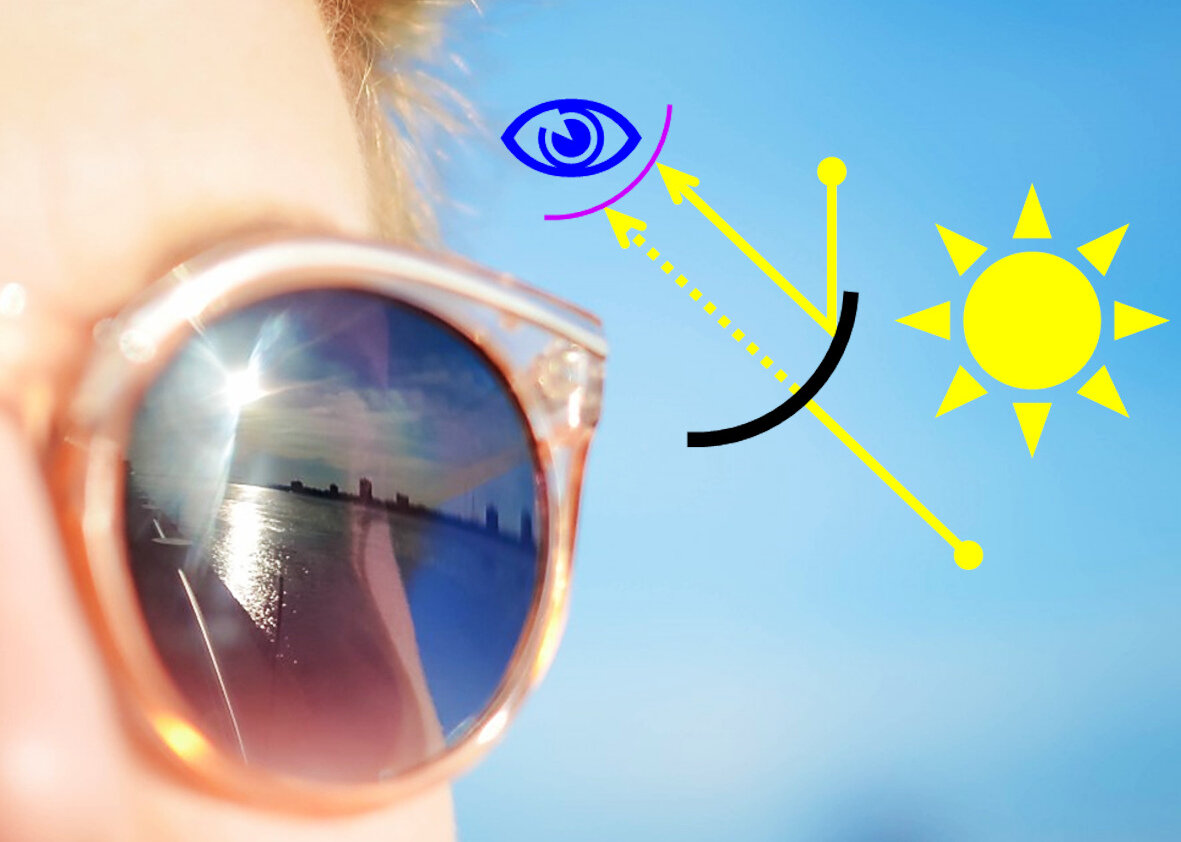
UV radiation is incident at the ocular surface either after transmittance through the sunglass lens itself, or by being obliquely incident around the edge of the sunglass lens.
This oblique incidence is termed a non-lens pathway. Thus, the eye can be exposed to UV radiation from the side – laterally, behind – light is reflected off the back surface of the lens and into the eye and below, leaving the lateral cornea and conjunctiva exposed (9).
Many sunglass designs give poor side protection allowing UV rays to enter the eye from the side (10).
A study showed that even with outer surfaces of prescription glass lenses completely covered by opaque black tape, over 6% of incident UV radiation still reached the eye via reflections (11). Anti-glare or anti-reflective coating is a common convenient feature for glasses. It works well against visible light, but can reflect UV (12). Such reflections can allow more of unmitigated UV radiation to reach the eye.
Intended attenuation of sunlight by sunglass lenses, and unintended “non-lens” paths of sunlight are shown in Figure 1.
The shadow seen through the glasses shows unmitigated sunlight coming near the eye.
This demonstrates that while conventional measures like sunglasses or a wide-brimmed hat help, they do not provide thorough enough protection.
Some authors recommend UV-blocking contact lenses to improve total protection (13). However, prolonged use of contact lenses can lead to papillary conjunctivitis, subclinical inflammation, and increase in mechanical sensitivity (14).
In professions involving hazardous or irritating materials, contact lenses could trap these materials and increase the risk of harm to eye.
Arguably, more comprehensive sun protection could be achieved by using sun-protective eye drops together with hats and sunglasses.
For example, sun-protective eye drops could further attenuate harmful light filtered by sunglasses, and provide some mitigation of light from non-lens pathways.
This could be valuable for people whose eyes are more easily harmed by light (e.g. after cataract surgery) or people exposed to unusual amounts of light (e.g. people living at higher altitudes or nearer equator, skiers, surfers, desert travelers).
Presently, there are few commercially available eye drops with UV or sun protection claims. Literature search found no relevant in vitro methods for testing efficacy of sun-protective eye drops. 
Therefore, we developed an in vitro method to evaluate the potential sun protection efficacy of eye drops.
Commercially available benchmarks were tested using the developed method.
A key parameter for characterizing the material using transmitted light is the path length, or thickness of material, through which light passes.
For measuring performance of eye drops in identical reasonable conditions, a liquid layer of appropriate thickness can be made by a single eye drop instillation spread over area comparable to exposed human eyeball surface.
Ophthalmic solutions are available for multidose or single-dose administration in a wide variety of glass and plastic dropper bottles which deliver drops with a volume between 25 and 70 microliters (0.025-0.07 ml) (15).
Thus, 40 microliter (0.04 ml) is a reasonable volume for a single eye drop instillation.
For both men and women, the mean surface area of eyeball exposed to external factors in the working environment is about 1.72 – 1.82 cm2 (16).
Thus, 2 cm2 is reasonably like exposed human eyeball area.
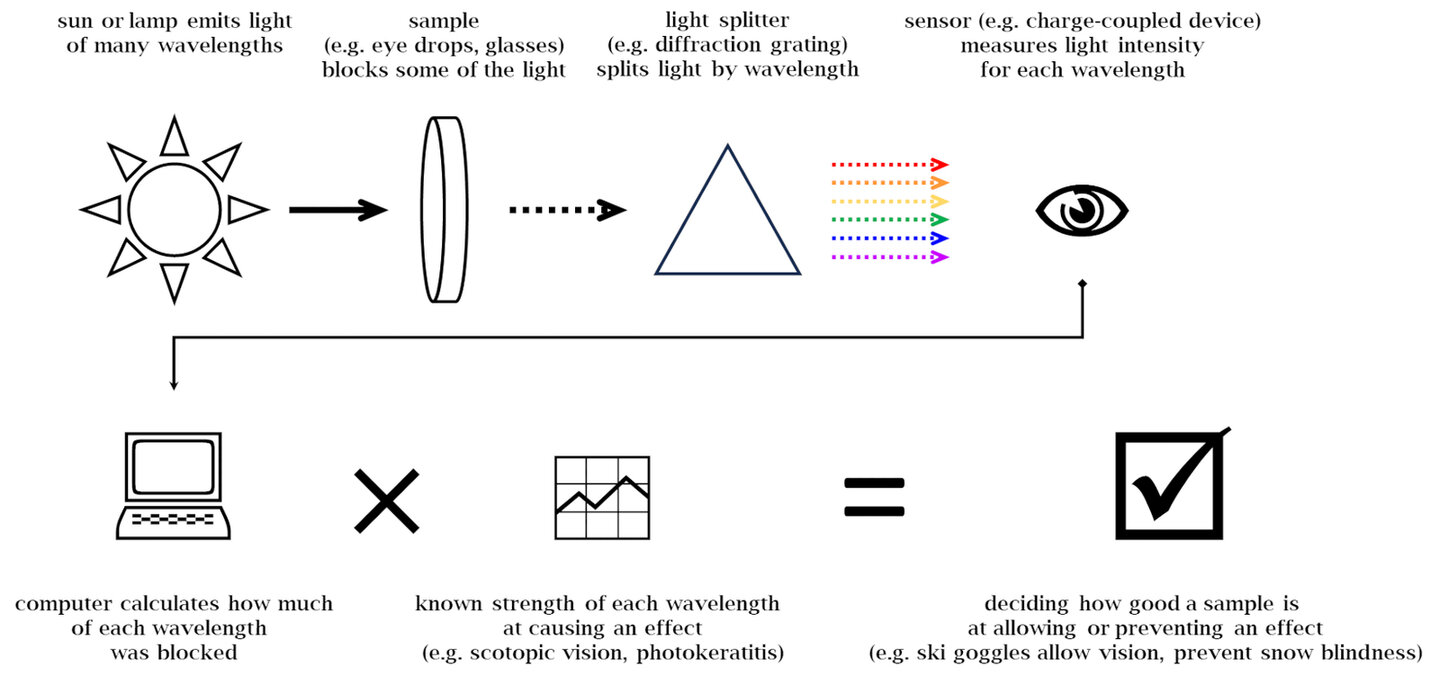
Relating spectrophotometric measurements to health effects involves the concept of “action spectrum”.
It is relative efficacy of different wavelengths of light at causing an effect.
For example, photosynthesis in land plants is powered by red and blue light, not green light; human night vision relies on response of rod cells in retina to blue-green light, but not red light. This also applies to wavelengths outside visible light range, like UV or IR.
Different ways that light – including UV and IR – can harm people have different action spectra.
Describing an action spectrum in terms of broad wavelength ranges is a common practical simplification.
Graphical explanation of spectrophotometry and action spectra relevant to the developed method is in Figure 2.
-SILVER-Nova Compact research grade spectrometer for 190-1110 nm range with thermoelectrically cooled CCD detector; SL3 deuterium light source; SL1 tungsten halogen light source; vertical transmittance fixture (all from StellarNet Inc., Tampa, FL, USA);
-Type 42 demountable disc-shaped circular dichroism quartz cuvettes with light path 0.2 mm, outer diameter 22 mm; inner diameter 16 mm; capacity 0.04 ml (from FireflySci, Inc., Northport, NY, USA).
Package labeling states that it is an anti-UV ophthalmic protective solution containing Riboflavin sodium phosphate 0.05%, Vitamin E TPGS, MSM, amino acids and Hyaluronic Acid.
Manufacturer further describes Drop Defence® as “unique and certified Personal Protective Equipment that protects cornea, crystalline lens and retina against UV radiation, blue light, artificial light sources, and prolonged sun exposure, preventing damages like photo-keratitis, photo-keratoconjunctivitis, cataract and AMD” while keeping “the ocular surface hydrated and protected” (17).
Product B – Refresh Optive® Advanced Lubricant Eye Drops Lot 392525, Expiration date November 2024.
Package labeling lists active ingredients: Carboxymethylcellulose Sodium 0.5%, Glycerin 1%, Polysorbate 80 0.5%; and inactive ingredients: boric acid, carbomer copolymer type A, castor oil, erythritol, levocarnitine, purified water, stabilized oxychloro complex.
Manufacturer describes this formulation as “recommended for the temporary relief of burning, irritation, and discomfort due to dryness of the eye or exposure to wind and sun” (18).
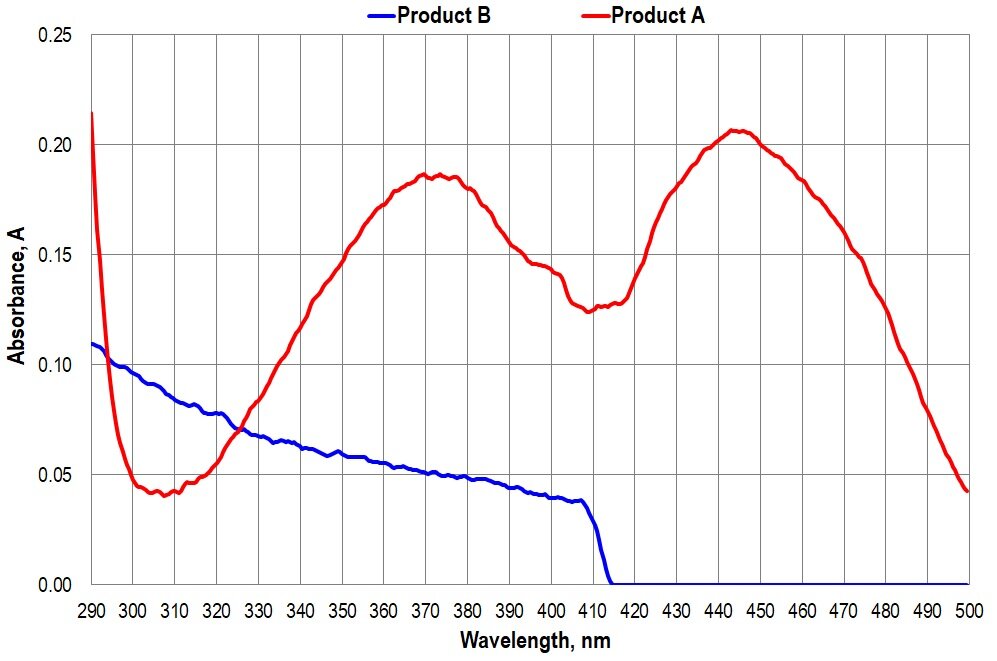
The absorbance spectra of the undiluted test article were recorded in circular quartz cuvettes with surface area 2 cm2 approximating the exposed human eyeball area and path length 0.2 mm, holding 0.04 ml of liquid.
These conditions are like average eye drop volume instilled in the eye.
Distilled water was used as a reference – for calculations, measurements of distilled water were treated as unblocked light.
Spectrometer settings included integration time of 60 milliseconds and averaging of 5 measurements, active temperature compensation.
Detector was actively cooled.
Absorbance spectra of undiluted test articles are shown in Graph 1.
Note that higher absorbance means more blocked light.
Absorbance is calculated as negative base-10 logarithm of fraction of transmitted light.
Sunlight data was US Government standard reference for sunlight at Earth surface for airmass 1.5 (19).
Results of calculations are shown in Table 2 below.


The developed in vitro method shows theoretical maximum protection as a tool for initial comparison of eye drop formulations, and a starting point for further development.
Simple method refinements like shorter path lengths or dilution with artificial tears are feasible.
More valuable are the conceivable formulations whose in vivo protection is retained for longer time, e.g. because active ingredients temporarily adsorb to cornea.
The maximum theoretical protection potential of eye drop benchmarks was determined in vitro under conditions mimicking immediate instillation of a single eye drop. The benchmarks demonstrated their protective effects against solar radiation, e.g. UVB, UVA and HEV. The results are given in Table 2.

Product B mainly absorbs UVB and UVA radiation. The shape of the absorbance spectrum suggests it is likely due to a nonspecific mechanism like scattering by emulsified droplets of castor oil rather than specific absorption by dissolved ingredients. This may be due to turbidity at UV wavelengths.
The developed in vitro method for the evaluation of eye drop’s attenuation in UV-HEV range could be used for development and assessment of novel eye drops protective potential, especially against the most dangerous UVB portion of sunlight.
For example, the ophthalmic compositions described in Soroudi US 11,369,812 (22) utilizing various sunscreen actives are good candidates for evaluation via the developed in vitro method.
As the equipment used in the method is portable and modular, instead of dedicated light source modules it can use real indirect sunlight in different conditions, e.g. clear sky, cloudy sky, or in shadow. This may allow evaluating protection potential of eye drops in more realistic conditions.
Given validated and accepted numerical values of action spectra for specific eye disorders and diseases (e.g. cataract, photokeratitis, photoconjunctivitis, pterygium, retinal degeneration) this novel in vitro method could provide more specific estimates of protection for eyes via eye drops.
This approach may be like current practices for developing sun-protective products for skin.
Ultimately, eye drops created with help of the developed in vitro method could provide comprehensive UV protection, especially when combined with conventional means.
- Roberts J. Ocular phototoxicity. J Photochem Photobiol B, 2001; 64:136-43. https://www.sciencedirect.com/science/article/abs/pii/S1011134401001968
- Young A. Acute effects of UVR on human eyes and skin. Prog Biophys Mol Biol. 2006; 92:80-5. https://pubmed.ncbi.nlm.nih.gov/16600340/
- Wittenberg S. Solar radiation and the eye: a review of knowledge relevant to eye care. Am J Optom Physiol Opt. 1986; 63(8):676-8. https://pubmed.ncbi.nlm.nih.gov/3532811/
- Delic N, Lyons J, Di Girolamo N, Halliday. Damaging Effects of Ultraviolet Radiation on the Cornea. Photochem Photobiol. 2017; 93:920-929. https://pubmed.ncbi.nlm.nih.gov/27935054/
- Zhao ZC, Zhou Y, Tan G, Li J. Research progress about the effect and prevention of blue light on eyes. Int J Ophthalmol. 2018; 11(12):1999-2003. https://pubmed.ncbi.nlm.nih.gov/30588436/
- Organisciak D, Vaughan D. Retinal light damage: Mechanisms and protection. Progress in Retinal and Eye Research. 2010; 29 (2):113- 134. https://www.sciencedirect.com/science/article/abs/pii/S1350946209000731
- Longstretch J et al. Health risks. J Photochem Photobiol B. 1998; 46:20-39. https://www.sciencedirect.com/science/article/abs/pii/S1011134498001833
- Sliney D. UV radiation ocular exposure dosimetry. Doc Ophthalmol. 1995; 88: 243-254. https://link.springer.com/article/10.1007/BF01203678
- Moore LA et.al. Review of photokeratitis: Corneal response to ultraviolet radiation (UVR) exposure. S Afr Optom. 2010; 69(3):123-131. https://avehjournal.org/index.php/aveh/article/view/137
- Sliney D. Epidemiological studies of sunlight and cataract: the critical factor of ultraviolet exposure geometry. Ophthalmic Epidemiol. 1994; 1:107-119. https://pubmed.ncbi.nlm.nih.gov/8790617/
- Rosenthal F, Bakalian A, Taylor H. The Effect of Prescription Eyewear on Ocular Exposure to Ultraviolet Radiation. AJPH. 1986; 76 (10): 1216-1220. https://ajph.aphapublications.org/doi/epdf/10.2105/AJPH.76.10.1216
- Citek K. Anti-reflective coatings reflect ultraviolet radiation. Optometry – Journal of the American Optometric Association. 2008; 79 (3):143-148. https://www.sciencedirect.com/science/article/abs/pii/S1529183907005775
- Walsh K. UV radiation and the Eye. Optician. 2009; 237; 6204: 26-33. https://www.jnjvisioncare.ae/sites/default/files/public/tvci_uv_radiation_and_the_eye.pdf
- Morgan P et al. CLEAR – Effect of contact lens materials and designs on the anatomy and physiology of the eye. Cont Lens Anterior Eye. 2021; 44(2):192-219. https://pubmed.ncbi.nlm.nih.gov/33775377/
- Santvliet LV, Ludwig A. Determinants of eye drop size. Surv Ophthalmol. 2004; 49(2):197–213. https://www.sciencedirect.com/science/article/abs/pii/S0039625703001838
- Juliszewski T, Kadłuczka F, Kiełbasa P. Determining eyeball surface area directly exposed to the effects of external factors. Int J Occup Saf Ergon. 2016; 22 (2): 279-282. https://pubmed.ncbi.nlm.nih.gov/26758027/
- https://servimed-industrial.com/wp-content/uploads/DROP-defence-Brochure-2021-eng_web.pdf
- https://www.refresheyedrops.com/products/refresh-optive-advanced
- Standard Airmass 1.5 (AM 1.5) Solar Irradiance, Watts per Square Meter per nanometer, ASTM G173-03 Reference Spectra (Direct + circumsolar W * m-2 * nm-1) https://www.nrel.gov/grid/solar-resource/spectra-am1.5.html
- Sheraz MA, Kazi SH, Ahmed S, Anwar Z, Ahmad I. Photo, thermal and chemical degradation of riboflavin. Beilstein J Org Chem. 2014; 10 (8):1999-2012. https://pubmed.ncbi.nlm.nih.gov/25246959/
- Cardoso DR, Libardi SH, Skibsted LH. Riboflavin as a photosensitizer. Effects on human health and food quality. Food Funct. 2012; 3(5):487-502. https://pubmed.ncbi.nlm.nih.gov/22406738/
- Soroudi AE. Non-irritating, non-blurring ophthalmic sunscreen. US 11,369,812.
- https://patents.google.com/patent/US11369812B2/en
Waterless Beauty: Hype or Sustainable Revolution?

C3 Reduct®: A Reductive Metabolite of Curcumin for Oral Hygiene
Consumer Perspective: Putting Consumer Experience at the Heart of Wate...

Advancements in skin microbiome that are redefining cosmetics

Adapting Skincare for Climate Change
Understanding cosmetic claims for hair care products: What you need to...

Body Cosmetic Care: Increasingly Similar to Facial Care
A word with Piera Pericu