The foundation of surfactant science is the physical chemistry of surfactants at surfaces. The ability of a molecule to remain clear in a solvent, but at the same time go to and alter the air-liquid interfacial surface tension is the key to surfactant efficiency. In order to get foam, emulsification, wetting, or conditioning, one must have as a prerequisite a lowering of surface tension. In other words, all surfactants lower surface tension but the structure of the surfactant determines if it will provide foam, emulsification, wetting, or conditioning. Surface tension of a liquid is a result of internal attractive forces. These forces cause the liquid’s surface to act as if it were a stretched elastic membrane, thus causing it to form spherical droplets.
Amphoteric surfactants have two or more different groups in the same molecule that in pure form are insoluble in each other. In most cases they are oil and water groups. Each group in pure form has a surface tension associated with the predominant moiety present. The surface tension is determined by the surface tension of the group that is found at the interface. The groups are shown in Table 1.
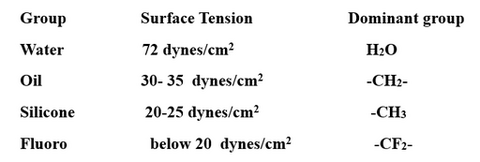
Table 1. Surface Tension.
The amphoteric surfactants we studied for this article have long organic chains. As will become clear, the long chain surfactants are amphoteric and have different properties that the more commonly studied C12 chains.
Broadly used to describe a wide range of multi-charged molecules, “amphoteric” surfactants are often simply zwitterionic or have some capacity of carrying multiple charged functional groups. This property makes them tremendously useful in the formulation of a wide range of cleansers, especially gels, but their charge characteristics also make them useful for other applications as well. They are well known for their ability to form mixed micelles with anionic surfactants, substantially lowering the irritation potential of those surfactants while greatly improving foam and viscosity building properties. Formulators are most familiar with the coconut-derived products, such as Cocamidopropyl Betaine, Cocamidopropyl Hydroxysultaine, Disodium Cocoamphoacetate (a true amphoteric), and the like. While the coconut derived products are excellent foaming products on their own and are often used alone for this property, analogous products derived from soybean and other oils high in stearic, oleic, and linoleic acids do not demonstrate this same property and have been largely ignored. As formulators move away from many traditional tertiary surfactants, especially those containing secondary amines and ethoxylates, it is increasingly important that alternative chemistries be considered for similar benefits.
Materials
All surfactants used in this evaluation were supplied by Colonial Chemical, Inc, South Pittsburg, TN. The amphoteric products of interest are described in Table 2.
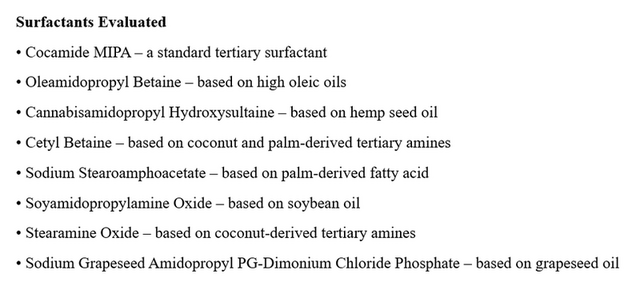
Table 2.
Methodology
A. Viscosity Development
Longer chain surfactants are known to exhibit a much greater ability to generate viscosity in solution. The impact on viscosity development of the long chain amphoterics was compared. A standardized base surfactant formulation consisting of Sodium C14-16 Olefin Sulfonate and Cocamidopropyl Hydroxysultaine was evaluated in combination with the tertiary additives listed previously according to Formulation 1.
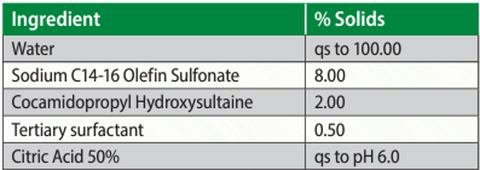
Formulation 1.
Standard salt-response curves were generated by measuring solution viscosity with a Brookfield LVT viscometer after incremental additions of sodium chloride are shown in Table 3. Samples were centrifuged to remove air and temperature adjusted to 25°C prior to each measurement.
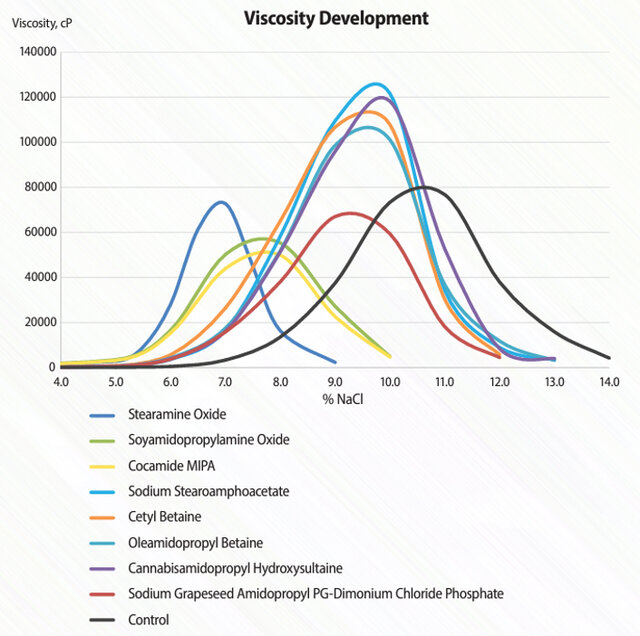
Table 3.
B. Foam Performance
Due to higher solution viscosity, long chain surfactants also tend to have improved foam stability. They also have lower inherent foam potential. The impacts of these materials on initial and stable foam were assessed by two different measurement methods, static and dynamic. For static measurements, test solutions of the same formulations of Part A at 1% solids in DI water at 25°C were prepared. Foam height was measured using the standard Ross-Miles test at two intervals: t=0 and t=300 seconds and are shown in Table 4.
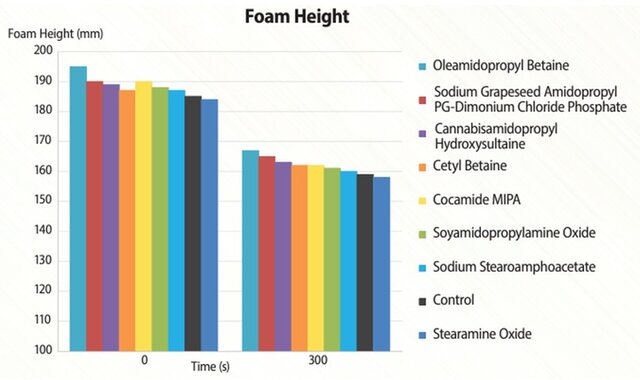
Table 4.
For dynamic measurements of bubble size and structure, test solutions of the same formulations of Part A at 0.05% solids in DI water at 25°C were prepared. Foam structure was analyzed using a Kruss DFA100 dynamic foam analyzer, measuring bubble size and bubble count nearly continuously over time, from the foam generation phase to 5 minutes after initiating foam generation as shown in Table 5. As bubble count increases relative to overall foam height, denser foam is observed, with fewer large bubbles. Maintaining a high bubble count is indicative of a lower propensity for bubble coalescence or breakage.
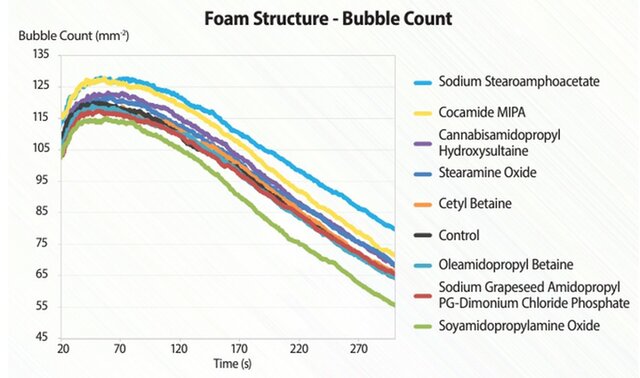
Table 5.
C. Irritation Potential
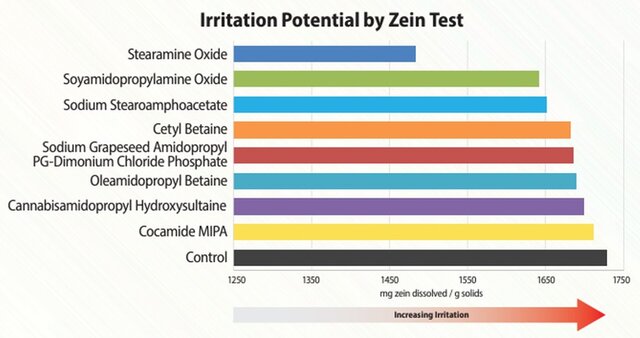
Despite their larger size, longer chain surfactants could exhibit increased irritation potential due to increased compatibility with lipids in the extracellular matrix. Although not a perfect proxy for this mechanism of irritation, additional information regarding irritation potential was assessed via a zein test. Zein protein solubility increases with increased denaturization and therefore increased potential for skin irritation. None of the test solutions exhibited an increase in zein solubility, with decreases ranging on a continuum from not significantly different to modest significance in the amphoacetate and amidopropylamine oxide to significantly decreased with Stearamine Oxide as demonstrated in Table 6.
Conclusions
While amphoteric surfactants are well known and frequently used, their application is typically limited to foam stabilization and irritation mitigation of primary anionic surfactants using the coconut derived varieties. The usefulness of long chain amphoterics has now been demonstrated.
For viscosity development all the products tested benefit the formulation by either substantially increasing the overall viscosity development of the system or by substantially reducing the amount of added salt required to achieve maximum viscosity. Sodium Stearoamphoacetate provided the greatest increase in overall viscosity, while Stearamine Oxide was most effective in reducing the amount of added salt required to reach peak viscosity. Notably, the Stearamine Oxide was more effective at reducing salt added than the traditional alkanolamide with negligible reduction in peak viscosity potential.
Assessing foam heights using the Ross-Miles test, despite the lower inherent foam potential of the long chain amphoteric additives, all the systems tested exhibited an increase in foam height at both initial and 300s time intervals. The stabilizing effect was not well observed in the traditional, static test. When evaluating the dynamic data, both positive and negative deviation from the baseline condition can be observed. At the extremes, the addition of Sodium Stearoamphoacetate imparted the greatest degree of stability while Soyamidopropylamine Oxide exhibited the greatest degree of coalescence.
For irritation potential, none of the test solutions exhibited an increase in zein solubility, with decreases ranging on a continuum from not significantly different to modest significance in the amphoacetate and amidopropylamine oxide to significantly decreased with Stearamine Oxide.
Long chain amphoterics have demonstrated themselves to be useful additives, with large impact on viscosity generation in gel cleansers and to a lesser extent improved irritation potential and foam stabilization. Additional testing to assess after-use benefits like skin feel and hair conditioning is warranted, as these additives have previously shown efficacy in both regards.
Recent Trends in Home Care Products: Navigating Sustainability and Aff...
Innospec sustainable and innovative “Blue Ocean” formulations to meet...

AI and surfactants
AI Formulators are coming are you ready?

Skin rejuvenating properties of a powerful blend of Gardenia jasminoid...
The popularity of vitamin C Serums for effective skin care
Navigating the sensory gap in metaverse personal care

What trends in testing for beauty