Introduction
Cosmetics brands and ingredients suppliers have to navigate a complex regulatory landscape to ensure their products remain within the cosmetic definition while still attracting consumers looking to address skin problems. This is an area that can be frustrating to businesses as although robust scientific data may exist to show that an ingredient or a product has a skin health benefit, it is not acceptable to translate those data into therapeutic claims. The main issue we are seeing often is not a lack of data but a regulatory claim constraint.
Definition of Dermocosmetic
The term “dermocosmetic” itself is not legally defined in EU cosmetic legislation (Regulation (EC) No 1223/2009). Instead, it is a marketing term used to position products that bridge the gap between traditional beauty and dermatological science. Companies often use claims focusing on the biological mechanism of action to convey efficacy, which can sometimes stray too close to the boundary of medicinal function. These products typically appeal to consumers dealing with specific skin problems such as for example skin sensitivity, blemish-prone skin or redness-prone skin.
The regulatory challenge is fundamentally defined by the difference between a cosmetic claim and a medicinal/therapeutic claim.
Cosmetic claims must relate solely to the external parts of the human body (epidermis, hair system, nails, lips, external genital organs) or the teeth and oral mucous membranes, with the exclusive or principal function of cleaning, perfuming, changing appearance, protecting, keeping in good condition, or correcting body odours (1).
Medicinal claims refer to preventing, diagnosing, treating, or alleviating a disease, or modifying physiological functions by pharmacological, immunological, or metabolic action (2).
Dermo-cosmetics are distinguished by strategically formulated products that prioritise skin health, often incorporating active ingredients supported by strong evidence. These products typically undergo evaluation, including testing under dermatological supervision. Consequently, consumers view dermo-cosmetics, with their science-led formulations and emphasis on higher-quality ingredients, as the optimal choice for promoting skin health.
Challenges – Ingredients Pushing the Boundary
Dermocosmetics is an area of opportunity for both cosmetics brands and ingredients suppliers. Cosmetics brands are used to navigating the cosmetics regulatory framework and will require their suppliers to adhere to the legislation. Therefore ingredient suppliers should always conduct a formal regulatory borderline risk assessment before launching an ingredient concept with a “dermocosmetic” focus. This includes:
- Reviewing the ingredient’s classification under EU medicinal product law.
- Evaluating existing product claims using the ingredient to ensure consistency with cosmetic definitions across various Member States.
- Maintaining clear separation between the ingredient’s pure scientific/biological data (which may be therapeutic in nature) and the marketing claims designed for the cosmetic market.
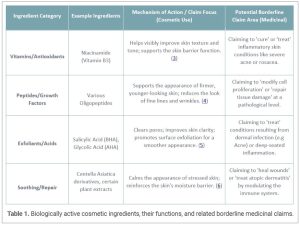
Certain ingredients, due to their established biological activity, are frequently at the centre of this regulatory tension, as their mechanisms of action can suggest a therapeutic effect even when used in a cosmetic context.
Examples include (Table 1)
Ensuring Compliance: Data Generation and Interpretation Preparation
Compliance should be addressed very early in the development stage to avoid unnecessary cost and the risk of being unable to use data. Careful planning, particularly regarding data generation and interpretation, is therefore crucial. Raw material suppliers and cosmetics brands should consider the following points to ensure success and compliance:
- Focus on Cosmetic Endpoints: All efficacy data (including in vitro and in vivo studies) must be focused on demonstrable cosmetic benefits—improvement in appearance, condition, or protection—rather than treating a disease state.
- Avoid Therapeutic Language: Data reports and subsequent marketing summaries for the ingredient must strictly avoid any language suggesting pharmacological action, prevention, or treatment of pathology. Terms like “anti-inflammatory,” “cure,” “repair,” or “therapeutic” should be replaced with cosmetic-appropriate terms like “helps sooth,” “comforting,” “barrier supporting,” or “improving the visible condition of.”
- Mechanism of Action: While the scientific basis of a mechanism of action may be biological, the final claim must always translate this action into a cosmetic effect. For instance, describing how an ingredient interacts with a cellular pathway is acceptable, but only if the ultimate benefit claimed is an improvement in skin appearance (e.g., reducing visible redness) and not the alleviation of a disease (e.g., treating rosacea).
Conclusion
Although the term “dermocosmetic” is a marketing concept rather than a legal one, the products positioned under this umbrella remain subject to strict cosmetic regulations. The key challenge for brands and ingredient suppliers is navigating the regulatory fine line: translating advanced scientific data—which often details a biological or physiological mechanism of action—into permissible cosmetic claims that focus solely on the appearance and condition of the skin, rather than the treatment or prevention of a disease. Success in the dermocosmetic space hinges on proactive regulatory risk assessment, particularly when developing ingredient concepts. By ensuring that all efficacy data is framed around cosmetic endpoints, and by substituting therapeutic language with legally compliant terminology, companies can leverage the benefits of dermatology-inspired science while maintaining adherence to the cosmetic regulatory framework.
References and notes
- Regulation – 1223/2009 – EN – Cosmetic Products Regulation – EUR-Lex https://eur-lex.europa.eu/eli/reg/2009/1223/oj/eng
- Directive – 2001/83 – EN – EUR-Le https://eur-lex.europa.eu/eli/dir/2001/83/oj/eng
- Lain T., Farris P., Niacinamide: A Multi-functional Cosmeceutical Ingredient. Available from: https://practicaldermatology.com/topics/aesthetics-cosmeceuticals/niacinamide-a-multi-functional-cosmeceutical-ingredient/23720/
- Waszkielewicz, A.M.; Mirosław, K. Peptides and Their Mechanisms of Action in the Skin. Appl. Sci. 2024, 14, 11495. https://doi.org/10.3390/app142411495
- Jeyaraman B, Kunjaram G, Thomas J, M AJA. A comparative study of 30% salicylic acid peel and 50% glycolic acid peel in mild to moderate acne vulgaris. IP Indian Journal of Clinical and Experimental Dermatology [Internet]. 2025 Feb 8;11(1):121–5. Available from: https://ijced.org/archive/volume/11/issue/1/article/8008#:~:text=Salicylic%20acid%2C%20a%20beta%2Dhydroxy,targeting%20comedones%20and%20inflammatory%20lesions.
- Ko K, et al. Enhanced Skin-Protective Effects of a Novel Centella asiatica Variety (BT-Care) Cultivated for 75 Days via Modulation of Antioxidant Defense, Collagen Synthesis, and Skin Barrier Function. Journal of Microbiology and Biotechnology [Internet]. 2025 Jul 14;35:e2504036. Available from: https://pmc.ncbi.nlm.nih.gov/articles/PMC12283260/#:~:text=Among%20the%20numerous%20active%20compounds,and%20pharmacological%20activities%20%5B3%5D.

The Biotechnology in Beauty: Progress, Limitations, and Formulation Re...

The science of safety in the booming pet care market

Pet Care products: a market in a regulatory grey zone

CLR Berlin: unique for multiple reasons

A Formulator’s Guide to Pet Care Trends 2026 and Beyond

Nutricosmetics: when beauty “from within” needs proof

Multifunctional Cosmetic Ingredients: The Growing Power of Innovation...

PEER REVIEWED – Peptides from Paeonia suffruticosa cell cultures...