
Introduction
In the quest for improved public health strategies, sun protection emerges as a critical frontier in preventing skin damage and reducing the risk of skin cancer, the most common form of cancer globally. While awareness campaigns and educational efforts have made significant strides, the integration of technology into sun protection measures offers a novel pathway to combat the risks associated with ultraviolet exposure (1). Among these technological interventions, wearable UV trackers stand out, promising to change how we approach sun safety (2).
These devices offer real-time UV exposure data, empowering individuals to make informed decisions about sun protection. The premise is simple yet powerful: by providing immediate feedback on UV levels and the personally exposed UV dose, wearable trackers can prompt timely protective actions, such as seeking shade or applying sunscreen.
Moreover, recent studies underscore the effectiveness of tailored digital interventions in enhancing sun protection behaviors (3) (4), suggesting that wearable UV trackers could play a pivotal role in personalized health strategies aimed at mitigating UV exposure risks.
Purpose and Idea behind Wearable UV Trackers
Traditionally, a cornerstone of sun protection communication is the publication of UV-Index (UVI) forecasts, along with protective measures. This forecast gives people an easy to understand idea of how strong the sun’s intensity will be at its maximum during the day. While it is certainly helpful to communicate the day’s maximum UV Index forecast to plan ahead and have an idea about how strong the sun might get on a given day, it leaves a few open questions to people that plan to go outdoors. For example:
- How strong will the late afternoon sun be?
- Is the shade of my umbrella protecting me well enough or do I need additional measures?
- Should I apply sunscreen for my bike ride at 10 am?
- What does that mean for my skin type?
This is where real-time UV trackers can help by providing UV dose and intensity information that is not solely based on forecast data, but tailored to the personal exposure, skin type, and preferences of the individual.
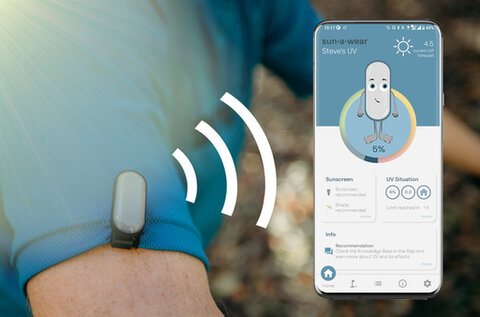
Figure 1. The basic operating principle of a sensor-app integrated UV tracker system. A body-worn sensor measures the UV intensity, transmits the data to a smartphone app, and the app provides recommendations and notifications to the user.
Stand-alone Wearable Trackers vs. Sensor-App Integrated Systems
In the realm of wearable UV trackers, two primary models have emerged: stand-alone devices and those that work in conjunction with a smartphone app (see Figure 1). While both types aim to enhance sun safety through technology, the complexity and personalized nature of sun protection significantly tilt the balance in favor of sensor-app integrated systems.
Stand-alone wearable UV trackers offer simplicity and convenience, functioning without the need for a connected device. They typically provide real-time UV exposure readings and sometimes a cumulative dose. However, the simplicity of stand-alone devices also limits their capability to deliver actionable information.
On the other hand, sensor-app integrated systems leverage the sophisticated interface of smartphones to offer a more tailored sun protection experience. By connecting a wearable UV sensor to a smartphone app, users gain access to a suite of features that can significantly enhance sun safety. These systems can process complex data from the sensor, consider factors like the user’s skin type, the specific sunscreen applied (including its SPF and water resistance), and even the local weather forecast.
Moreover, the smartphone app component can serve as an educational tool, providing users with insights into their sun exposure over time, highlighting potential risks, and educating them about recommended sun protection habits. This can also help foster a deeper understanding of effective sun safety practices over the long term.
Limitations and Misconceptions
Wearable UV trackers, while innovative and useful, are not panaceas for sun protection nor do they render traditional sun safety measures obsolete. It’s critical to address a common misconception: the belief that these devices offer complete protection against UV exposure or can replace the need for sunscreen, protective clothing, and seeking shade. In reality, wearable UV trackers should be viewed as sophisticated tools that enhance and complement, rather than replace, established sun protection strategies.
The primary function of these devices is to provide real-time information about UV exposure, enabling users to make informed decisions about sun safety, as well as alerting users in situations of high exposure or reminding them to (re-) apply sunscreen.
Basic Data Processing Principle
A typical sensor-app system uses 4 different types of input data to perform its operations (see Figure 2):
- Sensor data from the wearable sensor
- UV-forecasts from internet sources
- The personal UV-dose limit of the user, usually based on the Fitzpatrick skin type
- Sunscreen information the user enters
At the core of the data processing is the time-integral of the measured UV-index data of the sensor (Accumulate UV-dose in Figure 2). This accumulated UV intensity results in the personal UV dose of the user, which in return can lead to protection recommendations and alerts.
While this looks fairly simple at the surface, there is additional complexity when considering real-world imperfections. The following section shows this with the example of sunscreen applications.
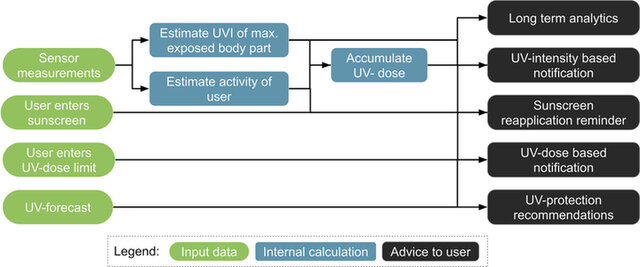
Figure 2. Basic data processing principles. Four types of input data are combined to estimate the body’s accumulated UV exposure. This information is used to derive various kinds of advice for the user.
Integration with Sunscreen Use
An essential aspect of enhancing the effectiveness of wearable UV trackers lies in their ability to integrate sunscreen application into their protective recommendations. Therefore, offer the user to enter sunscreen applications in the app and use it in their dose calculations (see Figure 3).
However, it’s important that these systems acknowledge and compensate for common gaps in sun protection practices, particularly in how sunscreen is applied. Research consistently reveals a stark discrepancy between the ideal application of sunscreen, as per manufacturers’ recommendations, and the reality of how it’s applied by consumers. Studies indicate that most individuals apply a significantly thinner layer of sunscreen than what is needed to achieve the advertised SPF (5). Petersen et at. reported that the effective SPF in real-world situations can easily be around 50% of its advertised SPF value (6).
Wearable UV trackers and apps should factor in real-world imperfections, such as suboptimal sunscreen application by users. For instance, if a user inputs that they have applied an SPF 30 sunscreen, the device could calculate exposure risks based on an effective SPF of 15, considering the common application discrepancies.
Additionally, it can be useful if the app reminds the user after they applied sunscreen to reapply sunscreen. But the timespan between the first application and the reapplication reminder should vary depending on various factors:
- In general, a reminder should be triggered 2-4 hours after the first application.
- In case the person is sweating or swimming this reminder should be triggered earlier.
- If the sunscreen application is 2-4 hours ago, but it’s already late afternoon and not much UV is forecasted for the rest of the day, the reminder is probably not needed.
- If the sunscreen application is 2-4 hours ago, but the person stays only indoors, no reminder is needed.
The usefulness of the app’s recommendations and the credibility of its recommendations can be greatly increased through the integration of external information sources about a user’s activity and the forecasted UV-intensity.
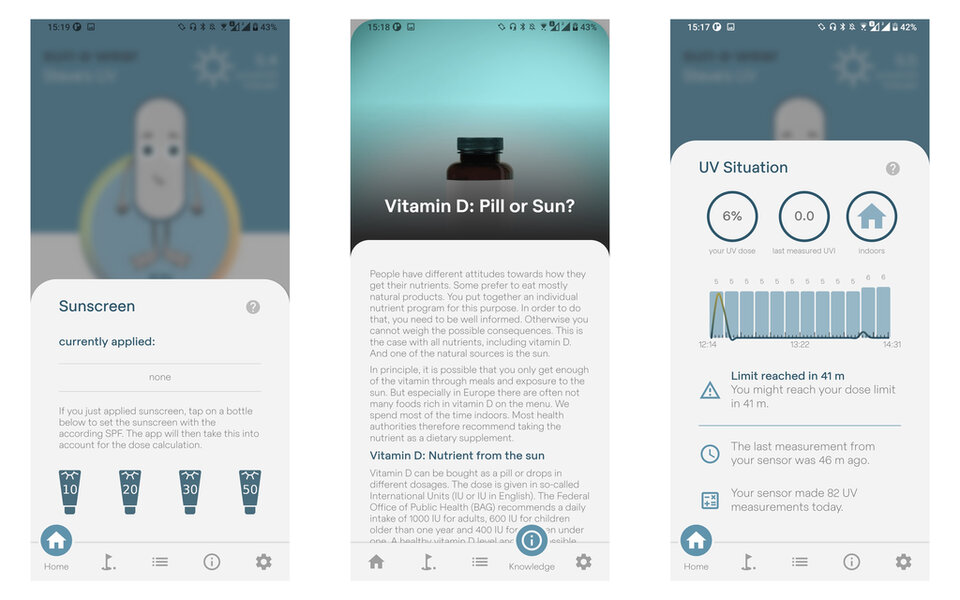
Figure 3. Examples of user interactions. Left: How the user can let the system know they just applied sunscreen of a certain SPF. Center: In-app education about UV radiation and its effects. Right: Basic information about one’s UV dose and how quickly the personal limit could be reached.
Optimal Location for Measurement
Their placement on the body significantly influences the effectiveness of wearable UV trackers in providing accurate UV exposure readings. The face and head in general are the body areas most affected by skin cancer (7), indicating they can be good proxies for gauging an upper limit of the overall UV exposure. Strategically positioning the tracker on or near the head is advocated due to these areas’ typically high exposure to sunlight.
This means that the device should be discreet and secure enough to be worn comfortably and continuously in these visible areas. For instance, a device designed for the collar of a shirt or jacket must be lightweight and adaptable to different clothing styles. As technology advances, a promising approach would also be to directly integrate the sensor into existing sun accessories like sunglasses or hats.
User Experience Challenges
Integrating wearable UV trackers into daily life presents a unique set of challenges that go beyond the mere technological capabilities of these devices. At the heart of these challenges is the potential inconvenience of adopting an additional gadget. The success of wearable UV trackers hinges not only on their functionality but also on their ability to align with the user’s daily routines and personal style.
Devices that are cumbersome to operate, have complicated interfaces, or require frequent maintenance are likely to be used less consistently, if at all. The ideal wearable tracker is one that demands minimal effort from the user — from intuitive setup processes to simple, clear notifications about UV exposure levels.
Moreover, the “wearability” of UV trackers — their size, shape, and how they are worn on the body — is a pivotal consideration in their design. Waterproofing is another crucial aspect, especially considering the lifestyle of potential users who may engage in swimming, beach visits, or water sports. It is still important though to keep the device lightweight with an unobtrusive design. A bulky or heavy tracker can become a nuisance, deterring users from wearing it consistently.
A pivotal feature for any wearable device is the ability to be operational when it is needed. Incorporating solar power or long-lasting batteries addresses this need, aligning with the device’s purpose to monitor UV exposure. Solar-powered devices, in particular, ingeniously leverage the very element they measure — sunlight — to sustain their operation, eliminating the inconvenience of frequent recharging.
Overall acceptance of wearable UV trackers is influenced by how well these devices integrate into users’ lives. Beyond the initial novelty, long-term use is dependent on the tracker’s ability to deliver meaningful, actionable data without adding complexity or inconvenience.
Conclusions
Wearable UV trackers represent a significant advancement at the intersection of technology and public health, offering innovative means to enhance traditional sun protection methods. Their success hinges on addressing technical and user experience challenges through continuous improvements, thorough research and user-centric design. By providing users with real-time, personalized UV exposure information, these devices encourage informed, proactive sun safety behaviors.
As we look to the future, the role of wearable UV trackers in promoting effective sun safety practices is undeniably promising, underscoring the importance of technological solutions in advancing health and wellness in the digital age.
References and notes
- Robinson JK, Durst DA, Gray E, Kwasny M. Protection‐adjusted UV dose estimated for body areas: Daily self‐reported sun protection modification of wearable UV sensor dose. Photodermatology, Photoimmunology & Photomedicine. 2020 Apr 28;36(5):357–64.
- Huang X, Chalmers AN. Review of Wearable and Portable Sensors for Monitoring Personal Solar UV Exposure. Annals of Biomedical Engineering. 2021 Jan 11;49(3):964–78.
- Niu Z, Bhurosy T, Heckman CJ. Digital interventions for promoting sun protection and skin self-examination behaviors: A systematic review. Preventive Medicine Reports. 2022 Apr;26:101709.
- Nioi A, Wendelboe-Nelson C, Cowan S, Cherrie M, Rashid S, Cowie H, et al. Nudging construction workers towards better sun-safety behaviour: Summary of the evidence for practitioners. Policy and Practice in Health and Safety. 2020 Jan 2;18(1):25–33.
- Couteau C, Paparis E, El-Bourry-Alami S, Coiffard LJM. Influence on SPF of the quantity of sunscreen product applied. International Journal of Pharmaceutics. 2012 Nov;437(1–2):250–2.
- Petersen B, Wulf HC. Application of sunscreen − theory and reality. Photodermatology, Photoimmunology & Photomedicine. 2014 Jan 6;30(2–3):96–101.
- Fijałkowska M, Koziej M, Antoszewski B. Detailed head localization and incidence of skin cancers. Scientific Reports. 2021 Jun 11;11(1):1–6.

H3i 2024: Detergents – navigating ecological transition, opportu...
Personalized skin care, an update

Amazonian Oils Blend calms sensitive skin while rebalancing skin micro...
Mind, body, beauty – decoding the holistic beauty revolution
The power of holistic beauty: the future of personal care
A Word With Beatrice Tassone (Senior Scientist Lab Head, dsm-firmenich...
How to formulate with active ingredients