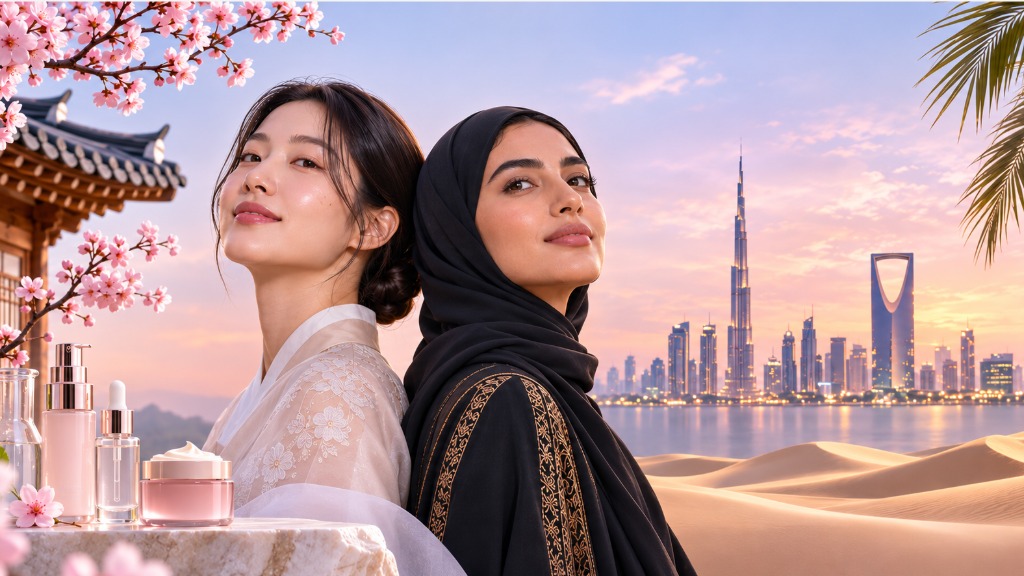
K-Beauty has moved well beyond the status of a digitally discovered import. South Korea exported US$11.4 billion of cosmetics in 2025, a new record, with skincare representing approximately three quarters of export value. The UAE rose to become Korea’s eighth-largest cosmetics export destination, with exports increasing 70.6% year on year (1, 2).
The Middle East beauty market, specifically the Gulf Cooperation Council (GCC) region is projected to reach nearly US$21 billion by 2030 (3). It has transformed from a passive consumer of global beauty products into a rapidly growing, influential trendsetter that is reshaping the industry. The market is shifting toward localisation with cultural identity, haircare, hydration and products relevant to inclusive skin tones and beauty practices identified as increasingly important market drivers (4).
The Middle Eastern consumer is therefore not simply absorbing global beauty trends, but remixes and re-exports them. The region is becoming more articulate about what relevance should look like locally and is setting new trends of its own.
The more interesting development, however, is not scale alone; it is infrastructure. In June 2026, Korea’s Ministry of SMEs and Startups and the Korean Embassy in Saudi Arabia launched a dedicated K-Beauty Saudi market-entry programme. More than 20 Saudi distributors, including Whites, expressed interest, while selected Korean SMEs were offered support spanning local retail access, product promotion and regulatory consultation (5). The strategic logic is clear; Saudi Arabia alone accounts for roughly 40% of the region’s total beauty spending (3).
In Dubai, the Korean Ministry of Culture, Sports and Tourism has established Korea 360, a government-backed Hallyu platform where cosmetics sit alongside Korean culture, food and design (6). Government, retail and culture are beginning to form a coordinated route into the region.
Retail partnerships reinforce that shift. CJ Olive Young’s agreement with UAE-based Life Healthcare Group is intended to distribute Korean beauty products through approximately 580 Life Pharmacy stores (7). In January 2026, Sephora and Olive Young announced a strategic global partnership bringing Olive Young-curated K-Beauty into Sephora, with Middle Eastern expansion planned for 2027 (8).
These are not simply new points of sale; they connect Korean curation and product discovery with two different forms of regional trust, placing Korean beauty within both prestige discovery and pharmacy-led environments. The commercial weight of the prestige route is quantifiable, drawing on July 2026 data and reports forecasting premium beauty and personal care growth of 75.0% in Saudi Arabia and 46.7% in the UAE between 2025 and 2030, against mass-market growth of approximately 32-33% in both markets (3). A dual-channel architecture, prestige for desirability and pharmacy for credibility, therefore aligns with where regional value is actually being created.
Dubai welcomed more than 691,000 international medical tourists in 2023, with dermatology accounting for 27% of demand (9). Korea recorded 1.17 million foreign patients in 2024, 56.6% of them in dermatology (10). These figures show two markets where dermatology and aesthetic medicine have high visibility alongside sophisticated beauty economies.
This matters because scientific credibility is becoming part of how skincare is understood. In the UAE, Euromonitor anticipates growing consumer interest in dermatologist-endorsed and personalised skincare; in Saudi suncare, pharmacy credibility and dermatologist or pharmacist endorsement are already commercially visible (11). Pharmacy creates an additional environment for education, ingredient literacy and efficacy-led skincare, provided cosmetic claims remain proportionate to the data.
The most relevant K-Beauty trend may no longer be the number of steps in a routine, but the performance engineered into each one. South Korean market analysis points to efficacy-driven skincare, skinification extending into scalp and body care, clinic-grade home treatments and increasingly evidence-conscious consumers (11). Sun care is likewise moving towards lightweight serum textures and multifunctional formulations incorporating hydration, tone correction and barrier support (12).
For Middle Eastern markets, that direction is particularly relevant. Serum sunscreens, high-water emulsions, essences, hydrogel systems, scalp treatments and multifunctional hybrids suit routines where sensorial elegance and speed matter. The opportunity is to translate the formulation intelligence behind K-Beauty into fewer, more relevant steps that work in Riyadh or Dubai.
In GCC luxury beauty, fragrance holds the largest category share at 49%, while skincare is the fastest-growing beauty segment (13). Mintel describes the “skinification of fragrance”, with a 200% jump in fragrance launches claiming suitability for sensitive skin between 2020 and 2025 (14). Gulf fragrance behaviour is inherently layered, extending across hair, clothing and repeated applications throughout the day (15).
For Korean formulators, the opportunity is not simply to add perfume to skincare, but to apply K-Beauty’s expertise in lightweight delivery to fragranced body serums, moisturising mists, hair formats and sensorial body care. Fragrance release, substantivity, skin feel, allergen management and climate performance become part of the same formulation brief.
The formulation opportunity, therefore, is localisation through co-development rather than correction. K-Beauty brings sophisticated emulsion systems, polymers, film formers, delivery formats and agile ODM development. Regional environmental conditions, pigmentation biology, hair behaviours and routines can make those technologies more specific.
Consumers in Gulf markets may repeatedly move between hot outdoor conditions and air-conditioned interiors while layering skincare, sunscreen and make-up. Scientific literature shows that ambient humidity can influence stratum-corneum water content, elasticity and roughness, although the evidence is heterogeneous and should not be simplified into claims that one environment inherently damages the barrier but how a product behaves across environmental transition (16). That can mean testing spread, drag, tack, pilling, residue, shine and wear alongside standard stability and efficacy endpoints.
A high-water gel may feel elegant at first application but become tackier as water evaporates; a richer emulsion may support moisturisation yet interact differently with perspiration, sunscreen or complexion products. Formulations should be validated where the product will actually be worn.
Pigmentation creates another area for meaningful collaboration. In a prospective study of 262 acne patients across the Middle East, 87.2% experienced post-inflammatory hyperpigmentation and half reported the pigmentation as more troublesome than the acne itself (17). Visible light is also relevant in darker phototypes: controlled research has shown that iron-oxide-containing formulations can provide meaningful protection against visible-light-induced pigmentation compared with a non-tinted mineral SPF sunscreen in Fitzpatrick type IV skin (18).
For K-Beauty, this opens an innovation space around elegant tinted photoprotection, shade inclusion, irritation-conscious pigmentation care and high-protection formats designed for real adherence.
Facial skincare has dominated the K-Beauty conversation, but scalp and hair offer credible regional whitespace. Hard-water exposure has been shown to increase calcium and magnesium deposition on hair fibres (19). The commercial opportunity is to formulate against measurable cosmetic consequences such as deposition, dullness, rough feel, difficult lather or reduced manageability through chelating pre-shampoos, low-residue cleansers or lamellar rinses.
Korean formulation science already has an advantage here. High-water emulsions, essences, ampoules, sun serums, hydrogel systems, fermentation platforms and sophisticated polymer technologies map naturally onto a consumer who values sensorial refinement but may resist heaviness.
A product intended for Riyadh or Dubai should be assessed at realistic skin temperature and humidity, through layered routines, under make-up and after several hours of wear. Cooling break, spread, drag, tack, residue and fragrance release influence application quantity, adherence and repurchase.
Formats should also reflect behaviour. The opportunity may be an essence-serum hybrid or a tinted sun fluid, a scalp serum that dries rapidly beneath covered hair or a fragrance-hair mist designed around Gulf layering rituals. This opens a practical development space through localised cultural relevance and the climates consumers actually live in.
Middle Eastern consumers are highly exposed to global beauty content, but digital discovery has made weak claims easier to challenge and the commercial stakes of that scrutiny are rising. The GCC is home to an estimated 263,000 social media influencers, more than 62% of consumers are regularly exposed to creator-led content and influencer-led beauty livestreams in the UAE and Saudi Arabia report conversion rates of up to 30%, against 2-3% for standard e-commerce (3). Scientific credibility therefore becomes commercial infrastructure rather than marketing decoration.
Claims such as “barrier repair”, “anti-pollution”, “microbiome balancing” or “clinically proven” need an endpoint, a method and a relevant test population. GSO 1943:2024 sets Gulf safety requirements for cosmetic and personal care products, while GSO 2528:2024 governs acceptable cosmetic claims and warns that unacceptable claims may move a product outside cosmetic scope (20, 21). Dubai’s Montaji system registers and assesses consumer products before local trade, (22) while Saudi Arabia operates its own cosmetic notification and classification requirements through the SFDA (23).
Korean brands are not unfamiliar with this discipline. Korea’s own Cosmetics Act prohibits labelling or advertising, likely to mislead consumers into believing that a cosmetic is a medicine (24). The adjustment required for the Gulf is therefore one of translation rather than principle.
The Middle East and K-Beauty are two sophisticated beauty ecosystems with complementary strengths. Korea brings formulation speed, advanced textures, ODM scale and a deeply developed culture of skincare innovation. The Middle East brings diverse pigmentation biology, distinctive hair and fragrance behaviours, growing pharmacy and healthcare ecosystems, sophisticated retail and increasing expectations of scientific relevance.
Hallyu can create desire, government-backed programmes can lower market-entry friction. Retailers can create access and pharmacies can add a credible context for efficacy-led skincare. The longer-term opportunity is collaboration. Korean formulation intelligence developed with regional scientific, regulatory and consumer insight from the outset. That is how K-Beauty can move from being successfully distributed in the Middle East to being meaningfully developed with the Middle East in mind.
References and notes
- Kim SA. Cosmetics surplus breaks USD 10B, exports ranked 2nd worldwide. Korea.net (Internet). Seoul: Korean Culture and Information Service; 2026 May 26 (cited 2026 Aug 28).
- Jhoo D. Korea becomes world’s No. 2 cosmetics exporter as trade surplus tops $10 bil. The Korea Times (Internet). Seoul: The Korea Times; 2026 May 22 (cited 2026 Aug 28).
- Messe Frankfurt Middle East. The GCC is no longer following global beauty, it is setting direction. 2026 Middle East Beauty Market Report (Internet). Dubai: Beautyworld Middle East; 2026 Aug 26 (cited 2026 Aug 28).
- Euromonitor International. Cultural identity drives the rise of A-Beauty in the Middle East and Africa (Internet). London: Euromonitor International; 2025 Dec 3 (cited 2026 Aug 28).
- Ministry of SMEs and Startups, Republic of Korea. Backing K-Beauty’s entry into the Saudi market (Internet). Sejong: Ministry of SMEs and Startups; 2026 Jun 29 (cited 2026 Aug 28).
- Lee D. 2nd branch of Hallyu-promoting center Korea 360 opens in UAE. Korea.net (Internet). Seoul: Korean Culture and Information Service; 2025 Apr 11 (cited 2026 Aug 28).
- Kim B. CJ Olive Young partners with UAE’s LHG on K-beauty product retail. Yonhap News Agency (Internet). Seoul: Yonhap News Agency; 2025 Nov 20 (cited 2026 Aug 28).
- Sephora. Sephora and Olive Young partner to bring the best of Korean beauty to Sephora consumers (Internet). Paris: Sephora; 2026 Jan 20 (cited 2026 Aug 28).
- Government of Dubai Media Office. Dubai welcomes more than 691,000 international medical tourists in 2023 (Internet). Dubai: Government of Dubai Media Office; 2024 Aug 19 (cited 2026 Aug 28).
- Jeon M. Medical tourism in 2024 attracts record 1.17M international patients. Korea.net (Internet). Seoul: Korean Culture and Information Service; 2025 Apr 3 (cited 2026 Aug 28).
- Euromonitor International. Beauty and personal care in South Korea (Internet). London: Euromonitor International; 2026 May (cited 2026 Aug 28).
- Euromonitor International. Sun care in South Korea (Internet). London: Euromonitor International; 2026 May (cited 2026 Aug 28).
- Khosla A. GCC luxury market defies global slowdown, beauty sales climb 12%. BeautyMatter (Internet). 2025 Aug 26 (cited 2026 Aug 28).
- Messe Frankfurt Middle East. The skinification of fragrance (Internet). Dubai: Beautyworld Middle East; (cited 2026 Aug 28). Data sourced from Mintel Global New Product Database.
- Culliney K. Givaudan: fragrance is “part of the culture” in the Gulf. BeautyMatter (Internet). 2026 Aug 25 (cited 2026 Aug 28).
- Goad N, Gawkrodger DJ. Ambient humidity and the skin: the impact of air humidity in healthy and diseased states. J Eur Acad Dermatol Venereol. 2016;30(8):1285-94. doi:10.1111/jdv.13707.
- Abanmi A, Al-Enezi M, Al Hammadi A, Galadari I, Kibbi AG, Zimmo S. Survey of acne-related post-inflammatory hyperpigmentation in the Middle East. J Dermatolog Treat. 2019;30(6):578-81. doi:10.1080/09546634.2018.1542807.
- Dumbuya H, Grimes PE, Lynch S, Ji K, Brahmachary M, Zheng Q, et al. Impact of iron-oxide containing formulations against visible light-induced skin pigmentation in skin of color individuals. J Drugs Dermatol. 2020;19(7):712-7. doi:10.36849/JDD.2020.5032.
- Srinivasan G, Chakravarthy Rangachari S. Scanning electron microscopy of hair treated in hard water. Int J Dermatol. 2016;55(6). doi:10.1111/ijd.13141.
- GCC Standardization Organization. GSO 1943:2024. Cosmetic products – Safety requirements of cosmetics and personal care products (Internet). Riyadh: GCC Standardization Organization; 2024 (cited 2026 Aug 28).
- GCC Standardization Organization. GSO 2528:2024. Cosmetic products – Technical regulation of cosmetic and personal care products claims (Internet). Riyadh: GCC Standardization Organization; 2024 (cited 2026 Aug 28).
- Dubai Municipality. Register consumer products and food contact materials: Montaji (Internet). Dubai: Dubai Municipality; (cited 2026 Aug 28).
- Saudi Food and Drug Authority. Saudi FDA products classification guidance. Version 8.0 (Internet). Riyadh: Saudi Food and Drug Authority; 2024 (cited 2026 Aug 28).
- Republic of Korea. Cosmetics Act. Article 13: Prohibition of wrongful labeling and advertisements (Internet). Seoul: Korean Law Information Center; (cited 2026 Aug 28).

The Skin Microbiome in 2026: From Modulation to Measurable Biology
Gale & Cosm and DKSH: Building New Opportunities for the Future o...

Multifunctional Ingredients in Hair and Scalp Care: From Active Perfor...
PEER REVIEWED – Breaking the Cycle: Complementary Biological Pat...

PEER REVIEWED – Scalp First: Advanced Solutions for Barrier Prot...
Beyond Compliance: Steering Cosmetic Packaging Innovation Towards 2030
What Cross-Platform Consumer Data Can Tell Us About the Ingredients Sh...
When Beauty Routines Become Sleep Rituals