1.3KABSTRACT: Euromonitor International has identified the focus on ingredients as having a far-reaching impact on industries and consumers in the future. The consumer focus on health, safety and active ingredients has naturally expanded to become a prominent theme within the beauty and personal care industries. Consumers are now more interested in shopping for products containing active ingredients, rather than immediately gravitating towards certain brands. The increase in digital educational platforms, as well as ongoing consumer demand for efficacy, transparency and safety, has led to the rise of ingredient-led beauty.Uncovering the ingredient-led beauty industryConsumer focus on health, safety and ingredients has naturally expanded and become a prominent theme within skin care. Consumers have grown more interested in shopping for star ingredients first and foremost, before gravitating immediately to certain brands. Increase in digital educative platforms as well as ongoing consumer demand for efficacy, transparency and safety has led to a rise of ingredient-led beauty.
More beauty players are embracing seasonal skin care through launches of AHAs, BHAs, vitamin C and retinol. Seasonality is influencing the facial skin care market, which is affected by consumers’ beauty habits and routines changing with each season. This offers manufacturers the chance to capitalise on products for specific skin needs throughout the year. During autumn months, retinol and cosmetic acids reigned supreme. Winter months are for skin regeneration and building the hydrolipid barrier. Spring is for repeating the cycle with acids and its early months – for retinol. During summer months skin needs light moisturisers in order to regenerate from higher sun exposure. At the same time, there is a growing awareness that SPF protection is a must throughout the entire year.Source: Euromonitor International, Voice of the Consumer: Beauty Survey, 2025New launches focus on strengthening the skin barrier through active ingredientsAn increasing number of skin care players are formulating with ‘’power’’ ingredients with
proven effects and natural origin – such as peptides, ceramides, and fruit acids. France-based
Payot’s luxury brand Payot (1) developed Neo-Serum, a daily facial serum enriched with niacinamide, hyaluronic acid, and cyclitol from the leaves of Ginkgo biloba. Another example is Kiehl’s (2) that has introduced a new addition to its best-selling Ultra Facial line: the Ultra Facial Barrier-Hydrating Cleanser. The soap-free amino acid cream-to-foam cleanser lifts away impurities while hydrating and supporting the skin’s barrier. Key ingredients include an amino acid surfactant, squalane and glycerin to remove dirt, makeup and sunscreen while providing immediate hydration.At-home medical aestheticsSince the pandemic, there has been a significant shift in skincare trends worldwide, largely influenced by the advanced medical aesthetics culture of countries such as South Korea. This has resulted in growing interest in treatments such as laser therapy, chemical peels, microneedling and Thermage at clinics and cosmetic surgery centres. These procedures aim to address and prevent common skin concerns, including acne, blemishes, enlarged pores and skin laxity. The concept of maintaining healthy, youthful skin through regular medical aesthetic treatments is increasingly referred to as ‘skin management’.
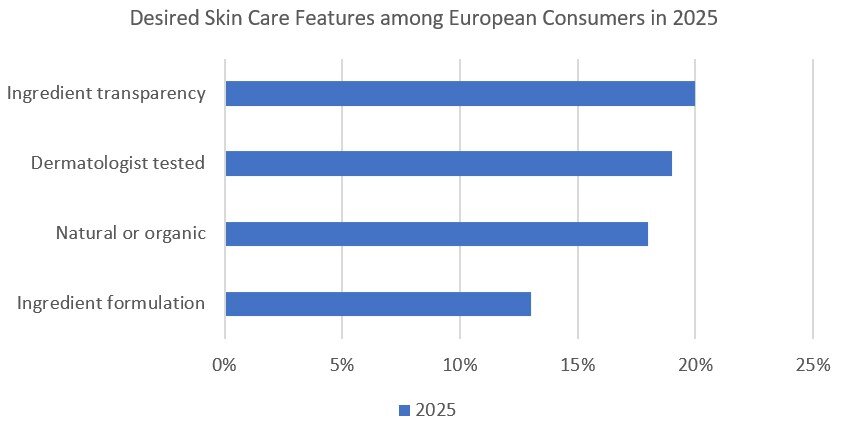
In response to this emerging trend, several skin care brands are integrating concepts from medical aesthetics into their product lines to appeal to consumers seeking high-performance solutions, either to replicate the effects of professional treatments or to help maintain their results. A notable example is Riddle Shot from VT Cosmetics (3) in South Korea, inspired by dermapen procedures commonly used in medical aesthetic clinics. The product has gained substantial popularity through promotional campaigns and positive customer reviews on platforms such as Amazon, and various online retailers specialising in K-beauty.Ingredient-led beauty strongly trending in EuropeThe hype surrounding ingredient-led beauty, particularly in skincare, is occupying the minds of both: manufacturers and consumers. This is supported by the voices of European consumers who claim to value ‘ingredient transparency’ highly when it comes to desired skincare features, as mentioned in the above graph. ‘Dermatologist-tested’ also appears to be an important claim for consumers. This suggests that consumers are looking for products that are scientifically proven to be effective and safe, and that do not cause irritation when addressing various skin concerns. This trend is driven by consumers prioritising scientifically backed products over marketing hype and their desire for evidence-based solutions for skin health. The rise of social media has also empowered consumers to seek expert information from dermatologists, further increasing the demand for trusted, dermatologist-tested products.Euromonitor’s Beauty Survey found that for a number of European consumers, skin care products featuring “natural or organic” ingredients are still relevant, aligning with the broader beauty trend of
ingredient transparency and authenticity.The future of beauty: opportunities for growthOver the forecast period, skin care will be shaped by AI and technology, both of which will drive personalised and precise solutions for skin care routines. Stressful lifestyles will make way for more conscious and intuitive skin care formulations. Industry players will offer formulas that work smart and provide solutions to restore balance. Brands will
continue to move away from harsher ingredients that only temporarily control
breakouts. Therefore, anti-inflammatory, probiotic and post-biotic formulas designed to balance bacteria and support the skin barrier will dominate the market as more research focuses on the skin microbiome. Brands will position their products as ‘balanced’ and specific to different skin pH levels, with a focus on acne-prone and dehydrated skin.Such ingredients will address skin concerns by using microbiome-balancing ingredients to improve overall skin health.
References and notes
Source: Euromonitor International, Voice of the Consumer: Beauty Survey, 2025
Magda Starula is a research consultant at Euromonitor International in Düsseldorf, Germany. She specialises in the health, home care, and beauty industries in the DACH region. Her areas of interest include survey analysis and megatrend evaluation.
Peptides have become one of the most advanced and versatile active ingredients in the cosmetics industry, transforming skincare and hair care far beyond traditional anti-ageing applications. When I first joined the industry, skincare revolved around well-established ingredients like retinol and vitamin C, with peptides receiving limited attention. However, with advances in biotechnology, AI-driven peptide discovery and next-generation delivery systems, peptides have rapidly evolved from an underexplored concept to a cornerstone of high-performance actives. Today, peptides are at the forefront of innovation, offering targeted, multifunctional solutions that push the boundaries of beauty.