Introduction
The cosmetic care industry has employed all four major classes of biological molecules to affect improvements in skin health, which includes carbohydrates, lipids, peptides/proteins, and nucleic acids. The latter category comprising deoxyribonucleic acid (DNA) and its more ancient cousin ribonucleic acid (RNA) have been used in cosmetic care for longer than most are aware, going back many decades.
Molecular biologists posit that RNA may have been the first biological molecule to evolve on Earth due its numerous structural forms and functionalities that have been discovered to date. Indeed, there are approximately 50 different varieties that exist in nature varying in size, structure, and activity. These include, but are not limited to: messenger RNA (mRNA), transfer RNA (tRNA), ribosomal RNA (rRNA), telomerase RNA (telRNA), ribozymes, small nuclear RNA (snRNA), small nucleolar RNA (snoRNA), long non-coding RNA (lncRNA), and circular RNA (circRNA). Collectively, the notion that there was a period in Earth’s history where many biological mechanisms were being promulgated by a diverse array of RNA molecules has been termed the “RNA World Hypothesis” (1). As time moves forward, more and more evidence has been amassed to support these contentions suggesting that we are far from plateauing with regard to RNA discovery.
A powerful example of one of the many forms of RNA is represented in the small non-coding RNAs (ncRNAs) that leverage an epigenetic mechanism known as RNA interference (RNAi) or more generally post-transcriptional gene silencing (PTGS), which toggles the expression of specific genes without any alteration to the genetic code (2), (3), (4). These small ncRNAs come in two varieties: short interfering RNAs (siRNAs) and microRNAs (miRNAs or miRs) (5). To understand their roles, it is important to remember biology lessons from early education, specifically the “central dogma of biology” governing how genetic information is molecularly transmitted during the process of gene expression. Segments of DNA sequence encoding particular proteins are used as a template for the construction of a mRNA molecule through a process known as transcription. The mRNA subsequently exits the cell nucleus to rendezvous with ribosomes that are themselves built mostly from rRNA. At these protein factories, translation occurs where the mRNA engages with tRNA that come tethered with different amino acids which are donated to a growing peptide chain that will eventually fold into a functional protein. The siRNAs and miRNAs “interfere” with translation by intercepting the mRNA before it can dock at a ribosome, thus decreasing the production of specific proteins. This article will focus on the application of this process for modern cosmetic care.
Discussion
The History
As described in the Introduction, there is an established history of RNA-based materials being formulated into cosmetic care products dating all the way back to the 1970s and 1980s. While there are no existing scientific publications to cite that investigated the purported benefits of these products, patent records do establish that these were real innovations for the time. The most notable example is a luxury, moisturizing cream called Rejuvenex® that was explicitly marketed as containing RNA as one of its primary active ingredients. Indeed, Rejuvenex® continues to be sold, though the RNA has since been replaced with polydeoxyribonucleotides (PDRNs) harvested from fish.
The New Technology
While RNA was being utilized as an active ingredient in cosmetic care products going back decades, the specific application of using small ncRNAs (siRNAs and miRNAs) to restore epigenetic homeostasis in skin tissue only started being explored around 2013 (6). These “interventionist” uses of siRNA and miRNA molecules have been embodied in constructs known as “mimics” and “antagomiRs” that serve as the “ying and yang” for modulating the expression of particular genes upwards and downwards (7), (8).
Mimics are small ncRNAs that are replicas of endogenous miRNAs. The intention behind their topical deployment is to bolster the existing levels of a specific, naturally occurring miRNA so as to augment its suppression of its targeted downstream gene pathways (7). Here, an increase in the miRNA concentration will result in diminished synthesis of the proteins that are part of that gene pathway. An excellent example of this approach would be to apply a mimic of miR-330-5p, a miRNA that targets the expression of tyrosinase (key enzyme in melanogenesis), which would culminate in reduced production of melanin leading to a skin brightening effect (9).
Alternatively, antagomiRs are small ncRNAs that will intercept specific cellular miRNAs before they can prevent a mRNA from associating with ribosomes, thus contributing to increased production of proteins that are targeted for diminishment by that particular miRNA (8). Topical application of antagomiRs that would interact with miR-29a-3p would be beneficial as they would strengthen the extracellular matrix (ECM) since this miRNA becomes dysregulated as we age leading to decreased synthesis of critical fiber proteins including: type I collagen, elastin, and fibrillin (10). This miRNA and others that interfere with mRNAs reaching the ribosome for these fiber proteins have rightfully been given the moniker of the “wrinkle miRNAs”.
The Success of the Application
Many groups within the cosmetic care industry have been investigating the utilization of mimics and antagomiRs as active ingredients. Each group seems to have a favorite set of skin-relevant miRNAs that they believe will facilitate the return of certain gene expression pathways to normal homeostatic levels that promote and support healthy skin. These different miRNA pathways are described to influence inflammation, reactive oxygen species, ultraviolet-induced damage, mitochondrial health, skin brightening, and certain aspects of skin aging. Some examples are shown with potential cosmetic care application in Table 1.

As mentioned above, much of the progress in this area has been with diagnostic applications of this technology, where alterations in relative miRNA abundances have been linked to certain skin conditions and the efficacy of specific topical solutions. But the interventionist approach involving topical deployment of RNA-based constructs has enjoyed a slow, percolating enthusiasm with exciting research findings to support its widespread deployment.
The emergence of these active ingredients in cosmetic care represents more than a passing scientific trend, rather it signals a broader evolution towards precision-guided, biologically intelligent skin interventions. As advances in delivery systems and epigenetic research continues to expand, the industry is increasingly well-positioned to move toward approaches capable of subtly influencing the molecular pathways that underlie pigmentation, inflammation, barrier integrity, and visible skin aging (Table 1). The growing experimental evidence and commercial interest unmistakably suggest that momentum is building. In many respects, RNA-based technologies now occupy the same inflection point once seen with peptides, probiotics, and exosomes; emerging platforms transcending from theoretic promise to credible scientifically driven innovation.
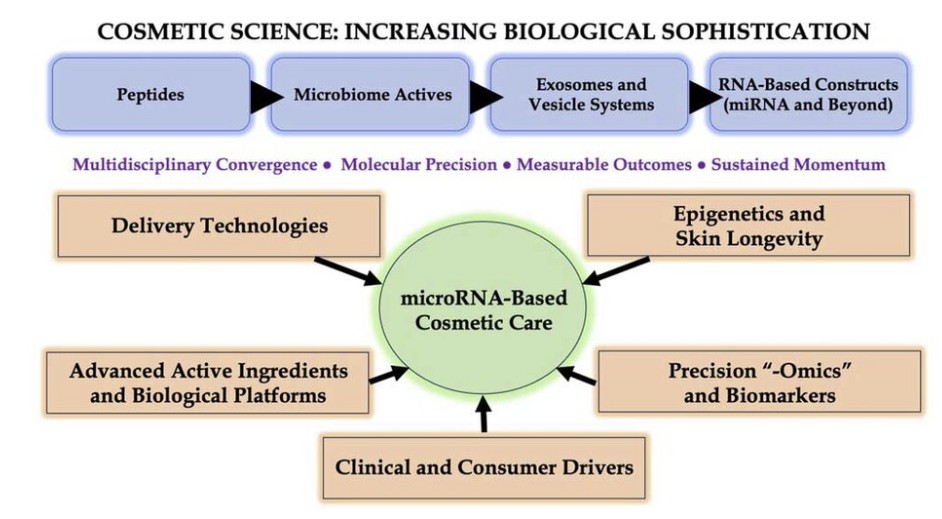
According to Mintel reports, there are multiple companies in the cosmetic care industry that have begun to explore this technology. Among the emerging directions attracting attention within cosmetic innovation, targeted miRNA modulation has been identified by Mintel as an area of growing interest. This form of miRNA-based cosmetic care is situated at the intersection of several rapidly advancing scientific fields. It is not an isolated innovation, but rather the product of multiple technologies maturing simultaneously; including, but certainly not limited to epigenetics and skin longevity, delivery technologies, precision “-omics”, advanced active ingredients, and clinical/consumer drivers (Figure 1). The convergence of these disciplines is moving the industry from conventional topical care to precision molecular cosmetics.
Conclusions
In summary, the emerging roles of miRNAs and siRNAs in topical skin care solutions represent a powerful paradigm shift in the cosmetic care industry. Rather than introduce chemical cocktails to contribute to skin health, epigenetic messages can be sent to remind skin cells that they are exquisitely capable of maintaining healthy tissue by their own means.
Indeed, these new active ingredients shift skin care toward molecular precision, where new strategies to improve and support skin health can be unlocked. From reducing inflammation to fine-tuning cellular repairs, the possibilities being opened by this new approach portend an exciting future of more targeted, effective, and personalized active ingredients.
References and notes
- Fine, J.L. and A.M. Moses, An RNA Condensate Model for the Origin of Life. J Mol Biol, 2025. 437(12): p. 169124. https://www.sciencedirect.com/science/article/pii/S0022283625001901?via%3Dihub
- Elbashir, S.M., et al., Duplexes of 21-nucleotide RNAs mediate RNA interference in cultured mammalian cells. Nature, 2001. 411(6836): p. 494-8. Duplexes of 21-nucleotide RNAs mediate RNA interference in cultured mammalian cells
- Elbashir, S.M., W. Lendeckel, and T. Tuschl, RNA interference is mediated by 21- and 22-nucleotide RNAs. Genes Dev, 2001. 15(2): p. 188-200. https://genesdev.cshlp.org/content/15/2/188
- Meister, G. and T. Tuschl, Mechanisms of gene silencing by double-stranded RNA. Nature, 2004. 431(7006): p. 343-9. Mechanisms of gene silencing by double-stranded RNA
- Carthew, R.W. and E.J. Sontheimer, Origins and Mechanisms of miRNAs and siRNAs. Cell, 2009. 136(4): p. 642-55. https://linkinghub.elsevier.com/retrieve/pii/S009286740900083X
- Lam, J.K., et al., siRNA Versus miRNA as Therapeutics for Gene Silencing. Mol Ther Nucleic Acids, 2015. 4(9): p. e252. siRNA Versus miRNA as Therapeutics for Gene Silencing – PubMed
- Bader, A.G., D. Brown, and M. Winkler, The promise of microRNA replacement therapy. Cancer Res, 2010. 70(18): p. 7027-30. https://aacrjournals.org/cancerres/article/70/18/7027/559655/The-Promise-of-MicroRNA-Replacement
- Krutzfeldt, J., et al., Silencing of microRNAs in vivo with ‘antagomirs’. Nature, 2005. 438(7068): p. 685-9. Silencing of microRNAs in vivo with ‘antagomirs’
- Rambow, F., et al., miR-330-5p targets tyrosinase and induces depigmentation. J Invest Dermatol, 2014. 134(11): p. 2846-2849. https://linkinghub.elsevier.com/retrieve/pii/S0022202X15365453
- Gallant-Behm, C.L., et al., A MicroRNA-29 Mimic (Remlarsen) Represses Extracellular Matrix Expression and Fibroplasia in the Skin. J Invest Dermatol, 2019. 139(5): p. 1073-1081. https://linkinghub.elsevier.com/retrieve/pii/S0022202X18328306
- Chevalier, F.P., et al., MiR-30a-5p Alters Epidermal Terminal Differentiation during Aging by Regulating BNIP3L/NIX-Dependent Mitophagy. Cells, 2022. 11(5). MiR-30a-5p Alters Epidermal Terminal Differentiation during Aging by Regulating BNIP3L/NIX-Dependent…
- Rebane, A., et al., MicroRNA-146a alleviates chronic skin inflammation in atopic dermatitis through suppression of innate immune responses in keratinocytes. J Allergy Clin Immunol, 2014. 134(4): p. 836-847 e11. https://linkinghub.elsevier.com/retrieve/pii/S0091674914007350
- Wu, D., et al., Mir-434-5p mediates skin whitening and lightening. Clin Cosmet Investig Dermatol, 2008. 1: p. 19-35. https://pmc.ncbi.nlm.nih.gov/articles/PMC3048595/

The Future of Beauty: Biotechnology and the Path to Commercial Viabili...

A Plant-Derived Oleosome-Stabilised Fibroblast Growth Factor-2 for the...

Modernising natural cosmetics while staying true to their core values

Bringing Waterless Innovations to Market Through Scientific Evidence

From Trend to Foundation: How Microbiome Is Redefining Beauty

A new era of skin health: the convergence of hygiene and protective be...

PEER REVIEWED – Mimicking Bioelectrical Stimulation: Enhancing I...

Beyond personalization: the emergence of Precision Skincare