DANILA FALANGA 1, RITAMARIA DI LORENZO 2, ANNALISA TITO* 1, MAURA ANGELILLO3, SONIA LANERI* 2
*Corresponding authors
1. Arterra Bioscience SpA, Naples, Italy
2. Department of Pharmacy, University of Naples Federico II, Naples, Italy
3. Vitalab Srl, Naples, Italy
INTRODUCTION
The process of aging is a multifaceted phenomenon that encompasses a myriad of physiological, psychological, and biochemical changes, which occur in living organisms over time [1]. Despite significant advancements in medical science, the complexities of aging remain a formidable challenge, necessitating a comprehensive approach to mitigate its effects. Traditional Chinese Medicine (TCM) offers a holistic framework that views aging as a natural process influenced by the balance and harmony of bodily systems [2]. In recent years, there has been growing interest in leveraging the principles of TCM and the therapeutic potential of natural bioactive molecules to address age-related disorders and promote healthy aging. Fungi have gained significance in TCM due to their potent therapeutic properties, notably as adaptogens [3]. Adaptogens aid the body in resisting stressors like pollution and disease, maintaining homeostasis without harming normal functions, and improving performance by promoting balance and resilience without notable side effects. Plant-originated adaptogens reduce harm from stress, provide positive excitatory effects without causing insomnia, and do not damage the human body [4–6].
Cordyceps sinensis, a type of ascomycete parasitic fungus belonging to the family Clavicipitaceae [7], is highly esteemed in traditional Chinese medicine (TCM) for its adaptogenic qualities. Previous studies have shown that it can enhance mitochondrial function [8], energy metabolism, and oxygen utilization in cells [9], potentially contributing to its anti-aging effects [10]. It contains bioactive compounds like polysaccharides, cordycepin, and adenosine, which are responsible for its pharmacological activity [11,8,10,12]. While traditionally used in TCM for various health purposes, research on its effects on human skin aging is limited, primarily linked to its photoprotection against UV rays [13,14].
This study explores the potential of natural bioactive molecules, integrating TCM wisdom with modern science, focusing on age-related disorders. Specifically, an extract from Cordyceps sinensis mycelium (CsEx), prepared under the guidance of Traditional Chinese Medicine experts at the University of Florence, was investigated for its activity on age-related markers using in vitro assays. As reported in Di Lorenzo 2024 [15], recent research has explored how various substances can influence key markers of longevity, such as SirT1, SirT3, and SirT6, known as sirtuins, which are crucial for regulating cellular processes that directly impact lifespan across various organisms [16]. Studies have analyzed the effects of these substances on ATP production, vital for cellular energy, and on Pro-Collagen I, essential for maintaining skin integrity and hydration [15].
Sirtuins are central to cellular health and protect against age-related damage through their anti-inflammatory and antioxidant properties, contributing to overall health and the cells’ ability to withstand environmental stress [16]. Additionally, adenosine triphosphate (ATP) is a crucial cellular energy currency, supporting all fundamental biological functions, reflecting an efficient energy metabolism crucial for healthy longevity. Pro-collagen I, essential for preserving skin youthfulness and elasticity, plays a vital role in structural support of the skin and protection against visible signs of aging. These markers not only highlight crucial aspects of cellular health and aging processes but also underscore the importance of further studies to better understand effective interventions in promoting healthy longevity and mitigating signs of aging [15,16].
In this study, we underline the effect of a Cordyceps sinensis mycelium hydroethanolic extract (CsEx) on skin energy by in vitro and clinical studies. A double-blind, placebo-controlled clinical trial involving 40 subjects with various skin aging-related disorders, such as a lack of firmness and laxity, wrinkles, and tired-looking and dull skin. These subjects were treated for 28 days with a topical formulation containing the CsEx, following the verification of its skin tolerability through an occlusive patch test. This comprehensive approach aims to elucidate the molecular mechanisms underlying the adaptogenic properties of the CsEx and assess its efficacy in alleviating common signs of skin aging by acting through energy boosting.
MATERIALS AND METHODS
Cordyceps sinensis extract
A hydroethanolic extract from mycelium of C. sinensis was prepared as reported in Di Lorenzo 2024 [15].
Cell line
HaCaT (Human keratinocytes) and HDFs (Human dermal fibroblasts) cells were cultured in Dulbecco’s modified Eagle’s medium (DMEM) supplemented with 10% foetal bovine serum (FBS), at 37°C in a 5% CO2 atmosphere.
In-vitro assays
Sirtuin Expression Assay
For basal gene expression analysis, HaCaT cells were treated with the extract (0.0006% w/v) or resveratrol (0.002% w/v) for 6 hours. Total RNA was extracted using the PureLink RNA Mini Kit (Invitrogen-Thermo Scientific). Semi-quantitative RT-PCR analyses were performed using 18S primer/competimer (Invitrogen-Thermo Scientific) as internal standards.
NAD/NADH Ratio Assay
The NAD/NADH ratio was quantified in HaCaT incubated with the extract using the NAD/NADH quantitation kit (Merck KGaA), following the manufacturer’s instructions. Absorbance values were recorded using the Victor Nivo instrument (Perkin Elmer).
ATP Production Assay
The quantity of ATP in HaCaT incubated with the extract was determined using the CellTiter-Glo Reagent (Promega Corporation). The luminescent signal of the samples was then measured using the Victor Nivo instrument (Perkin Elmer) after 15 minutes.
Cytosolic ROS Assay
The quantity of reactive oxygen species (ROS) was measured in HaCaT incubated with the extract or ascorbate, used as positive control, for 2 h. At the end, the cells were washed in PBS and incubated with the dye CM-DCFDA (5-(e-6)-clorometil-2,7-dichloro dihydrofluorescein diacetate, Invitrogen). The fluorescence of the samples was then measured at 535 nm (excitation 490 nm), using the instrument Victor Nivo (PerkinElmer).
Collagen Production Assay
Pro-Collagen I measured in HDF by ELISA using specific primary antibody, followed by secondary HRP-labelled antibodies. The proteins were measured by a colorimetric reaction according to the manufacturer’s protocol (p-Phenylendiamine). The absorbance at 490nm was measured by a multiplate reader Nivo (Perkin Elmer). The absorbance values were normalized to cell density determined by crystal violet staining.
All data were assessed using the Student’s t-test, which provides a probability denoted as “p” for determining the significance of differences between the average of three independent experiments in triplicate. The significance level for this study was established as follows: if p < 0.1 (#), this indicated a 90% probability of the two batches being significantly different; if p is 0.05 (*), this indicated a 95% probability of significant difference; and if p < 0.001 (**), this indicated a 99% probability of significant difference.
Clinical Study
A double-blind clinical study enrolled forty subjects aged 40 to 65 years (included), with Fitzpatrick skin types I–III and a dull face marked by aging with wrinkles and fine expression lines, were included in this study. Only generally healthy subjects were enrolled and randomly assigned to the two treatment groups. One group received treatment with an O/W emulsion containing 0.0006% w/v of CsEx, while the other received a placebo formulation. The emulsions were applied to the face twice daily for four consecutive weeks. Data were collected regarding four parameters: skin energy, collagen production, reduction in roughness, and CsEx tolerability. Instrumental assessments were conducted before product use (baseline) and after specified intervals (Day 7, Day 14, and Day 28). Tewameter® TM Hex (C+K electronic GmbH) was utilized to analyze skin energy. Ultrasonography (DermaScan® C, Cortex Tech.) and VISIA 7th (Canfield Scientific Inc.) were employed to evaluate collagen production and roughness reduction. For CsEx tolerability assessment, its potential irritant properties were evaluated using a 48-hour occlusive patch test on intact human skin, specifically on the volar forearm due to its suitability for such testing. This test aimed to identify and classify CsEx’s irritant potential following EEC Directive 76/768 guidelines [17]. Finn Chambers® AQUA patch delivery system was used, adhering to established procedures [18]. Results were assessed based on morphological criteria recommended by the International Contact Dermatitis Research Group [19], with an irritancy limit set at 1.5 on a 0–3 scale for visual scoring. The tests adhered to the principles of the Helsinki Declaration [20] and the Colipa Guidelines [21]. Good clinical practice was maintained throughout the study period.
Statistical Analysis in Clinical Trial
A sample size of 40 panelists, randomly assigned (approximately 20 subjects per group), was considered sufficient to achieve adequate statistical power for detecting differences between the CsEx cream and placebo. Inter-group differences for both primary and secondary endpoints were assessed using the ANOVA test, while intra-group differences, expressed as average percentage variations compared to baseline, were analyzed using the student t-test. The significance level for all analyses was set at a two-sided p-value of 0.05.
RESULTS AND DISCUSSION
Effect of CsEx on NAD/NADH ratio and ATP Production In Vitro and Boosting Skin Energy In Vivo
Mitochondria are essential powerhouses of the cell, playing a crucial role in cellular metabolism by generating adenosine triphosphate (ATP), the primary energy currency for various cellular processes [22]. To evaluate the impact of CsEx on ATP production, we treated keratinocytes with CsEx and observed remarkable results. Figure 1a illustrates that CsEx stimulated ATP production by approximately 68% at a concentration of 0.0006% w/v and by 25% at 0.002% w/v. These results were comparable to the efficiency seen with resveratrol. We further investigated the impact of CsEx on the induction of NAD by measuring the NAD/NADH ratio in HaCaT cells treated with CsEx and using resveratrol as a positive control. As shown in Figure 1a, CsEx increased the NAD/NADH ratio by 20%, whereas resveratrol achieved an increase of more than 50%.
The study also focused on cellular respiration in skin cells, which involves the release of heat, a crucial parameter reflecting the local energy balance directly linked to cellular respiration and ATP production [23]. Using the Tewameter TM Hex, we quantified the heat loss in volunteers treated with CsEx. Skin energy was recorded during the clinical trial after 7, 14, and 28 days of treatment with a topical cosmetic formulation containing 0.0006% w/v CsEx. Figure 1b demonstrates a significant increase in skin energy over the treatment period with CsEx, showing a 17% increase at Day 7, 25.5% at Day 14, and an impressive 52.0% by Day 28. The placebo, on the other hand, showed no significant effect on skin energy.
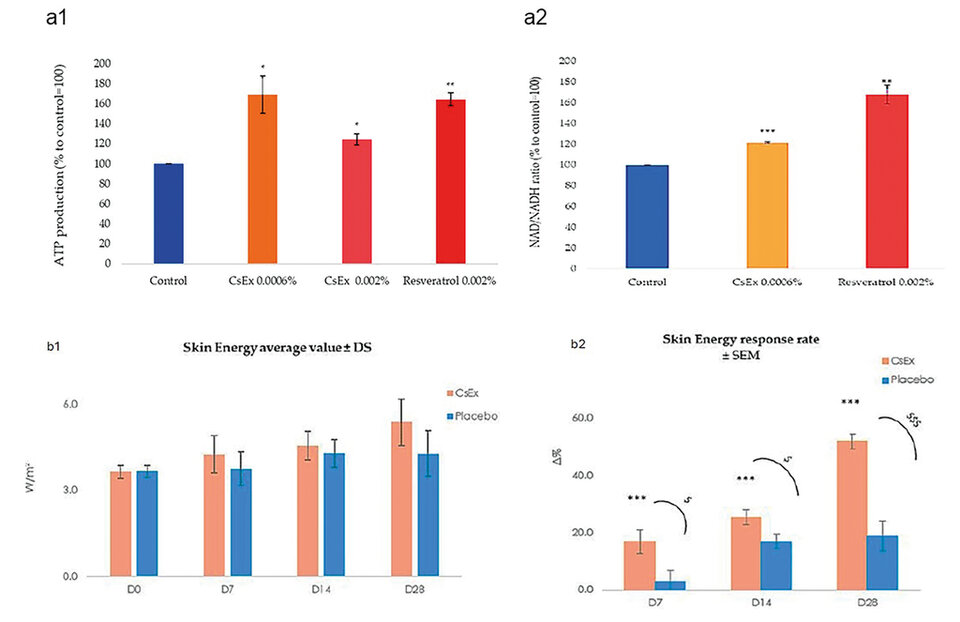
Figure 1. (a1) Effect of the C. sinensis extract (CsEx) on ATP production in keratinocytes. (a2) Effect of the C. sinensis extract (CsEx) on NAD/NADH ratio in keratinocytes. The keratinocytes were stimulated with 0.0006% w/v and 0.002% w/v of CsEx for 24 h and then induced to lysis. The reported values represent the averages of three independent experiments; the control was set to 100%. The bars represent the standard deviations, and the asterisks indicate the p-value according to Student’s t test (* p < 0.05, ** p < 0.01). (b) Effect of the C. sinensis extract (CsEx) on skin energy boosting in treated volunteers vs. placebo. (b1) Skin energy average value ± SD; (b2) Skin energy average percentage variation vs. D0. The asterisks indicate statistically significant values vs. D0 (*** p-value was between 0.0001 and 0.001). The $ indicates statistically significant values vs. placebo ($ p < 0.05, $$$ p < 0.001).
Effect of CsEx on Collagen Production
The ability of CsEx to induce collagen production was analyzed by measuring newly synthesized collagen type I in human dermal fibroblasts (HDFs) treated with CsEx or TGFβ as the positive control. As shown in Figure 2a, CsEx at both concentrations significantly stimulated Pro-Collagen I production, like TGFβ, indicating a positive role of the extract in maintaining dermal tone.
To confirm these promising in vitro results, we examined the ability of formulated CsEx to increase collagen production in subjects. Collagen levels were assessed using ultrasound detection at various follow-ups. Figure 2b shows that CsEx significantly induced collagen production after 14 and 28 days by 10.5% and 10.0% respectively, compared to the placebo which showed no effect on collagen production. Echographic images in Figure 2 demonstrate that CsEx densified the skin by increasing collagen amount and improving dermal bundles
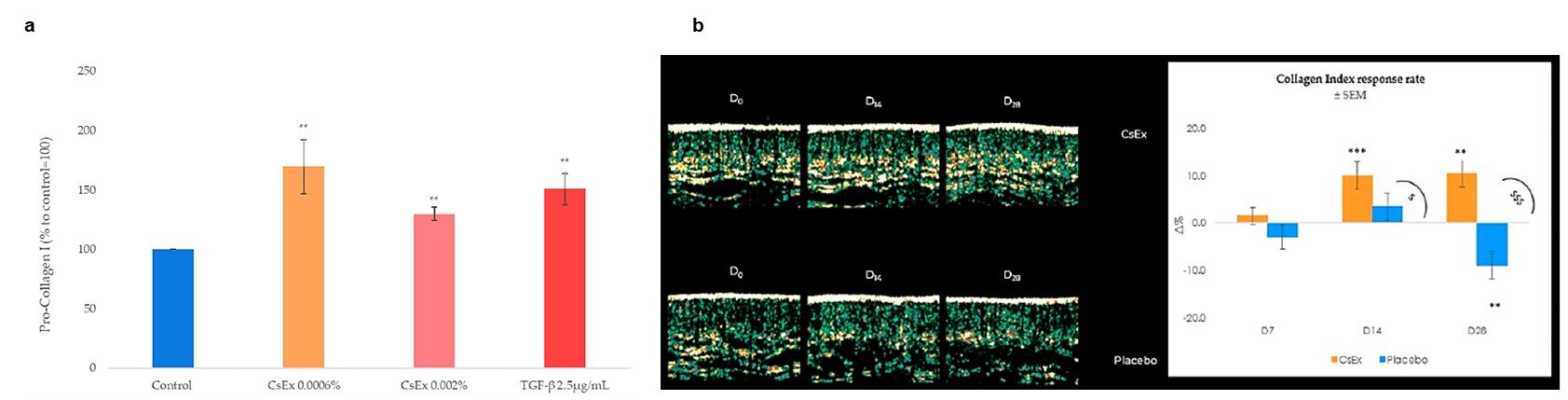
Figure 2. (a) Effect of the C. sinensis extract (CsEx) on Pro-Collagen I production in skin fibroblasts. The cells were stimulated with 0.0006% and 0.002% CsEx for 24 h. The reported values represent the averages of three independent experiments. The asterisks indicate statistically significant values (** p-value was between 0.001 and 0.01). (b) Effect of the C. sinensis extract (CsEx) on collagen production during 28-day topical application. Collagen index average percentage variation vs. D0 recorded for 20 volunteers throughout the study period (after 7, 14, and 28 days of treatment) for CsEx and placebo, intra-group difference t-test ** p < 0.01, *** p < 0.001), and inter-group difference ANOVA test $ p < 0.05, $$$ p < 0.001). The echo-graphic images were obtained with a 20 MHz HFUS ultrasound probe (DermaScan® C, Cortex Technology Aps), after placing it on test subjects’ faces.
Effect of CsEx on Wrinkle Appearance Reduction
Aging alters both the structure and mechanical properties of the skin, leading to the development of wrinkles [24]. Microscopically, the fine mesh of the skin surface deteriorates, and each wrinkle becomes more prominent as its width and height increase with age [24]. The stimulating action of CsEx on fibroblasts, combined with its antioxidant and energizing properties, plays a pivotal role in mitigating the phenotypic manifestations of skin aging, such as wrinkles and fine lines. Our study demonstrated that CsEx treatment significantly reduced the appearance of facial wrinkles. Specifically, T-zone wrinkles (forehead and frown lines) were measured using a VISIA 7th (Canfield Scientific Inc), showing a statistically significant decrease over time by −12.5%, −19.0%, and −28.0% at Day 7, Day 14, and Day 28 respectively, compared to baseline (Figure 3). In contrast, the placebo-treated group showed no significant improvement. These results validate the effectiveness of CsEx in treating common signs of skin aging.
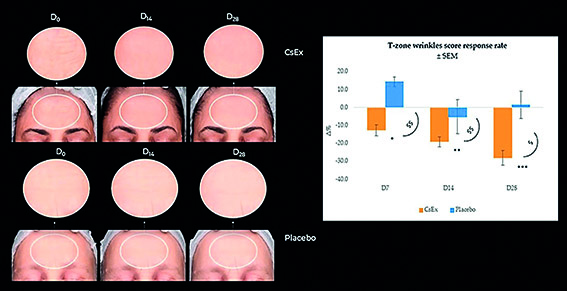
Figure 3. Effect of the C. sinensis extract (CsEx) on collagen production during 28 day topical application. Collagen index average percentage variation vs. D0 recorded for 20 volunteers throughout the study period (after 7, 14, and 28 days of treatment) for CsEx and placebo, intra-group difference t-test * p < 0.05, ** p < 0.01, *** p < 0.001), and inter-group difference ANOVA test $ p < 0.05, $$ p < 0.01). The images of forehead wrinkles over a 28-day treatment with 6 mg/L CsEx vs. placebo were obtained with a Visia 7th (Canfield Scientific Inc).
The study on CsEx treatment has shown promising results but presents several significant limitations that need to be addressed to improve future research quality and relevance. These limitations include a small and non-diverse sample size and a brief 28-day study duration, which may not adequately capture long-term effects or side effects.
Future research could focus on further elucidating the mechanism of action of CsEx, identifying additional molecular targets, optimizing efficacy, and extending the duration of clinical studies. Prioritizing larger, more diverse participant samples across different demographics and extending study durations are crucial for more comprehensive assessments. Comparative studies with established treatments would provide clearer insights into the effectiveness of CsEx.
CONCLUSION
In conclusion, this study highlights the promising anti-aging properties of a Cordyceps sinensis mycelium extract (CsEx). Significant increases in sirtuin expression, NAD+ synthesis, ATP production, ROS scavenging, and collagen synthesis were observed following CsEx treatment, indicating its exciting potential to enhance skin longevity through natural adaptogen sources. This suggests that CsEx could be a valuable addition to skincare regimens, leveraging the body’s natural defenses and repair mechanisms to promote healthier, more resilient skin over time. The study has several limitations, such as a small and non-diverse sample size, a short duration. Future research could focus on further elucidating CsEx’s mechanism of action, identifying additional molecular targets, optimizing efficacy, and extending the duration of clinical trials involving larger and more diverse populations to address the limitations encountered in the present study.
References and notes
- Guo, J.; Huang, X.; Dou, L.; Yan, M.; Shen, T.; Tang, W.; Li, J. Aging and Aging-Related Diseases: From Molecular Mechanisms to Interventions and Treatments. Signal Transduct. Target. Ther. 2022, 7, 391. https://doi.org/10.1038/s41392-022-01251-0
- Cong, W.; Chen, K. Traditional Chinese Medicine and Aging: Integration and Collaboration Promotes Healthy Aging. Aging Med. 2019, 2, 139–141. https://doi.org/10.1002%2Fagm2.12077
- Chugh, R.M.; Mittal, P.; Mp, N.; Arora, T.; Bhattacharya, T.; Chopra, H.; Cavalu, S.; Gautam, R.K. Fungal Mushrooms: A Natural Compound with Therapeutic Applications. Front. Pharmacol. 2022, 12, 925387. https://doi.org/10.3389/fphar.2022.925387
- Liao, L.Y.; He, Y.F.; Li, L.;Meng, H.; Dong, Y.M.; Yi, F.; Xiao, P.G. A Preliminary Review of Studies on Adaptogens: Comparison of Their Bioactivity in TCMwith That of Ginseng-like Herbs Used Worldwide Milen Georgiev, RuibingWang. Chin. Med. 2018, 13, 57. https://www.ncbi.nlm.nih.gov/pmc/articles/PMC7601865/
- Amir, M.; Vohra, M.; Raj, R.G.; Osoro, I.; Sharma, A. Adaptogenic Herbs: A Natural Way to Improve Athletic Performance. Health Sci. Rev. 2023, 7, 100092. http://dx.doi.org/10.1016/j.hsr.2023.100092
- Maisto, M.; Annunziata, G.; Schiano, E.; Piccolo, V.; Iannuzzo, F.; Santangelo, R.; Ciampaglia, R.; Tenore, G.C.; Novellino, E.; Grieco, P. Potential Functional Snacks: Date Fruit Bars Supplemented by Different Species of Lactobacillus spp. Foods 2021, 10, 1760. https://doi.org/10.3390%2Ffoods10081760
- Olatunji, O.J.; Tang, J.; Tola, A.; Auberon, F.; Oluwaniyi, O.; Ouyang, Z. The Genus Cordyceps: An Extensive Review of ItsTraditional Uses, Phytochemistry and Pharmacology. Fitoterapia 2018. https://doi.org/10.1016/j.fitote.2018.05.010
- Bai, X.; Tan, T.Y.; Li, Y.X.; Li, Y.; Chen, Y.F.; Ma, R.; Wang, S.Y.; Li, Q.; Liu, Z.Q. The Protective Effect of Cordyceps Sinensis Extract on Cerebral Ischemic Injury via Modulating the Mitochondrial Respiratory Chain and Inhibiting the Mitochondrial Apoptotic Pathway. Biomed. Pharmacother. 2020, 124, 109834. https://doi.org/10.1016/j.biopha.2020.109834
- Cao, C.; Yang, S.; Zhou, Z. The Potential Application of Cordyceps in Metabolic-Related Disorders. Phytother. Res. 2020, 34, 295–305. https://doi.org/10.1002/ptr.6536
- Ji, D.-B.; Ye, J.; Li, C.-L.;Wang, Y.-H.; Zhao, J.; Cai, S.-Q. Antiaging Effect of Cordyceps Sinensis Extract. Phytother. Res. 2009, 23,116–122. https://doi.org/10.1002/ptr.2576
- Olatunji, O.J.; Tang, J.; Tola, A.; Auberon, F.; Oluwaniyi, O.; Ouyang, Z. The Genus Cordyceps: An Extensive Review of Its Traditional Uses, Phytochemistry and Pharmacology. Fitoterapia 2018, 129, 293–316. https://doi.org/10.1016/j.fitote.2018.05.010
- Ashraf, S.A.; Elkhalifa, A.E.O.; Siddiqui, A.J.; Patel, M.; Awadelkareem, A.M.; Snoussi, M.; Ashraf, M.S.; Adnan, M.; Hadi, S. Cordycepin for Health and Wellbeing: A Potent Bioactive Metabolite of an Entomopathogenic Medicinal Fungus Cordyceps with Its Nutraceutical and Therapeutic Potential. Molecules 2020, 25, 2735. https://doi.org/10.3390%2Fmolecules25122735
- Prommaban, A.; Sriyab, S.; Marsup, P.; Neimkhum,W.; Sirithunyalug, J.; Anuchapreeda, S.; To-anun, C.; Chaiyana,W. Comparison of Chemical Profiles, Antioxidation, Inhibition of Skin Extracellular Matrix Degradation, and Anti-Tyrosinase Activity between Mycelium and Fruiting Body of Cordyceps Militaris and Isaria Tenuipes. Pharm. Biol. 2022, 60, 225–234. https://doi.org/10.1080/13880209.2021.2025255
- Wong, W.C.; Wu, J.Y.; Benzie, I.F.F. Photoprotective Potential of Cordyceps Polysaccharides against Ultraviolet B Radiationinduced DNA Damage to Human Skin Cells. Br. J. Dermatol. 2011, 164, 980–986. https://doi.org/10.1111/j.1365-2133.2010.10201.x
- Di Lorenzo R, Falanga D, Ricci L, Colantuono A, Greco G, Angelillo M, Nugnes F, Di Serio T, Costa D, Tito A, Laneri S. NAD-Driven Sirtuin Activation by Cordyceps sinensis Extract: Exploring the Adaptogenic Potential to Promote Skin Longevity. Int J Mol Sci. 2024 Apr 12;25(8):4282. https://www.mdpi.com/1422-0067/25/8/4282
- Zi˛etara, P ; Dziewi˛ecka, M; Augustyniak, M. Why Is Longevity Still a Scientific Mystery? Sirtuins Past, Present and Future. Int.J. Mol. Sci. 2023, 24, 728. https://doi.org/10.3390/ijms24010728
- https://cosmeticseurope.eu/download/RnY2VHo4N1l1UDNFVEF0a2s5OXRvQT09
- Di Lorenzo, R ; Maisto, M.; Ricci, L.; Piccolo, V.; Marzocchi, A.; Greco, G.; Tenore, G.C.; Laneri, S. Annurca Apple Oleolite as Functional Ingredient for the Formulation of Cosmetics with Skin-Antiaging Activity. Int. J. Mol. Sci. 2024, 25, 1677. https://doi.org/10.3390/ijms25031677
- Lazzarini, R.; Duarte, I.; Ferreira, A.L. Testes de Contato. An. Bras. Dermatol. 2013, 88, 879–888. https://doi.org/10.1590/abd1806-4841.20132323
- https://www.evidence.it/articoli/pdf/e1000059.pdf
- https://www.cosmeticseurope.eu/files/4214/6407/6830/Guidelines_for_the_Evaluation_of_the_Efficacy_of_Cosmetic_Products_-_2008.pdf
- Sreedhar, A.; Aguilera-Aguirre, L.; Singh, K.K. Mitochondria in Skin Health, Aging, and Disease. Cell Death Dis. 2020, 11, 444. https://doi.org/10.1038/s41419-020-2649-z
- Busbridge, N.J.; Rothwell, N.J. Thermogenic Effects of Cytokines: Methods and Mechanisms. Methods Neurosci. 1993, 17, 96–110. https://doi.org/10.1016/S1043-9471(13)70011-9
- Matsumoto, T.; Ikuta, N.; Mori, M.; Nagayama, K. Mechanics of Wrinkle Formation: Micromechanical Analysis of Skin Deformation during Wrinkle Formation in Ultraviolet-Irradiated Mice. Ski. Res. Technol. 2010, 16, 179–189. https://doi.org/10.1111/j.1600-0846.2009.00419.x
The shifting landscape of cosmetic claims in 2024: Key themes, challen...

Our journey to sustainable beauty

Hair skinification: an innovative perspective in scalp care

THE WORLD OF FRAGRANCES: Types, Impact, and Durability Evaluation

Biodiversity and the nature-positive economy: A fragrance industry cha...

The beneficial use of co-products in cosmetics, an upcycling approach

Common Ingredients, Impressive Synergy: Enhancing Rapid Kill with Sodi...

Sun protection: Cosmed clarifies the challenges ahead