The product we have chosen to start with our column is honey infused scalp treatment by gisou, a brand that formulates with plant-derived ingredients and honey & propolis sustainably sourced from their bee-friendly garden.
According to the brand’s description, this is a “lightweight, fast-absorbing, intensive leave-on scalp serum that nourishes, balances and protects the scalp resulting in healthier-looking and shinier hair and scalp”.
Though this product was launched a couple of years ago, it still is relevant nowadays as belonging to the category of scalp treatments, currently even more popular due to the skinification trend, which will likely last for the foreseeable future.
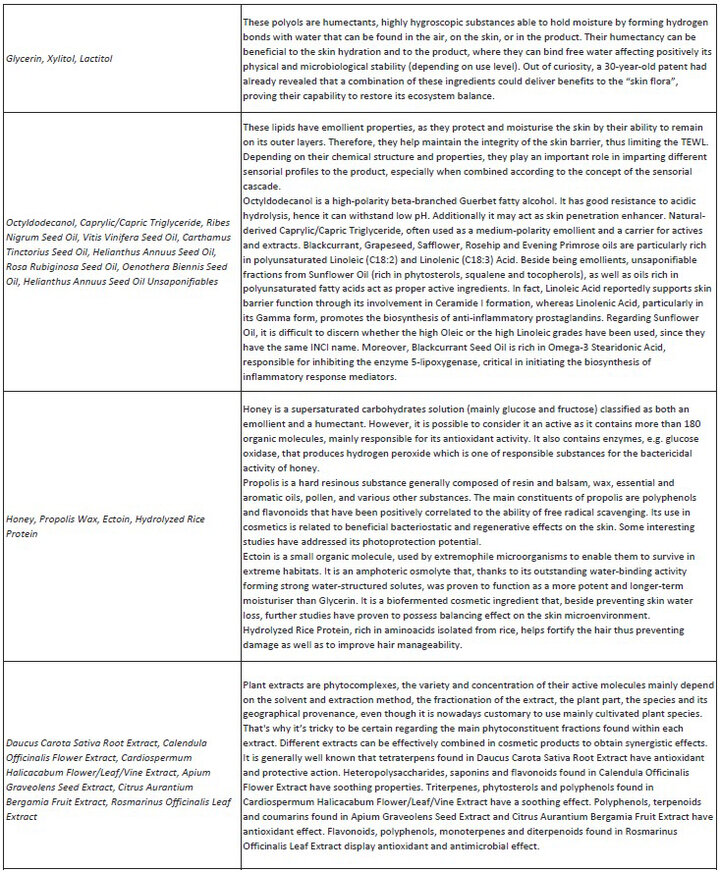
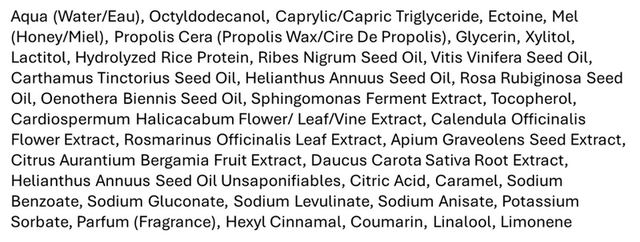
The ingredients featured in this formula have been conveniently grouped and described in the table below focussing on their main cosmetic functions.
The catchy side of the formula
By the INCI reading and the product skin feel, the formula would appear to feature 4-8% of lipids within a hydrophilic phase, no emulsifying systems, and then Sphingomonas Ferment Extract.
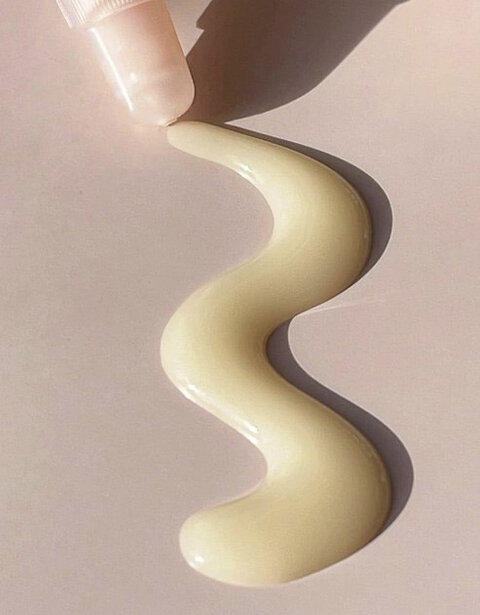
It is a milky, pale-yellow, non-sticky serum characterised by a rather low viscosity and a pH of approximately 4.8-5.0.
Upon testing the product in our lab for over a year, we haven’t seen any stability issues, which was not that obvious. Even when subjected to microscopy analysis, the product structure looked homogeneous.
Having analysed the rheological behaviour of Sphingomonas Ferment Extract in oscillatory regime a while back, we observed that the elastic modulus (G’) is greater than the loss modulus (G’’) across the range of angular frequencies swept. This indicates that the intra- and intermolecular interactions generated within the biopolymer are strong enough to form a tight and rigid structure, and when emulsifying the fatty phase into the water phase, the small droplets formed will position themselves within such polymer lattice, as if they got stuck in the tiny meshes of a net.
The above has made it clear that Sphingomonas Ferment Extract plays the soloist role in forming an O/W emulsion, even without emulsifiers.
Such behaviour, if sought among other biopolymers, is exerted by certain grades of Sclerotium Gum, whereas among chemically-modified polymers, by some acrylates which instead can rely on covalent cross-linking and, often, effective hydrophobic side chains showing intense interactions with lipophilic phases.
However, back to the product, as it’s difficult to state whether Sphingomonas Ferment Extract by itself would be capable of emulsifying any fatty phase and amount (no data publicly available), it’s pretty evident that with this formula they must have gotten the right mix.
Additionally, an in-depth Mintel analysis conducted worldwide from May 2014 to date, has revealed the absence of other products developed through such a formulation approach, despite containing Sphingomonas Ferment Extract.
Though we wonder, from a sustainability perspective, whether this formula could be fully cold-processable (notwithstanding the high-melting-point Propolis Wax), in our opinion, this is an all-natural and no-frill formula designed to be functioning in its entirety with no-nonsense ingredients, without compromising on sensory and texture.
In a nutshell, an interesting example of a formula conceived thinking out of the box and merging technical insights with creativity.
What AI doesn’t know…yet…is that formulating is “a kind of magic”.
H3i 2024: Detergents – navigating ecological transition, opportu...
Personalized skin care, an update
Amazonian Oils Blend calms sensitive skin while rebalancing skin micro...
Mind, body, beauty – decoding the holistic beauty revolution
The power of holistic beauty: the future of personal care
A Word With Beatrice Tassone (Senior Scientist Lab Head, dsm-firmenich...
How to formulate with active ingredients