Home » Insights » Towards an EU Harmonised Definition of Nanomaterials: Implications for the Cosmetics Sector

Towards an EU Harmonised Definition of Nanomaterials: Implications for the Cosmetics Sector

Introduction
Nanotechnology has become ubiquitous, underpinning advances in diverse sectors from aerospace to healthcare. Its unique properties, such as small particle size and high surface area, enable functionalities that are otherwise unattainable at the macroscale.Nanoscale titanium dioxide and zinc oxide are widely used in sunscreens as UV filters. At this scale, they block UV rays effectively while appearing transparent on the skin, avoiding the white residue of traditional sunscreens. Nanomaterials also enhance delivery of active ingredients, helping compounds like vitamins or antioxidants reach superficial skin layers more effectively, boosting the performance of creams and serums. Additionally, they improve product texture and finish. Silica nanoparticles, for example, scatter light to blur fine lines and imperfections, creating a smoother, more refined appearance in foundations and primers.However, their unique properties also raise important questions about safety and consumer protection. For this reason, the European Union’s Cosmetics Regulation includes specific provisions for nanomaterials (1), however the lack of a harmonised definition initially led to uncertainty and fragmented compliance requirements across Member States.In any case, the provisions in Regulation 1223/2009 aim to ensure that nanomaterials used in cosmetic products are both safe and transparently communicated to consumers.A harmonised definition is also important for global trade. For cosmetics companies operating internationally, alignment with ISO standards and European definitions helps ensure that products can be sold in multiple markets without facing differing nanomaterial classifications and regulatory barriers.For the cosmetics sector, the link between the definition of nanomaterials and regulation is both direct and critical. The definition determines whether manufacturers must notify authorities, label their products accordingly, and provide additional safety data. A misunderstanding of the definition can lead to regulatory non-compliance, product recalls, or barriers to market entry. Staying informed about evolving definitions and regulatory expectations is essential for ensuring product safety, protecting brand reputation, and maintaining access to the European and global markets.

Why Do We Need a Definition?
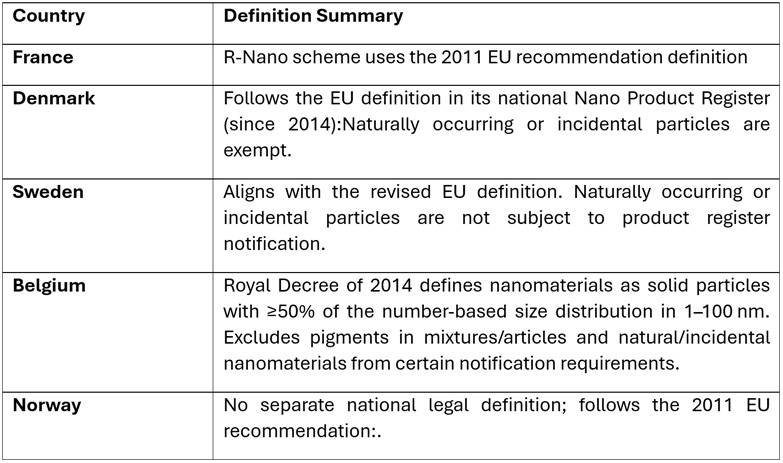
A nanomaterial definition serves as a regulatory gateway—triggering specific legal obligations if an ingredient qualifies. It is fundamental for consistent regulation and enforcement across EU policies. Without a harmonised framework, manufacturers face uncertainty, and regulators struggle to ensure safety and environmental protection.Historically, the European Commission’s (EC) recommendation has served as a horizontal framework, applicable across diverse sectors. Several Member States, including France (2), Denmark (3), Sweden (4), Belgium (5), and Norway (6), have already implemented national measures relying on this EC definition.It is important to note that the definition was never intended to distinguish hazardous from non-hazardous materials; rather, it focuses solely on size-based criteria to enable regulatory clarity.The Evolution of DefinitionsOver the years, various definitions have emerged globaly regarding nanomaterials (Figure 1):

  • EU Cosmetic Regulation 1223/2009 defines a nanomaterial as an insoluble or biopersistent, intentionally manufactured material with external dimensions or internal structures between 1 nm and 100 nm.
  • ISO/TS 80004-1:2010 defines nanomaterials as materials with any external dimension in the nanoscale, or having internal or surface structures in the nanoscale (1–100 nm). However, this definition focuses on particulate solid materials.
  • EC Recommendation 2011/696/EU, updated in 2022, defines a nanomaterial as a natural, incidental, or manufactured material consisting of solid particles where 50% or more of the particles (in number-based size distribution) have one or more external dimensions in the 1–100 nm range.
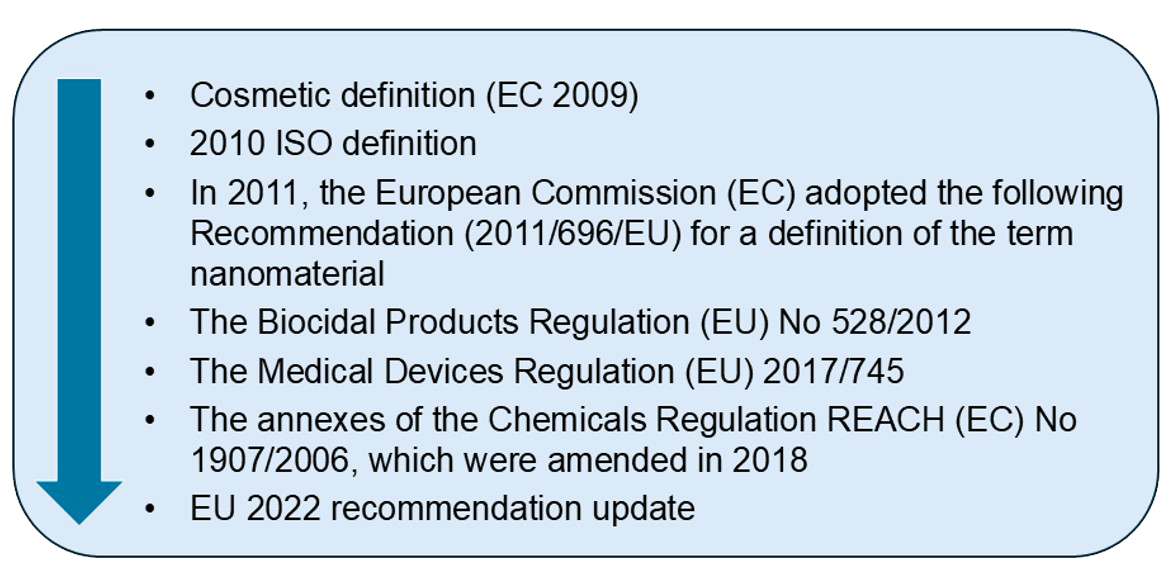
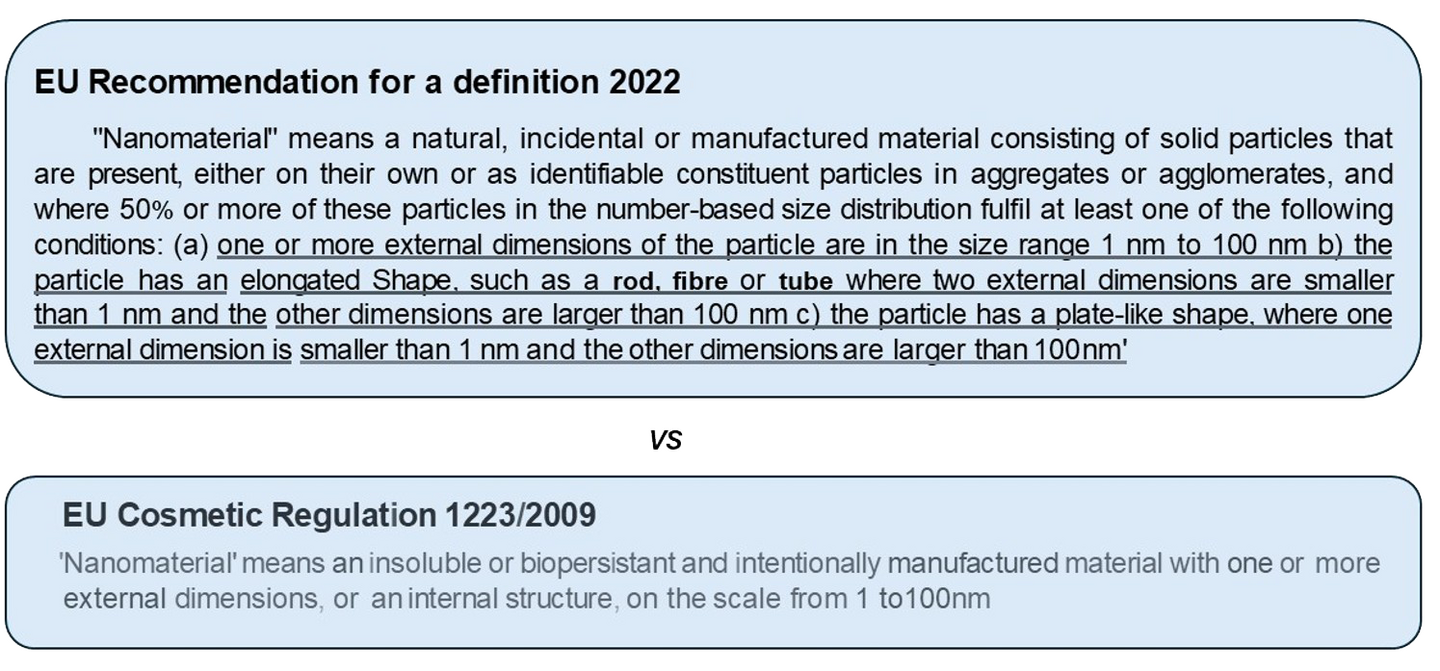
Figure 1. Definition of nanomaterial across different organisation and sectors.For the cosmetics sector, these distinctions are significant because only intentionally manufactured nanomaterials are regulated under EU Cosmetic Regulation 1223/2009, creating potential gaps for materials incidentally present or derived as by-products from other industries (Figure 2).
Figure 2. Differences among the EU recomendation for a definition of nanomaterials and the EU definition for nanomaterials in cosmetics.In the European Union, if a product contains a material which falls under the definition depicted in Figure 2, further provisions need to be provided regarding notifications, safety assessment and labelling.Besides the EU recommendation and the Cosmetic product definition, different EU countries have their own definitions (Table 1).
Table 1. Comparative overview of how selected European countries define ‘nanomaterial’ in national legislation or regulatory practice. While many definitions stem from the European Commission Recommendation (2011 or 2022), differences remain in interpretation and implementation.
Current regulatory landscape
The European Union’s Cosmetic Products Regulation (CPR) is currently undergoing a comprehensive evaluation what is called a “fitness check” of the CPR to assess whether the Regulation is still fit for purpose in the current European changing environment. Nanomaterials remain a significant area of attention in these ongoing updates.The revision is not emerging in a vacuum. Over the past few years, the legislative landscape has been increasingly shaped by initiatives such as the European Green Deal (7), the Chemicals Strategy for Sustainability (8), and broader political goals like decarbonisation and digital transformation.However, updating the definition alone is not sufficient. Industry stakeholders stress the need for a clear transition mechanism to manage positive lists of nanomaterials permitted in cosmetics. Without this, sudden regulatory shifts could disrupt the market, especially for existing products. A targeted amendment of the CPR would allow alignment with science and international standards while avoiding major disruptions for manufacturers and importer.The timeline for the revision starts with the results of the evaluation expected to be published by mid-2026, followed by an Inception Impact Assessment by the end of that year. A legislative proposal for revising the CPR is anticipated by the end of 2027, with the legislative procedure potentially concluding in 2028. This suggests that a revised CPR could be published in early 2029 (9).
Challenges in Characterising Nanomaterials
Characterising nanomaterials under the EU 2022 definition presents several technical challenges, especially regarding particle size, shape, and structure. Nanoparticles are often irregular, existing as single particles, aggregates, or agglomerates, raising questions about which dimensions to measure. The EU definition relies on direct physical measurements (e.g., Feret diameter, maximum inscribed circle) rather than indirect equivalents, which can misclassify irregular particles. For elongated or plate-like shapes, cross-sectional dimensions or thickness are key.Distinguishing between aggregates (strongly bound) and agglomerates (loosely held) is also critical, as constituent particle dimensions are generally preferred for classification—though sometimes only the aggregate can be measured. The JRC requires all identifiable particles to be counted in number-based size distributions, which better reflect the presence of nanoscale particles than mass-based methods.The definition applies only to solid particles, excluding liquids, gases, and single molecules. Additional complexity arises from nanomaterials’ nonlinear, fractal, and dynamic behavior, which challenges traditional models and leads to batch variability.In cosmetic matrices, nanomaterial detection is further complicated by emulsions, encapsulation, and matrix interference. Advanced imaging techniques like TEM are often required but remain labor-intensive. Overall, accurate classification demands robust, context-specific methods and ongoing scientific refinement.
Regulatory Implications for Cosmetics
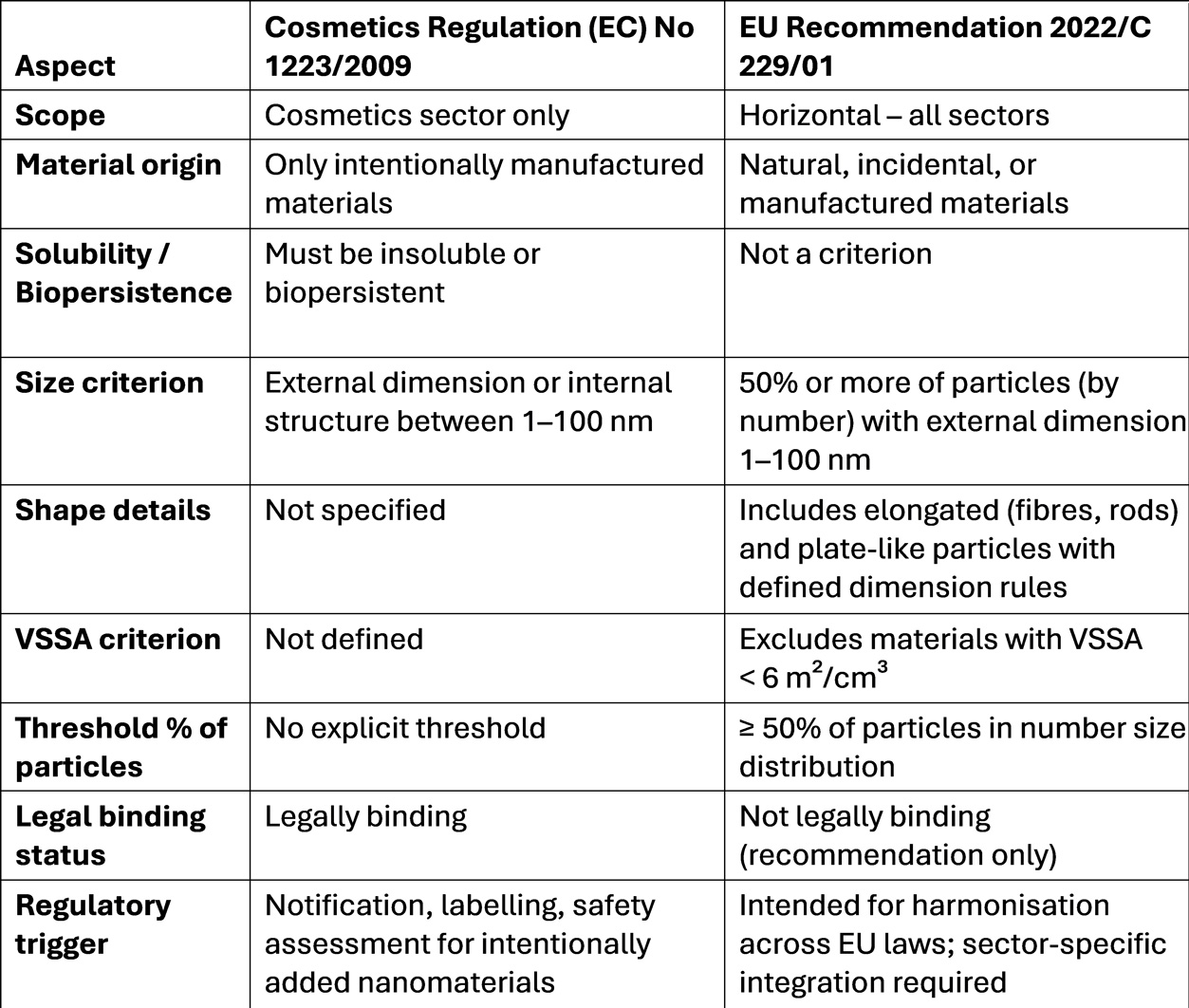
Under the European Union’s Cosmetics Regulation (EC) No 1223/2009, if an ingredient in a formulation is defined as a nanomaterial, the manufacturer must follow a series of obligations. Conversely, if the ingredient does not meet this definition, these requirements do not apply. This is why it is so important for companies to determine whether a substance truly qualifies as a nanomaterial under the regulation.Under EU Cosmetic Regulation 1223/2009, only intentionally produced nanomaterials are regulated, excluding incidental or natural particles. Consequently, materials such as cellulose derived from other industries might not be considered nanomaterials if they have not been deliberately engineered to nanoscale dimensions.In contrast, the broader EU 2022 update encompasses all naturally occurring, incidental, and intentionally produced nanomaterials, applying stricter criteria for classification and potentially widening the regulatory net.Despite these differences, a harmonised definition remains critical to enable safe innovation in cosmetic formulations while ensuring consistent regulatory compliance and consumer protection (Table 2).
Table 2. Comparison of Nanomaterial Definitions: Cosmetics Regulation vs EU Recommendation 2022.Changes discussed in Table 1 have profound implications for the classification of various cosmetic ingredients. In essence, materials currently regulated as nanomaterials under the CPR may no longer fall under this category if the revised definition is adopted, while conversely, other substances not previously considered nanomaterials may meet the criteria. A few examples are provided below:
Ingredients Potentially No Longer Classified as Nanomaterials
Titanium Dioxide (TiO₂)Titanium dioxide is widely used in sunscreens and cosmetic formulations as a UV filter. Under the current CPR definition, TiO₂ produced with primary particles in the nanoscale range is regulated as a nanomaterial. However, many commercial grades of nano-TiO₂ are heavily aggregated or surface-coated, which can result in a specific surface area below the 6 m²/cm³ threshold. Should the revised definition be adopted, certain aggregated or coated forms of TiO₂ may no longer qualify as nanomaterials, provided their number-based size distribution reflects a majority of particles exceeding 100 nm and their specific surface area remains low (European Commission JRC, 2022).Silica (SiO₂)Similarly, certain forms of silica, such as fumed silica used as rheology modifiers in cosmetic creams, possess primary particle sizes within the nanoscale. However, these materials often exist as large, fused aggregates with relatively low specific surface areas. If their specific surface area is below 6 m²/cm³, they may fall outside the revised nanomaterial definition, even though they have historically been treated as nanomaterials under the CPR.
Ingredients Potentially Newly Classified as Nanomaterials
Carbon BlackCarbon black, used as a pigment in cosmetics such as mascaras and eyeliners, has historically been considered a non-nanomaterial due to its aggregated state. However, primary particles frequently measure 30–50 nm in diameter. Under the revised definition, if particle counting techniques reveal that >50% of the particles in number-based distributions are nanosized and the material’s specific surface area exceeds 6 m²/cm³, carbon black could newly be classified as a nanomaterial, thereby triggering additional regulatory obligations.Certain Bulk Pigments and AdditivesSimilarly, some pigments and additives not previously regulated as nanomaterials may become subject to nanomaterial requirements if advanced characterisation techniques detect a high proportion of nanoscale particles. This is particularly relevant for materials with complex manufacturing processes, where micron-sized aggregates conceal nanoscale primary particles that would only be revealed through techniques such as electron microscopy or field-flow fractionation (10).
Ingredients Remaining Excluded
Nanoemulsions and Labile NanostructuresIt is noteworthy that the revised definition explicitly targets solid particles and excludes non-solid structures. Thus, nanoemulsions, liposomes, micelles, and other labile self-assembled systems would remain outside the nanomaterial definition under both the current CPR and the 2022 Recommendation. These systems disintegrate upon application and lack the solid, persistent character associated with nanomaterials of regulatory concern.
Conclusion
Nanotechnology is reshaping the cosmetics industry, enhancing product performance and consumer benefits. The EU has updated its nanomaterial definition through Commission Recommendation 2022/C 229/01, which, if taken up by the CPR may lead to reclassification of common ingredients like titanium dioxide, silica, or carbon black, prompting new obligations for manufacturers. Dynamic systems, where particles aggregate or disassemble, further complicate compliance. Ongoing regulatory updates and scientific research are vital to ensure effective implementation and to help industry navigate evolving EU requirements for nanomaterials in cosmetics.

Trusted by

40 years connecting the world of science for industry

Our journals:

Login