The sun offers several benefits to the skin, including the production of vitamin D, mood enhancement through serotonin, regulation of the sleep-wake cycle via melatonin, and a boost to the immune system. However, excessive exposure can cause sunburn, skin aging, DNA damage, and skin cancer (melanoma).
Thus, sunscreen is crucial year-round. This need has led to innovations in UV filters, delivery systems, and multifunctional ingredients that not only protect the skin but also offer additional skincare benefits, such as hydration and anti-aging properties. Moreover, increasing consumer demand for eco-friendly and reef-safe options is pushing the industry toward more sustainable and biodegradable ingredients.
As a result, modern sunscreens are evolving into multifunctional skincare products that address both environmental concerns and specific skin needs, providing effective sun protection along with added skincare benefits.
Regulatory framework
The development of a sunscreen is, in my opinion, one of the most complex tasks for a formulator. It requires extensive knowledge of sunscreen regulations, as well as experience in the galenic aspects of emulsions and/or dispersions, and above all, expertise in achieving the desired textures.
The first step in any product development is to fully understand the regulatory framework applicable to the product in question. In the case of sunscreens, the level of complexity increases, as they are not subject to uniform regulations worldwide. Depending on the region, sunscreens are classified and regulated differently:
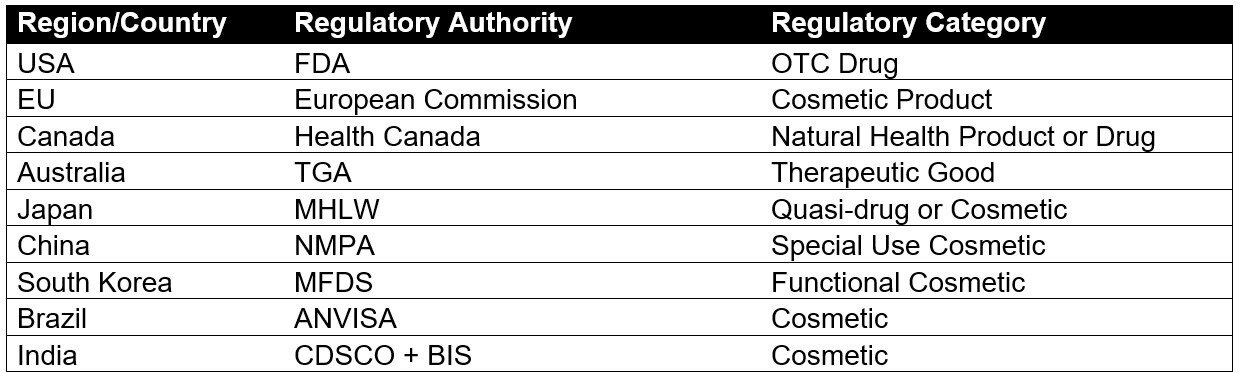
This means that if we aim to sell or import a sunscreen product in a different region, we must ensure that it complies with the applicable local regulations. Each region presents differences in:
- Permitted UV filters and their concentration limits
- Labeling requirements for the final product
- Efficacy testing methods (SPF, UVA protection, and water resistance)
Furthermore, sunscreen filters are currently under significant regulatory scrutiny due to their potential impact on both consumer health and the environment.
If we focus on the European market, UV filters are subject to three laws and must comply with all of them before they can be marketed :
- EU Cosmetic Regulation (EC) nr. 1223/2009 where the European Commission may request the opinion of the SCCS at any time if there is a concern about safety.
- REACH Regulation (EC) 1907/2006 where data generation can be requested to address environmental and human health risks.
- CLP Regulation (EC) nr. 1272/2008 where the classification of the ingredient could lead to restrictions on its use or a re-evaluation.
The use of UV filters that are not included in Annex VI of EU Cosmetic Regulation (EC) 1223/2009 (last revision from 4/3/2025) is not permitted.
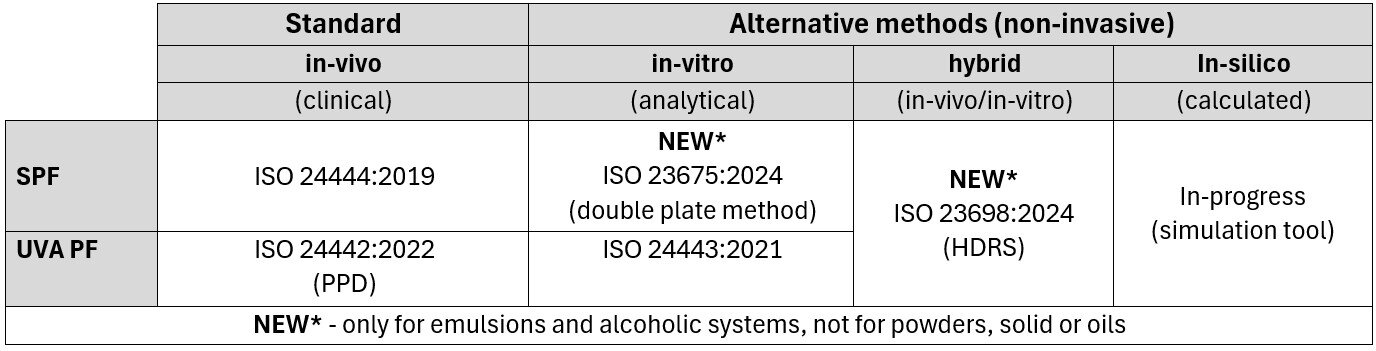
Another added challenge lies in determining the efficacy of sunscreen products. Once the formulation has been completed and the product stabilized, it must be tested to verify that it meets the product brief (required SPF, UVA protection, critical wavelength, and water resistance). The currently available efficacy tests, both in-vitro and in vivo, are costly and significantly increase the final product cost.
Alternative in-vitro methods to replace in-vivo testing are currently under development, aiming to reduce both the cost and time required for sunscreen efficacy evaluation. While these methods still present some limitations, particularly in achieving consistent correlation across the various types of sunscreen formulations, they represent a promising advancement.
Efficacy test – ISO standard methods
Types of sunscreen filters
The UV filters are substances that are intended exclusively or primarily to protect the skin against certain UV radiation, by absorbing, reflecting or scattering UV radiation.
Sunscreen efficacy depends primarily on the active ingredients (the UV filters) which come in two main categories:
1. Mineral (Inorganic) Filters
- Examples: Zinc Oxide (ZnO), Titanium Dioxide (TiO₂)
- Mechanism: Reflect and scatter UV rays
- Broad spectrum coverage, particularly ZnO
- Appearance: Supplied as powders or oil-based dispersions
- Insoluble pigments that require mechanical dispersion, not dissolution. Require proper emulsifiers, emollients, and high-shear mixing
- Often cause skin whitening; particle size optimization is key. Nano-sized pigments offer better transparency but raise regulatory and safety concerns
- EU limit: up to 25%; nano ingredients must be labeled as such
2. Chemical (Organic) Filters
- Mechanism: Absorb UV radiation and convert it into harmless heat
- Available as liquids or powders
- Primarily are oil-soluble, with some water-soluble options (requiring neutralization)
- Require complete solubilization to avoid crystal formation.
- Photostability, some UV filters degrade under UV radiation
- Can enable transparent formulations
- Sensory impact: Often greasy or sticky; formulation balance is critical
- Regulatory limits vary per ingredient
- Increasingly questioned for human and environmental safety
Contrary to popular belief, SPF value is not linearly linked to the total concentration of filters. Effective sun protection results from a:
- Strategic combination of filters with complementary absorption spectra
- Proper dispersion or solubilization
- Stabilization within the chosen vehicle
- Optimization of texture and film-forming behavior
The formulation goal is to use the minimum effective concentration of UV filters to deliver maximum SPF, ensuring improved skin feel, lower cost and enhanced safety and tolerability.
Market trends
The modern consumer expectations and the daily use trends has transformed sunscreen uses not longer restricted to summer or beach use. There is a widespread awareness of year-round UV exposure, UVA-linked photoaging and blue light and infrared damage from digital screens and pollution. This has led to the integration of sun protection into daily skincare products, especially facial treatments. The demand is now for :
- Multifunctional ingredients
- Non-greasy, ultra-light textures
- Fast absorption with no residue
- High compatibility with make-up
Hybrid sunscreens are a strategic evolution, combining the strenghts of both mineral and organic filters to meet the growing demands of efficacy, safety, sensoriality and sustainability.
This approach allows formulators to:
- Reduce the whitening effect typically associated with mineral filters by balancing them with transparent organic filters.
- Improve the texture and sensory feel, creating more elegant, lightweight, and daily-wearable formulations.
- Optimize UV coverage by strategically combining filters with complementary absorption profiles with a balanced broad-spectrum protection
- Enhance product stability and reduce irritation potential by using lower doses of individual filters.
- Reducing cost
Formulatiors are increasingly turning to biological filters, functional actives that protect the skin from oxidative stress, inflammation, and DNA damage caused by solar radiation. These include :
- Antioxidants (e.g., vitamin C, e, ferulic acid)
- Moisturisers (e.g., hyaluronic acid)
- DNA-repair enzymes
- Anti-inflammatory agents (e.g., niacinamide, panthenol)
Formulation Tricks for Sunscreen Products
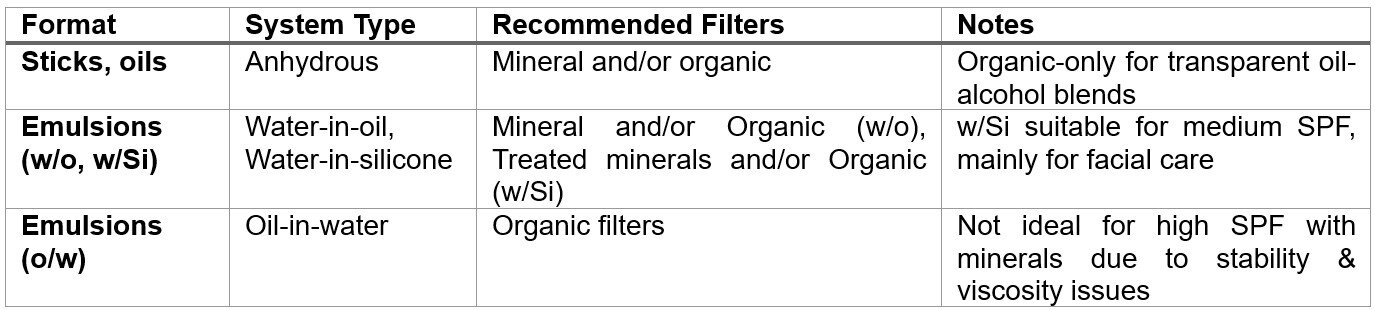
Recent trends in sunscreen formulation emphasize the development of ultra-light textures, which are typically achieved through highly fluid systems. These formulations often involve a high oil phase content, posing significant challenges in terms of both physical stability and formulation robustness. As a result, achieving the desired sensorial properties while maintaining product stability requires careful selection of the right emulsifiers, rheology modifiers, and aesthetic modifiers agents.
After years of formulating sunscreen products, in my opinion, the recommendation regarding the type of UV filters to be used depends on the formulation system and the intended product format:
Conclusion
The formulation of sunscreen products remains a significant challenge, both technically, achieving lightweight, stable textures at a reasonable cost, and from a regulatory perspective, ensuring compliance with evolving restrictions and legislation.
There are still several open questions to address, such as whether new efficacy testing methods will be appropriate and reliable for assessing the performance of biological filters.
Additionally, the EU Green Claims Directive is expected to have a considerable impact on the sunscreen sector, significantly influencing marketing, labeling, and product development for sun care products sold in the European Union. Any environmental or sustainability-related claims must be scientifically substantiated and supported by standardized testing protocols.
- EU Cosmetic Regulation 1223/2009 (Annex VI)
- https://health.ec.europa.eu/system/files/2016-11/cosmetic_1223_2009_regulation_en_0.pdf
- MINTEL Report – « A year of innovation in suncare 2025“ (February 2025)
- Reef-safe sunscreens : a formulatior’s perspective (Personal Care Magazine, October 2024)
- BASF – Sunscreen simulator https://sunscreensimulator.basf.com/Sunscreen_Simulator/login
- DSM-Firmenich – Sunscreen optimizer https://www.sunscreen-optimizer.com/user/table.html
- Elevating sun protection (Cosmetics & Toiletries, February 2025 ) https://cosmeticsandtoiletries.texterity.com/cosmeticsandtoiletries/library/item/february_2025/4248134/
- Antioxidants in Sunscreens : which and what for ? (Antioxidants – MDPI, January 2023)
- https://www.mdpi.com/2076-3921/12/1/138
- Suncare 2025 (Happi, March 2025 ) https://happi.texterity.com/happi/march_2025/MobilePagedReplica.action?pm=2&folio=Cover#pg1
- The HLB system https://www.scientificspectator.com/documents/personal%20care%20spectator/The%20HLB%20Book%20ICI.pdf

Precision Fermentation Meets AI: Transforming Personal Care Ingredient...

Exploring Hybrid Beauty: from the origins to the latest trends and reg...
Skinimalism, Hybrid Beauty and What Consumers Really Want
Soothing and Protective effects of a mixture of Saccharide Isomeratem...

Patents for Chemists: A Practical Guide to Innovation Protection
EUDR – Europe’s Dumbest Regulation

The Green Transformation: Strategies to Achieve Net Zero in the Househ...
The unique multifunctionality of polyglyceryl esters: The science, sus...