Introduction
The personal care ingredients market is a sector of great opportunities for chemical suppliers worldwide. Europe and the United States are the two largest markets, together accounting for more than 50% of the global sales of specialty ingredients. In Asia, China continues to lead the region with steady expansion of local brands, while India emerges as a key targetable market, supported by increasing awareness of personal hygiene.Within the total ingredient market roughly estimated at USD 30 billion, the consumption of specialty personal care ingredients globally is estimated at USD 23.3 billion, of which specialty active ingredients are estimated at USD 2.6 billion in 2024. This market is expected to continue to grow at a CAGR of 3.5% through 2029, driven by growing consumer demand and technological advancements such as advancements in biotechnology actives.
Market Overview
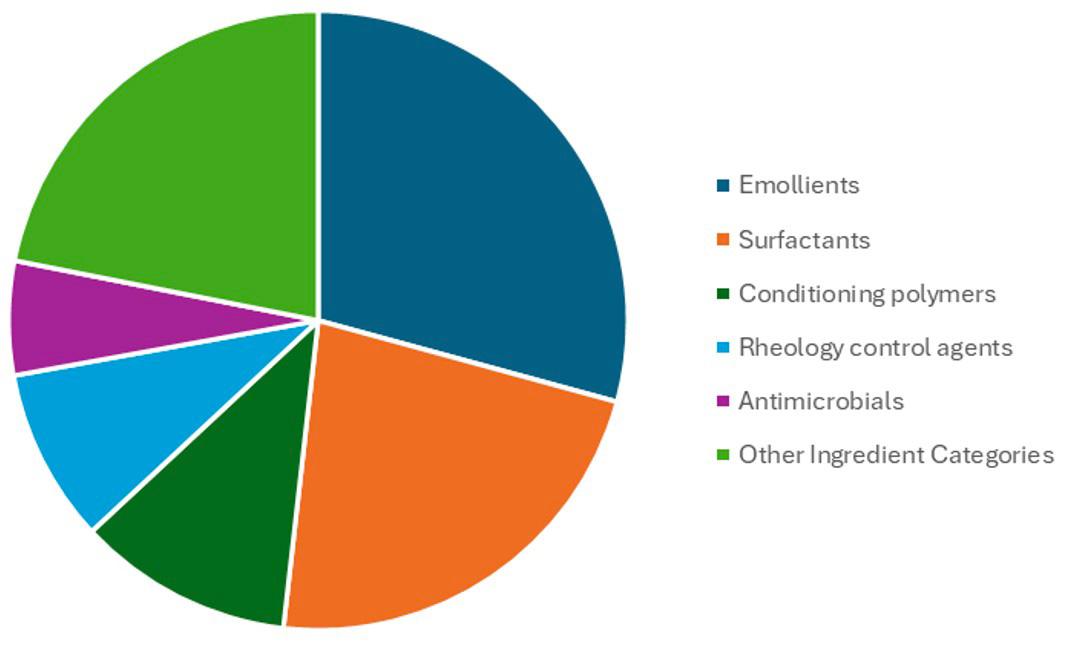
The challenges that the personal care market faced over the past three years, have significantly impacted dynamics. High inflation was recorded across the globe, leading to a rise in the cost of raw materials, production, and hence finished products. Consequently, consumers changed purchasing habits, reducing unnecessary expenses by shifting away from premium to more standard options, with an increasing focus on high-efficacy products.Disruptions in the supply chain were also felt globally, from raw material sourcing to strongly increased lead time. These factors forced suppliers, distributors, formulators, and brands to adapt and refocus their strategies, resulting in diversification of their supplier base.The interest in local sourcing grew to avoid longer lead time and improve sustainability. The preference to collaborate with smaller suppliers has also increased due to their capacity to react faster to changing market conditions. Lastly, cost-efficiency has gained further importance due to inflation, which has in turn benefited relatively new entrants and ingredient suppliers supplying from Asia.The global personal care market for functional ingredients includes a variety of categories, of which emollients and surfactants currently dominate with more than half of total market sales. Acyl isethionates lead the surfactant category with more than 20% market share, while glycerin is the most commonly used emollient in the sector. Conditioning polymers and rheology modifiers follow, holding close to 11% and 9% of industry sales, respectively.
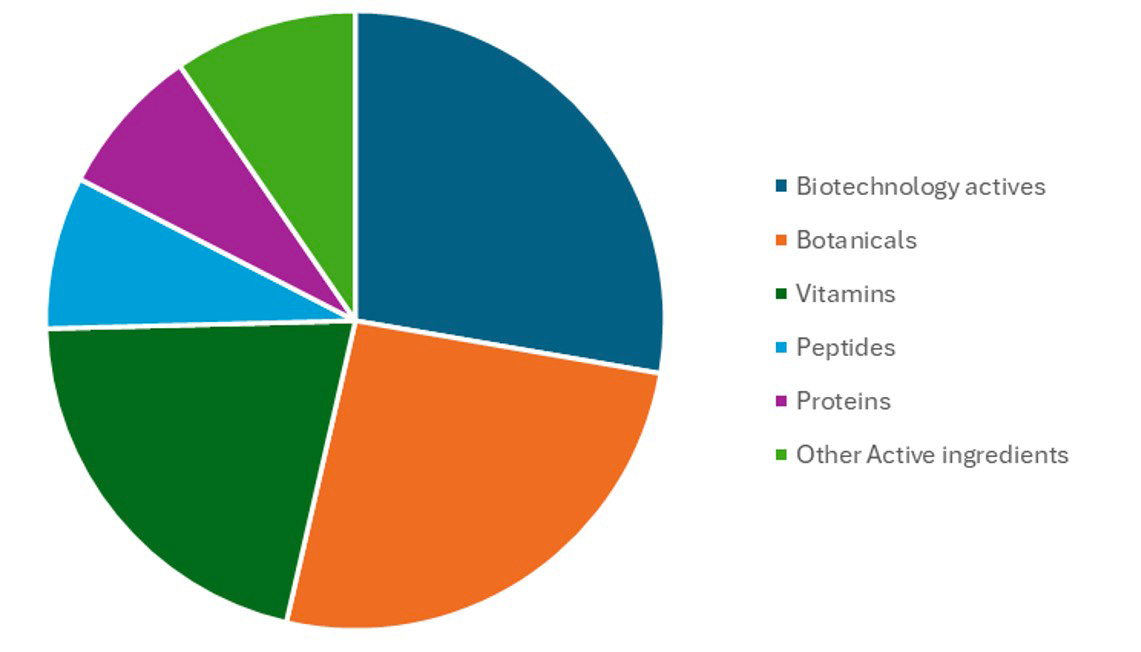
In terms of active ingredient categories, biotechnology products, substantiated botanical extracts, and vitamins lead the market, holding more than 75% of the market sales globally. Following botanicals, hyaluronic acid and salts, vitamin E and its derivatives, and ceramides are the largest types of active ingredients, together accounting for 22.5% of total market sales. Peptides have gained traction in the market, due to increasing consumers’ awareness and excellent performance results. They are followed by proteins, and both account for 8% of industry sales.
Global Value Share by Specialty Personal Care Ingredients, 2024
Global Value Share by Specialty Active Ingredients in Personal Care, 2024
Market Trends
From 2020 to 2022, the COVID-19 pandemic and subsequent chain of events have reshuffled the personal care industry landscape. Key disruptions included factory shutdowns, shortages, and logistic and shipping issues, while demand for hygiene products surged worldwide.After 2022, inflation and increase in energy costs in key markets further impacted the sector, which also recorded hikes in cost of raw materials. The industry called for improvements in supply chain and logistics, with some players focusing on shorter supply chains, while some looked for less expensive alternatives, which created opportunities for suppliers in Asia to gain market share.
Sustainability
As the industry gradually shifted toward a new normal, sustainability and naturality regained importance among brands and consumers. Demand for environment-friendly products continues to grow, leading to an increasing demand for eco-friendly ingredients for manufacturing personal care products. This trend is expected to further create opportunities for natural and naturally derived ingredients, with an increasing interest in biodegradability.In the active ingredients sector, demand for sustainable, ethical, and transparent sourcing of natural extracts is expected to grow substantially. Biotechnology is also presented as a key sector for sustainable solutions, with the development of laboratory-grown ingredients with low environmental impact.In the functional ingredients sector, this trend is likely to have various implications based on natural alternative solutions, with stronger opportunities in emollients, rheology modifiers, and surfactants.
Proven Efficacy
In addition to sustainability, the performance of personal care products is of key importance as consumers increasingly demand for proven efficacy. There has been an increase in inspection on false claims by regulatory bodies and label regulations to protect consumers. Moreover, consumers’ awareness of active ingredients is also boosted by easy access to information on brand websites, social media platforms, and ingredient-debunking applications.Furthermore, as cost remains a key concern across the supply chain, formulators and brands focus their development on high-performance ingredients at low concentrations. This creates opportunities to formulate products with shorter ingredient lists, thereby preventing cost increases in formulations as much as possible.
Longevity
Marketing claims play a key role in promoting personal care products, and choosing the right word to illustrate performance is essential to capture the attention of consumers. For instance, the term “longevity” has been propelled in the spotlight and is now used for a variety of ingredients and blends.Anti-aging remains a key functionality in the industry, holding more than 60% of sales for active ingredients in 2024 globally. The concept, however, has evolved throughout the years to maintain attractiveness. The term changed, for instance, to “well-aging” to embrace a healthy approach to skin care rather than fighting the natural cycle of aging through the use of the right products. Now “longevity” is taking the concept one step further to include proactive measures for supporting skin health, while also the overall well-being of the skin. With the longevity trend, the personal care industry is taking an additional scientific step toward developing more potent ingredients, with a stronger focus on biomimetic active ingredients, which act at a cellular level.
Neurocosmetics
Several other trends support the longevity movement. This includes the neurocosmetics trend, which has emerged in the Europe and North America markets and is gradually expanding globally. Neurocosmetics focus on the connection between emotions, mental health, and beauty. Skin care routines have long been presented as rituals to enhance overall well-being. The neurocosmetics trend takes this concept a step further, with active ingredients directly affecting neurotransmitters and claims about actives that evoke skin sensations. More opportunities to develop solutions are expected to arise as further studies are done on the impact of hormones on skin health, including throughout women’s various life stages.
Skinification
As inclusivity further becomes a pillar of the personal care industry, the trend around skinification is expected to remain key for future product developments and launches. The concept of skinification is seen across various applications, including hair care, makeup, and body care.The increased consumer interest in hair wellness and scalp care drives growth for solutions surrounding the scalp microbiome. As more studies are conducted on the topic, products formulated with active ingredients targeting scalp balance, hydration, protection, repair, and hair growth are expected to grow in demand.On par with consumers’ increased demand for effective solutions, more makeup products in the market are promoted with skin care claims. These claims are typically related to anti-aging, anti-inflammation, anti-acne, and sun protection. Examples of finished products include multi-use balms or foundations with SPF, infused with active ingredients.Consumers increasingly recognize the importance of body care, leading to a rise in body creams, lotions, serums, and sprays formulated with active ingredients. Ceramides, vitamins, and peptides are among the active ingredients expected to strongly benefit from this trend in the short term. The slimming industry in body care is shifting its focus toward skin enhancement, aligning with the “longevity” trend seen in facial care.
Aesthetic Procedures Growth
Closely related to the industry shift toward skin health and skin firming is the world of aesthetic procedures. Aesthetic procedures are now more accessible to consumers and have gained strong popularity due to social media influence. Post-procedure treatment demand is rising and is seen as a great opportunity for products with hydrating and soothing actions. For instance, high-performance active ingredients such as hyaluronic acid and vitamin E are gaining traction.On the other hand, demand for non-invasive alternatives is expected to further increase as a preferred solution among consumers. This is likely to create demand for more potent active ingredients, such as peptides and other biotechnology-based ingredients closely related to the neurocosmetics trend.Moreover, the increased use of fast weight-loss solutions, such as the GLP-1 drug, requires the development of new skin firming solutions. The fast-thinning process caused by the intake of those products impacts skin elasticity and hydration, as well as leads to wrinkles and fines lines. As a result, fast-acting personal care products formulated with high-performance active ingredients are likely to see a growth in demand.Based on market trends seen the personal care ingredients market is expected to grow at a CAGR of 3.5% through 2029. Peptides, substantiated botanical extracts, and biotechnology active ingredients will be the fastest-growing ingredients, together at a 4.4% CAGR over the same period, driven by the demand for sustainable and high-performance solutions.
Conclusion
The personal care market has recorded significant transformations over the past few years, due to economic challenges, supply chain disruptions, and evolving consumer preferences. The shift toward cost-efficiency and sustainability has reshaped industry strategies, with a growing emphasis on local sourcing and diversification.As consumers and brands increasingly prioritize efficacy and transparency, demand for high-performance and sustainable ingredients continues to increase. Trends such as longevity, neurocosmetics, and skinification are redefining product development, emphasizing holistic well-being and inclusivity. The long-term trends will create new opportunities for ingredient suppliers to work with formulators and brands to develop innovative solutions, which are sustainable and high-performance.

Cosmetic Market Trends 2025: Innovations, Consumer Shifts and a Vision...

Influences and Insights into Future Claims Technology and Testing

Gale & Cosm: Innovation in Made-In-Italy raw materials

Improving skin longevity by targeting biological aging causes

Longevity’s Groundbreaking AI Revolution: Reinventing Ingredient...

Clean Beauty: From Consumer Perception to Scientific Validation

Active ingredients in beauty – top trends

Redefining How We Measure Skin Longevity