Despite their efficacy, retinoids, particularly retinol and its active metabolite, retinoic acid, present significant limitations as chemical instability (3) and side effects like skin dryness, redness, itching (4), and photosensitivity (5), which restrict their use in long-term treatments and cosmetic formulations.
A variety of alternative approaches have emerged, including milder retinoid derivatives and botanical compounds that aim to replicate the effects of retinol with fewer side effects (6). Other active ingredients, such as peptides and niacinamide, offer gentler support for skin health, while synthetic innovations seek to improve stability and reduce irritation (7). However, these alternatives do not address the underlying metabolic instability of retinoic acid itself.
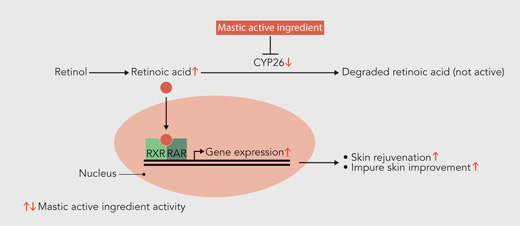
Retinoic acid exerts its biological effects by binding to nuclear receptors and regulating gene expression. However, it is rapidly degraded in the skin by cytochrome P450 family 26 (CYP26) enzymes, which limits its bioavailability and therapeutic potential (8). High concentrations are often required to achieve clinical efficacy, increasing the risk of irritation and adverse effects.
To overcome the limitations, recent strategies have focused on enhancing endogenous retinoic acid levels by inhibiting its enzymatic breakdown. Specific CYP26 inhibitors, such as liarozole and talarozole, have demonstrated improved tolerability and efficacy in medical applications compared to traditional retinoid therapies (9).
Chios mastic enhances retinoic acid activity through CYP26A1 inhibition
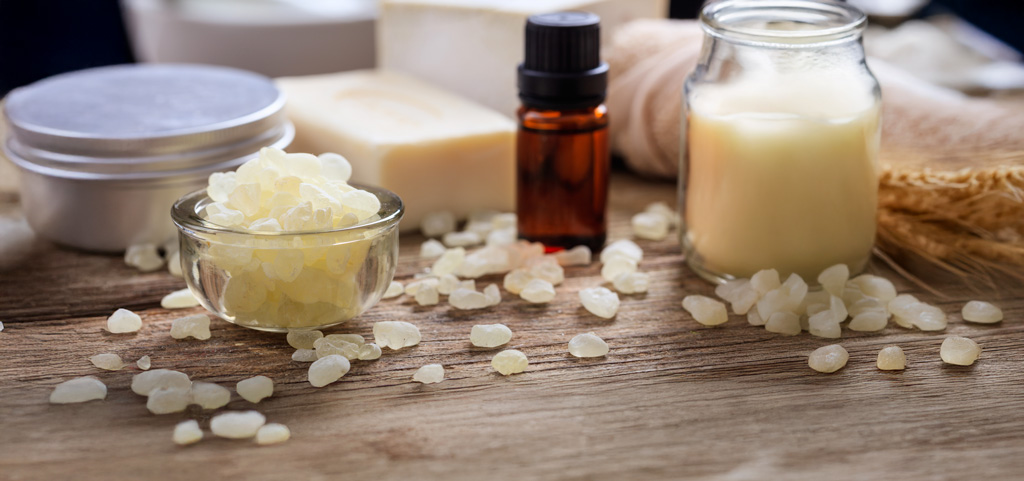
One notable plant-based alternative is mastic, a natural resin from the Pistacia lentiscus tree, traditionally known as the “Gold of Chios.” Valued for its numerous valuable ingredients (10), its antibacterial, anti-inflammatory, antioxidant, and anticancer properties (11), and also for its wound healing capacities (12), Chios mastic is sustainably harvested and recognized for its cultural and therapeutic significance (13).
Unlike conventional alternatives that merely mimic the effects of retinol, mastic active ingredient introduces a novel approach by targeting the metabolic regulation of retinoic acid. Retinoic acid can induce its own degradation by upregulating CYP26 enzymes, particularly CYP26A1, which converts it into inactive metabolites. In keratinocytes, CYP26A1 plays a key role in this degradation process (8).
By inhibiting CYP26A1, mastic active ingredient increases endogenous retinoic acid levels, leading to activation of RXR (Retinoid X Receptor) and RAR (Retinoic Acid Receptor) nuclear receptors (1, 14), which function as transcription factors to modulate the expression of specific genes involved in skin rejuvenation and impure skin improvement (Figure 1).
By maintaining natural retinoic acid levels in the skin, mastic enhances efficacy without requiring high concentrations. This upstream mechanism supports the skin’s intrinsic retinoid activity and delivers benefits like improved texture, reduced lines, and enhanced cell turnover, while minimizing irritation. As a result, Chios mastic is especially suitable for sensitive skin and natural skincare. Its development offers a next-generation plant-based retinol alternative that overcomes conventional limitations.
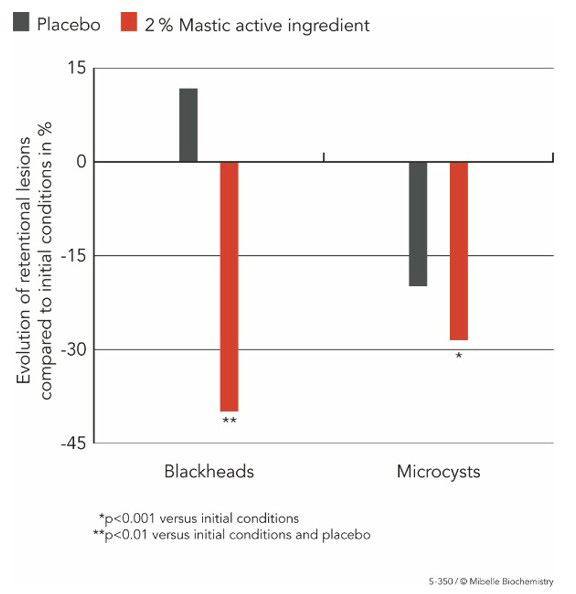
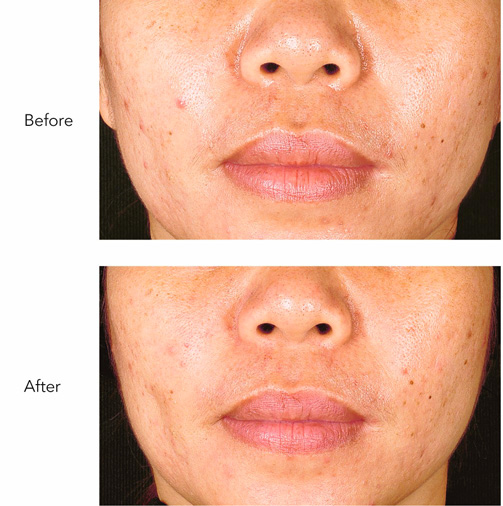
This double-blind, placebo-controlled study involved a total of 44 (Asian, female) volunteers, aged 30 to 52 years (mean age: 38.3 y). Participants applied either an emulsion containing 2 % mastic active ingredient or a placebo emulsion twice daily to the face for 28 days. The parameter was impure skin (blackheads and microcysts).
The comedogenic potential was assessed by a clinician through the count of impurities across four facial zones: forehead, temples, cheeks, and chin. Visual changes were documented using macrophotographs (Nikon D80). At the end of the study, participants completed a self-evaluation questionnaire to assess perceived efficacy.
14-day clinical study on the efficacy of Chios mastic on sebum and skin hydration
This randomized, placebo-controlled half-face study was done with 23 volunteers (Asian, female) aged 21 to 48 years (mean age: 28.3 y) having oily skin and impurities. They applied a cream containing 2 % mastic active ingredient or a placebo twice daily for 14 days. Measured parameters on day 0, 7 and 14 were sebum output (Sebumeter® SM810) measured on the forehead, skin hydration (Corneometer® CM825) measured in the cheek region, and standardized facial photography (VISIA® CR).
28-day clinical study on the anti-ageing efficacy of mastic active ingredient
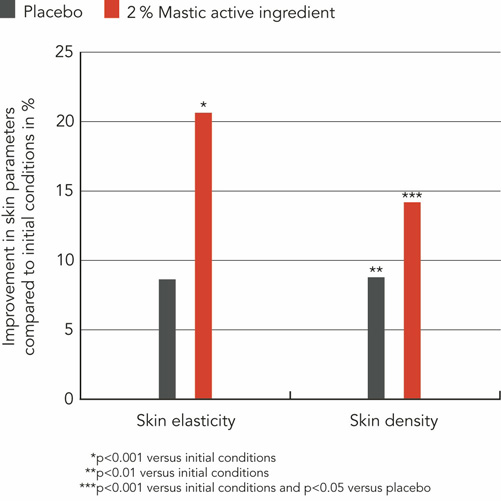
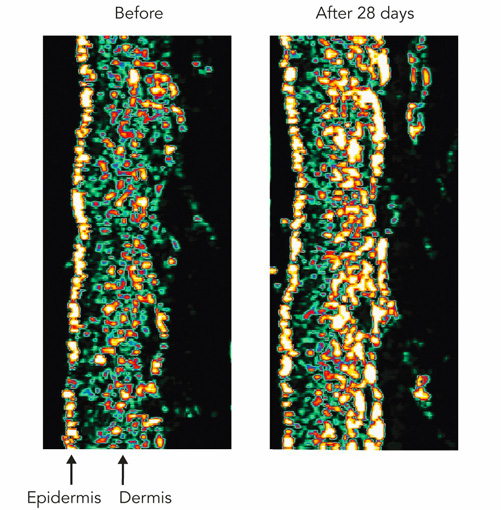
This randomized, placebo-controlled study involved 18 volunteers (Caucasian, female) aged 42 to 70 years (mean age: 57 y). They applied a cream containing 2 % mastic active ingredient or a placebo to one half of the face and the inner sides of each forearm twice daily for 28 days. The measured parameters were skin elasticity on the face (Cutometer® dual MPA 580, Courage + Khazaka, Germany) and density on the forearms using the Dermalab® Ultrasound system (Cortex Technology, Denmark).
28-day clinical study on the scalp-care efficacy of mastic active ingredient
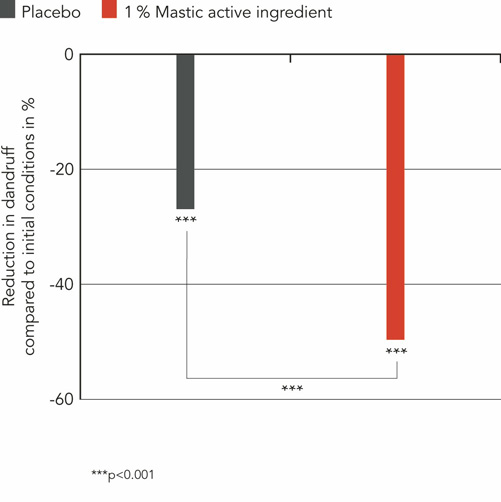
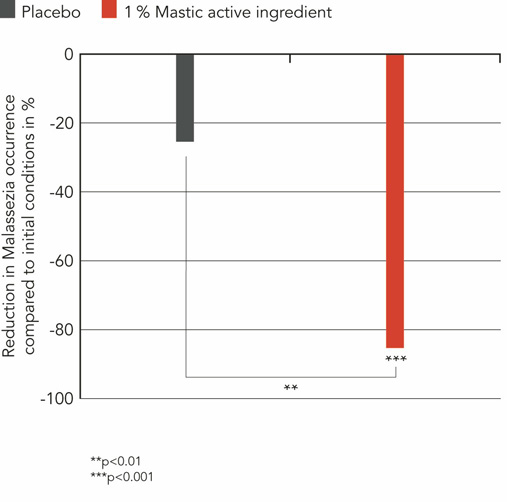
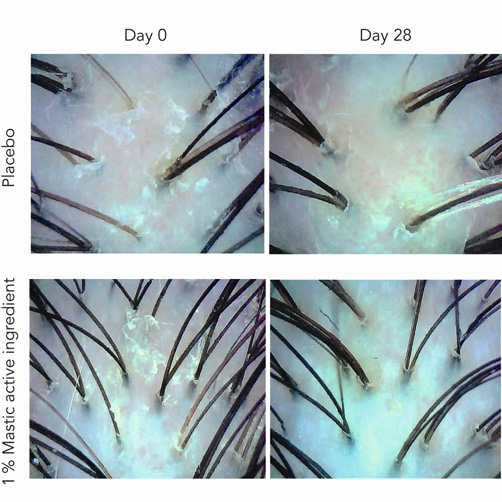
This randomized, placebo-controlled trial included a total of 42 volunteers (Caucasian, female & male), aged 18 to 68 years (mean age: 46.5 y), all with oily scalp and visible dandruff. Volunteers were split into two groups and applied either a leave-on serum with 1 % mastic active ingredient or a placebo serum once daily to the entire scalp and massaged in thoroughly. The parameters were visible scalp dandruff (Aramo® ASW 300F system, 60 x magnification) and Malassezia occurrence (microbiota samples collected from the neck using sterile swabs). Swabs were streaked onto plates (ChromAgar medium) and incubated for 72 h at 30-37±1 °C under aerobic atmosphere. Grown colonies were transferred to Columbia Agar and, after microscopic preparation (Gram staining), analysed through biochemical and enzymatic tests to identify and quantify microbial strains. Malassezia was not present in all participants: it was detected in 12 individuals in the group using mastic active ingredient and in 14 individuals in the placebo group. Microbiota analysis was therefore conducted on these 26 volunteers. Dandruff severity was quantified using numeric values derived from the macrophotographs.
Results showed that after 28 days of treatment with mastic active ingredient, a clear improvement in impure skin was observed: the number of impurities (blackheads and microcysts) decreased significantly (Figure 2).
A visible improvement of impure skin was achieved after 28 days of treatment with mastic active ingredient (Figure 3).
Reduced sebum production and improved skin hydration
Another clinical study evaluated the effectiveness of mastic in reducing sebum production and improving hydration. Results indicated that after 14 days of treatment with mastic active ingredient, a significant improvement in these key skin parameters was observed.
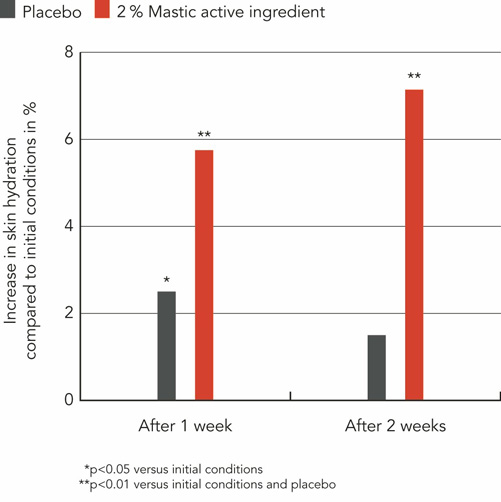
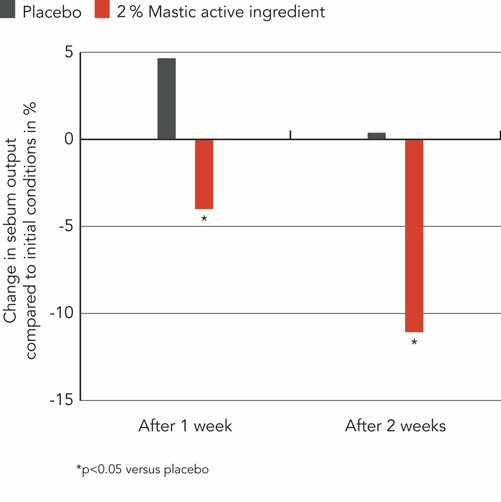
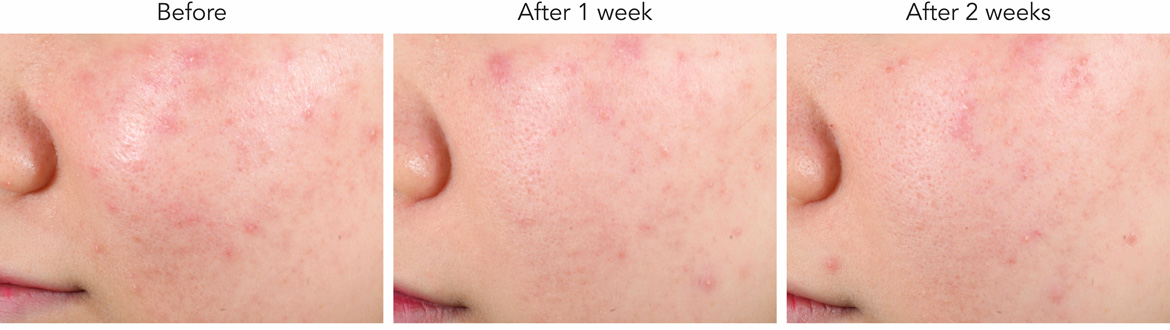
Skin hydration showed a significant increase at both time points – day 7 and day 14 – compared to baseline and placebo, demonstrating the moisturizing benefits of mastic active ingredient (Figure 4, left). On the other hand, sebum levels were significantly reduced after both 7 and 14 days of treatment compared to baseline and placebo, indicating effective sebum-regulating properties (Figure 4, right). Moreover, the visible improvement of skin condition in terms of sebum reduction was clearly visible after 2 weeks of treatment (Figure 5).
After 28 days of treatment with mastic active ingredient, a significant improvement of skin elasticity of 20.4 % compared to initial conditions was observed in the face of the volunteers. In addition, skin density measured at the forearm improved significantly by 13.8 % after the treatment with mastic active ingredient (Figure 6, left). Ultrasound measurements clearly showed visible improvements in skin density (Figure 6, right).
After 28 days of treatment, the scalp serum containing 1 % mastic active ingredient demonstrated significant efficacy in improving scalp condition. Dandruff levels were reduced by 50.4 % compared to baseline, while the placebo group showed a reduction of only 27.8 % (Figure 7, left). Microbiological analysis further supported these findings. The occurrence of Malassezia colonies was significantly reduced by 85.3 % in the mastic group, compared to a 25 % reduction with the placebo treatment (Figure 7, right).
The underlying mechanism of action, inhibition of CYP26A1, sets mastic active ingredient apart from conventional retinoid alternatives. By preventing the enzymatic degradation of retinoic acid, mastic increases endogenous levels of this key metabolite, thereby enhancing its biological activity without the need for external application. This may lead to normalized cell turnover, reduced inflammation, and strengthened barrier function, benefits that are crucial for both skin and scalp health.
These findings emphasize the broad applicability and scientific significance of mastic active ingredient. It effectively combats surface-level issues like oiliness, dryness, and dandruff while simultaneously addressing their underlying causes through a gentle, retinoid-boosting mechanism. The clinical data presented in this study confirm its comprehensive performance, positioning Chios mastic active ingredient as an innovative, plant-derived alternative to conventional retinoids. Its capacity to improve diverse skin and scalp conditions makes it a uniquely integrative active component in contemporary skincare formulations. Further studies are currently underway to explore the broader cosmetic potential of mastic active ingredient, including its anti-aging effects and benefits for scalp care.
- Zasada M, Budzisz E. Retinoids: active molecules influencing skin structure formation in cosmetic and dermatological treatments. Postepy Dermatol Alergol. 2019;36(4):392-7. https://pubmed.ncbi.nlm.nih.gov/31616211/
- van de Kerkhof PC. Update on retinoid therapy of psoriasis in: an update on the use of retinoids in dermatology. Dermatol Ther. 2006;19(5):252-63. https://onlinelibrary.wiley.com/doi/10.1111/j.1529-8019.2006.00082.x
- Temova Rakusa Z, Skufca P, Kristl A, Roskar R. Retinoid stability and degradation kinetics in commercial cosmetic products. J Cosmet Dermatol. 2021;20(7):2350-8. https://pubmed.ncbi.nlm.nih.gov/33206444/
- Yin S, et al. Retinoids activate the irritant receptor TRPV1 and produce sensory hypersensitivity. J Clin Invest. 2013;123(9):3941-51. https://pubmed.ncbi.nlm.nih.gov/23925292/
- Failloux N, Bonnet I, Perrier E, Baron MH. Effects of light, oxygen and concentration on vitamin A1. J Raman Spectrosc. 2004;35(2):140-7. https://analyticalsciencejournals.onlinelibrary.wiley.com/doi/10.1002/jrs.1116
- Mukherjee S, et al. Retinoids in the treatment of skin aging: an overview of clinical efficacy and safety. Clin Interv Aging. 2006;1(4):327-48. https://pubmed.ncbi.nlm.nih.gov/18046911/
- Zhong J, Zhao N, Song Q, Du Z, Shu P. Topical retinoids: Novel derivatives, nano lipid-based carriers, and combinations to improve chemical instability and skin irritation. J Cosmet Dermatol. 2024;23(10):3102-15. https://pubmed.ncbi.nlm.nih.gov/38952060/
- Heise R, et al. Skin retinoid concentrations are modulated by CYP26AI expression restricted to basal keratinocytes in normal human skin and differentiated 3D skin models. J Invest Dermatol. 2006;126(11):2473-80. https://pubmed.ncbi.nlm.nih.gov/16778795/
- Verfaille CJ, Borgers M, van Steensel MA. Retinoic acid metabolism blocking agents (RAMBAs): a new paradigm in the treatment of hyperkeratotic disorders. J Dtsch Dermatol Ges. 2008;6(5):355-64. https://pubmed.ncbi.nlm.nih.gov/17941881/
- Panagiota S, et al. Revealing the Potential of Chios Mastic Gum and Its Constituents for Cosmetic Applications through Chemical Profiling and Biological Evaluation. Cosmetics. 2024;11(5):155. https://www.mdpi.com/2079-9284/11/5/155
- Dimas KS, Pantazis P, Ramanujam R. Review: Chios mastic gum: a plant-produced resin exhibiting numerous diverse pharmaceutical and biomedical properties. In Vivo. 2012;26(5):777-85. https://pubmed.ncbi.nlm.nih.gov/22949590/
- Haghdoost F, et al. Pistacia atlantica Resin Has a Dose-Dependent Effect on Angiogenesis and Skin Burn Wound Healing in Rat. Evid Based Complement Alternat Med. 2013;2013:893425. https://pubmed.ncbi.nlm.nih.gov/24285978/
- Pachi VK, et al. Traditional uses, phytochemistry and pharmacology of Chios mastic gum (Pistacia lentiscus var. Chia, Anacardiaceae): A review. J Ethnopharmacol. 2020;254:112485. https://pubmed.ncbi.nlm.nih.gov/32092498/
- Szymanski L, et al. Retinoic Acid and Its Derivatives in Skin. Cells. 2020;9(12). https://pubmed.ncbi.nlm.nih.gov/33322246/
- Eisenstein M. The skin microbiome. Nature. 2020;588(7838):S209. https://www.nature.com/articles/d41586-020-03523-7

Bakuchiol: A Comprehensive Review of Its Anti-Aging, Antioxidant, and...
The Rise of Upcycled Ingredients in Cosmetics: A Sustainable Innovatio...

High Active Alpha Olefin Sulfonate
A word with Marine Pasquier – Seppic

The feel of foam: innovating sensory evaluation for solid shampoo form...
Retinol Alternatives

Now and Beyond: The Top Trends Shaping the Laundry and Cleaning Market