The centre of gravity of the surfactant industry has been moving East for many decades, driven largely by development of the oil palm plantations in Indonesia and Malaysia. A co-product of palm oil is of course palm kernel oil, rich in fatty acids with detergent range alkyl chains, ie. C8 – C18 and most particularly C12 – C14, which is the basis for lauryl alcohol used in alcohol sulfates, ether sulfates, alcohol ethoxylates, fatty amines, APGs and other surfactants and intermediates.
Figure 1 shows that palm and palm kernel together to account for 36% all global oils and fats consumption currently, the largest single source.
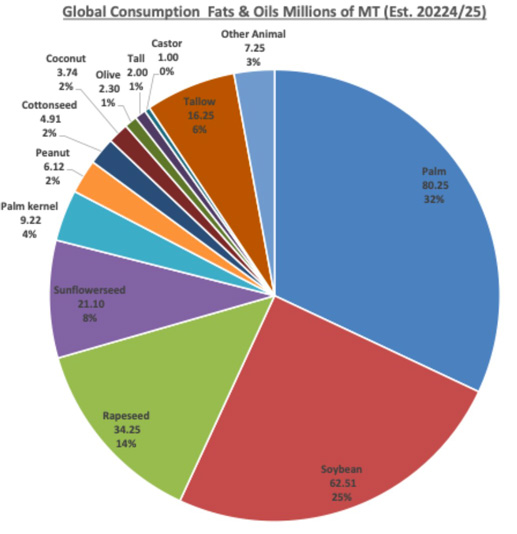
(Source USDA and NAB analysis)
As most readers know, Indonesia produces 58% of global palm oil. Malaysia produces 25%. The next three countries, Thailand, Colombia and Nigeria produce 8% between them. Other countries, including an additional 11 in Western Africa, produce palm oil, but in very small amounts today. The industry itself is similarly concentrated with roughly two thirds of palm plantation acreage owned seven companies; SD Guthrie (formerly Sime Darby), Golden Agri Resources (Sinar-Mas), Felda, Wilmar, KLK, Genting and IOI. Many of these companies are vertically integrated downstream into the production of fatty acids, fatty alcohols and surfactants. Regardless, palm kernel oil has become the starting point of choice for the production of detergent range alcohols in the last few decades. Today, over three quarters of installed detergent range alcohol production capacity runs on palm kernel oil. Thirty years ago, that figure was around 40%.
It is not just cheap and plentiful palm kernel oil that has driven this change. The availability of the production technology itself is another key factor. Two off-the-shelf technologies for the production of palm kernel oil based alcohols are available from the companies, Johnson Matthey (the Davy Process) and JJ Lurgi (the Lurgi process). Conversely the petrochemical processes for alcohol production operated by the major producers such as Sasol, Shell and ExxonMobil are not available for license to third parties and, therefore not easily practiced at commercial scale. In fact those three companies account for over 80% of the petrochemical detergent range alcohol capacity globally. These underlying economic factors of feedstock supply and technology availability along with growing demand for surfactants in Asia, have led to now just under one half (49 %) of all detergent range alcohol capacity located in Asia (excluding China).
There are strong demographic forces driving the growth of surfactants in Asia, where there are plenty of young consumers. And more people are entering the middle class in Asia than anywhere else in the world; around 100 Million per year, with 30 – 35 Million each from India and China, 15 – 20 Million from Southeast Asia and another 10 – 15 Million from other Asian countries. Middle class growth is one of the most reliable predictors of surfactant growth as people transition from using bar soap for every cleaning job to using more specialized household cleaners and personal care and cosmetic products, the more money they have to spend. This effect is accelerated as washing machines and dishwashers penetrate consumer markets. Today a little under half of all surfactants (44%) are consumed in Asia and I estimate that figure will reach one half by the end of the decade as Asian growth rates continue to outpace mature markets like Europe and North America.
One other element to take into account, when we consider the impact of Asia on surfactant production and consumption is culture, particularly in the beautycare market. J-Beauty and K-Beauty trends are well established and have influenced offerings in Europe and the US by Estee Lauder, L’Oreal and others. In addition, Japanese and Korean companies and brands such as Amore Pacific, Shiseido, Tatcha, DHC, LaNeige, Beauty of Joseon and many others continue to be successful in global markets. As little as ten years ago, most Asian products were repurposed Western products. Today that is no longer the case.
With all that is taking place in surfactants in Asia from consumption and production standpoints, it is no surprise that many companies, including relatively new ones are establishing collaborations, ventures and facilities in the region. Such facilities are not just for production but also for R&D, sourcing and marketing. Something to consider as you plan for the coming years. For myself, I’ve been visiting the region at least once per year for decades. I will be there next in Kuala Lumpur, November 13th – 14th for my 11th Asian Surfactants Conference. I expect I’ll see many readers there.
The Rise of Upcycled Ingredients in Cosmetics: A Sustainable Innovatio...

High Active Alpha Olefin Sulfonate

More than anti-ageing: the retinol-alternative Chios mastic as a compr...

Bakuchiol: A Comprehensive Review of Its Anti-Aging, Antioxidant, and...
A word with Marine Pasquier – Seppic

The feel of foam: innovating sensory evaluation for solid shampoo form...
Retinol Alternatives

Now and Beyond: The Top Trends Shaping the Laundry and Cleaning Market