
Introduction
Personal care companies are increasingly driven by the evolving expectations of consumers, who are now prioritizing sustainability in their product choices. This shift encompasses various aspects, including recyclable and biodegradable packaging, the use of plant-based rather than petroleum-based ingredients, and the elimination of substances like parabens, phthalates, PFAS, and others. Furthermore, consumers are also demanding that companies implement broader Environmental, Social, and Governance (ESG) measures.These additional sustainability requirements must be integrated with existing product mandates such as technical performance, consumer appeal, cost efficiency, and stability. Formulators face the challenge of optimizing numerous parameters simultaneously, across an expansive array of potential ingredients, ingredient quantities, and processing steps. This task involves performing multi-objective optimization within a vast design space.
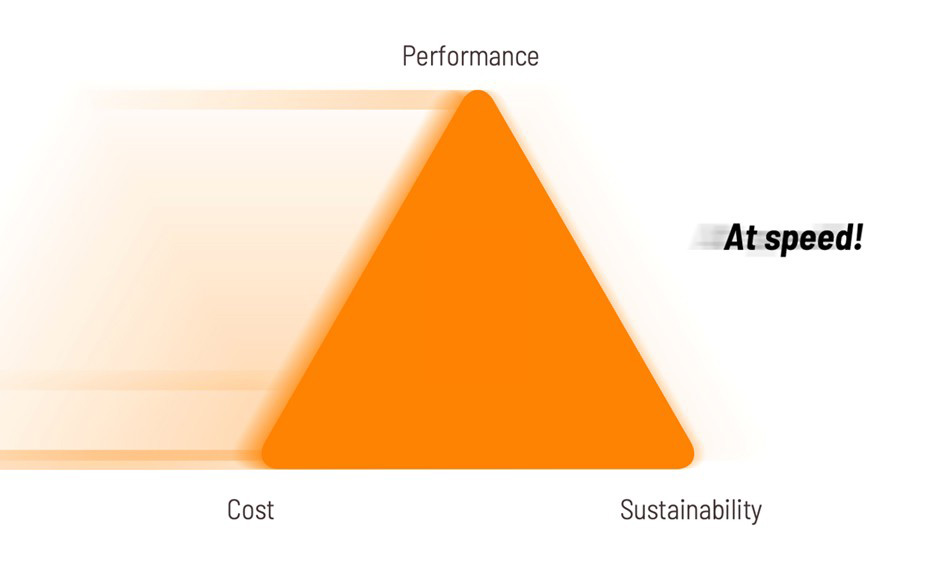
Figure 1. The triangle of requirements.
Adopting a strategic AI approach to this complex landscape ensures companies can meet both traditional and emerging consumer demands while advancing sustainable practices across their entire product lifecycle.
AI Workflow
DataAn effective AI workflow in the personal care industry begins with data. The data must have a robust connection between input variables—such as formulation components and processing parameters—and output characteristics like shear viscosity and sensory attributes (e.g., after feel). Given the necessity for physical experiments in this field, the resulting datasets tend to be relatively small. The most proficient AI platforms, especially those focused on materials, chemicals, and consumer goods, have developed methods to make AI functional with limited data sets. These platforms enable easy integration of data by allowing uploads from Excel files and facilitating the creation of data pipelines. Moreover, they are equipped with chemical awareness, utilizing molecular structure data to enhance your experimental data.
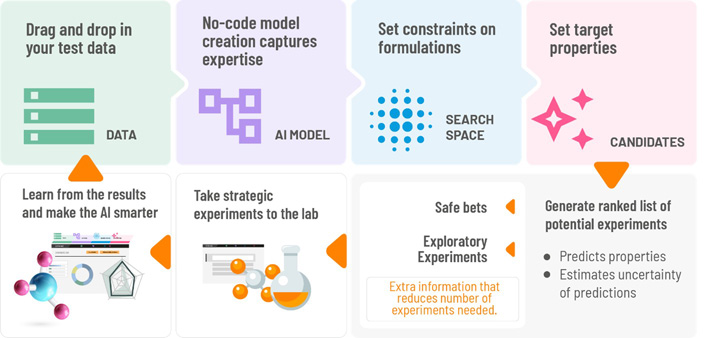
Figure 2. AI Workflow – how AI accelerates R&D.
AI Models
Modern AI technology has evolved to allow formulators in the personal care industry to create AI models without the need for coding expertise. This direct engagement lets formulators integrate their specialized knowledge and learn from the models, significantly accelerating the development process. Leading systems today offer a remarkably user-friendly experience, where creating a model is achievable in just a few clicks.
The AI model begins by taking data as input, processing it to generate “features”—such as the mean polarizability of surfactants or the weight percentage of emollients within a formulation. It then employs machine learning (ML) models to examine properties of interest. These ML models are trained to predict these properties based on the inputs provided.
Once training is complete, various methods are deployed to evaluate the accuracy of the models. If necessary, the models can be adapted to incorporate additional features for improved precision. Interestingly, while accuracy is an important aspect, it may not always be as critical as one might assume. You can read more about this in (1).
Search Space
Next, it’s crucial to guide the AI by defining a precise search space. This search space comprises a list of constraints, which determine the boundaries of the formulation process. Constraints include permissible ingredients, maximum concentrations of elements like water or surfactants, and allowed processing parameters. By establishing these parameters, you ensure that the candidate formulations generated by the AI are both practically feasible and commercially viable.
For instance, you can tailor search spaces to meet regional regulations, creating distinct constraints for markets like the EU and the US based on their specific ingredient approvals. Despite these differences, you can maintain consistent target properties and utilize the same AI model, provided it aligns with both markets’ consumer preferences.
Candidate Formulations
Finally, setting target properties allows you to focus on specific objectives and constraints, such as minimizing cost, maintaining viscosity within certain ranges, and maximizing overall consumer liking. By defining these goals, the AI model can efficiently explore the search space to find the most promising formulation options.
The AI doesn’t exhaustively evaluate every possible combination; instead, it uses advanced statistical techniques to sample the search space, homing in on the most promising areas. This approach generates a ranked list of experiments to prioritize for lab testing. Additionally, the platform provides not only property predictions but also estimates the uncertainty of these predictions, informing you about whether an experiment is a secure option or more exploratory in nature (2).
For example, at the beginning of a project, when you have a 20% chance of meeting all targets and achieving an overall liking score of 9, it may be worthwhile to conduct that experiment to explore potential breakthroughs. Conversely, as you approach a deadline, you’ll likely opt for experiments with a higher probability of success to ensure targets are met consistently.
By leveraging these insights, you can strategically decide which experiments to pursue, significantly reducing the number needed and streamlining the development process.
Every time you run an experiment, you can put that data point into the AI and retrain the model to make it more accurate. Even failed experiments are useful, as they teach the AI what doesn’t work. In this way we have a learning loop that gets closer and closer to targets.
Learning as well as teaching
The most effective AI platforms in chemical informatics prioritize transparency, addressing the preference of scientists to avoid “black box” approaches. Unlike large language models, the machine learning employed in this field can reveal the specific features it uses for predictions. It can effectively display which features have the most significant impact, indicating whether they are influencing the outcome in a positive or negative direction, and quantifying the magnitude of this effect.
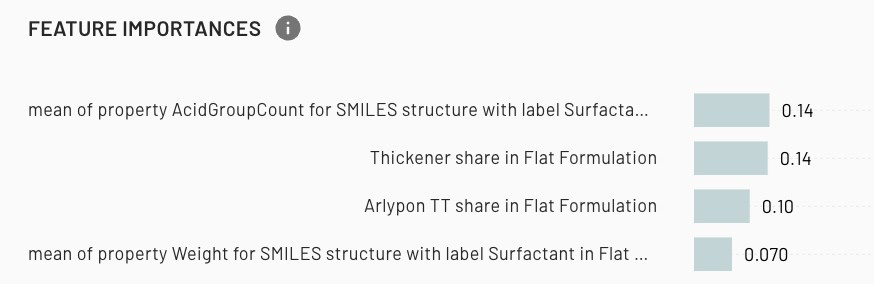
Figure 3. Feature importance visualization – Partial ranked list of the most important features for predicting shampoo viscosity according to the AI model. (Ranked on a scale from 1-0, with 1 the most important)
Researchers highly appreciate this aspect of AI utilization, as it provides invaluable insights into the model’s decision-making process. For example Oliver Drum of Dorfner Gmbh said “We understand our own laboratory more than before. It’s fun to work in this way.” By examining these features, scientists can perform a “gut check” to verify that the AI is beginning to comprehend the chemistry involved. Furthermore, it can occasionally highlight factors they hadn’t previously recognized as important, leading to those pivotal “aha moments” that enhance their understanding of their own work.This transparency not only builds trust in the AI system but also enriches the research process. It fosters deeper learning and exploration, allowing scientists to refine their hypotheses and approaches, ultimately driving innovation in the development of personal care products.

Figure 4. Diagram showing the complementarity of AI and product experts.
Three key areas where AI is being used to improve sustainability
- Reformulating products to use plant-based ingredients
- Reformulating products to substitute out problem ingredients e.g. parabens and PFAS
- Optimizing packaging materials to use recycled content or create biodegradable alternatives
Reformulating with Plant-Based Ingredients
In their pursuit of sustainability, personal care companies are increasingly focusing on replacing petroleum-based components, like petroleum jelly, with plant-based emollients such as jojoba oil, coconut oil, and others. While beneficial for the environment and consumer preferences, this transition presents several challenges. Plant-based ingredients can vary in composition due to seasonal changes, often incur higher costs than traditional counterparts, and necessitate vigilant management to ensure photostability and microbial stability.
To navigate these complexities, companies are leveraging AI to achieve precise rheology targets across a variety of product formulations. AI assists in optimizing the trade-offs inherent to using plant-based ingredients by modeling and discovering the most effective combinations that meet performance expectations while maintaining quality and affordability. Find a link to more detail in the notes below (3).
Identifying Alternative Ingredients Using AI
The drive to replace ingredients being phased out due to regulatory restrictions is a dynamic area of AI application in the personal care industry. By leveraging chemical formulae and molecular structures, AI systems can automatically compute essential “features.” This is done by encoding molecular structures using computer-readable formats like SMILES (Simplified Molecular Input Line Entry System), which allows the computation of various molecular properties including number of hydrogen bonds, polarizability, molecular weight, and more.
As AI models analyze these features to determine their significance for achieving target properties, they can efficiently evaluate alternative molecules that possess these key attributes. By identifying viable substitutes, AI aids companies in reformulating products more swiftly and effectively. For example, businesses have successfully utilized AI to replace PFAS ingredients, reducing reformulation time by an impressive 60%. Find a link to more detail in the notes below (4).
Advancements in Sustainable Packaging Using AI
The quest for sustainable packaging solutions has intensified, driven by EU legislation mandating increased recycled content in plastic packaging. This has spurred significant investment into both chemical and mechanical recycling of plastics, as well as the exploration of alternative plant-based biodegradable materials. AI is playing a pivotal role in optimizing and innovating these processes.
In chemical recycling, AI is utilized to refine the solvent mixtures and processing parameters, enhancing yields and efficiency. AI also supports the agile adaptation of plastic compound formulations by identifying additives that address the variability in post-consumer recyclates. This ensures consistent quality despite inherent challenges in the recycling process. More information in this white paper (5).
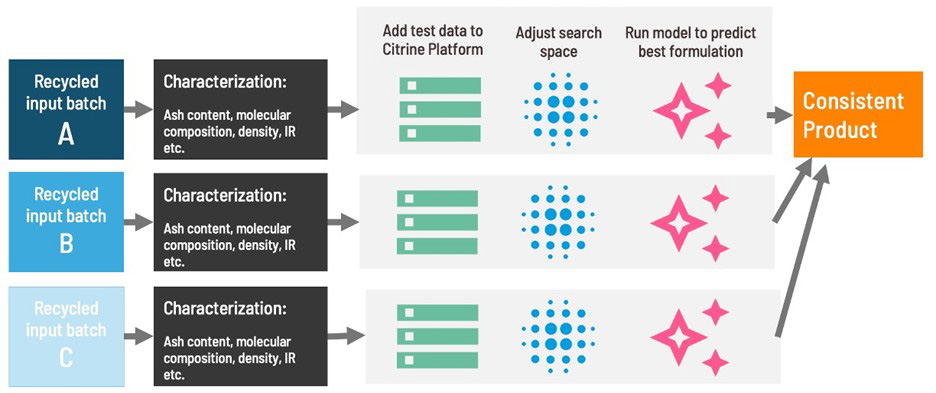
Figure 5. Schematic of how AI is used to adapt compound formulations depending on the batch of PCR.
AI also contributes to the design of multi-layer packaging materials, which must balance essential barrier properties with compostability. By modeling material mechanical and barrier performance, AI helps formulate packaging solutions that are both environmentally friendly and effective in preserving product integrity.
Conclusion
Machine learning has firmly established its value within the personal care industry, with larger brands already integrating it into their operations, although not yet comprehensively across all divisions and products. Currently, the industry is witnessing the early majority embracing AI, marking a pivotal point on the technology adoption curve.In the personal care sector, where datasets tend to be small, the expertise of individual formulators remains crucial. These professionals add valuable insight to AI models and exercise judgement in deciding which experiments to advance to laboratory testing. Nonetheless, AI offers an undeniable competitive edge to companies that leverage it. Brands that fail to adopt AI risk falling behind as those who embrace it.
For medium-sized brands, this represents a significant opportunity. By capitalizing on their typically agile management structures, they can swiftly scale AI adoption, potentially outpacing larger, slower competitors.
AI’s capability to manage multiple objectives simultaneously and efficiently navigate vast ingredient search spaces makes it indispensable in accelerating the transition to sustainable practices. As personal care companies continue to embrace this technology, they position themselves to innovate effectively, meet consumer demands for sustainability, and maintain competitiveness in a rapidly evolving market.
- This blog explains why accuracy is not the most important thing about models:
Does model accuracy really matter? https://citrine.io/does-accuracy-really-matter/ - Ling, J., Hutchinson, M., Antono, E. et al. High-Dimensional Materials and Process Optimization Using Data-Driven Experimental Design with Well-Calibrated Uncertainty Estimates. Integr Mater Manuf Innov 6, 207–217 (2017). https://doi.org/10.1007/s40192-017-0098-z https://link.springer.com/article/10.1007/s40192-017-0098-z
- Webinar with more details on using AI to reformulate formulations to use plant-based ingredients – Accelerate the Move to Plant-based Ingredients Using AI: https://citrine.io/accelerate-the-move-to-plant-based-ingredients-using-ai/
- This webinar goes into more detail on removing problem ingredients – Removing PFAS From Formulations : https://citrine.io/removing-pfas-from-formulations/
- This white paper covers how plastics used in packaging can include more recycled content by using AI to adapt formulations to varied post consumer recyclate: Agile Recycled Plastics Formulation Using AI: https://citrine.io/resources/white-papers/white-paper-agile-recycled-plastics-formulation-using-ai/
The Rise of Upcycled Ingredients in Cosmetics: A Sustainable Innovatio...

High Active Alpha Olefin Sulfonate

More than anti-ageing: the retinol-alternative Chios mastic as a compr...

Bakuchiol: A Comprehensive Review of Its Anti-Aging, Antioxidant, and...
A word with Marine Pasquier – Seppic

The feel of foam: innovating sensory evaluation for solid shampoo form...
Retinol Alternatives

Now and Beyond: The Top Trends Shaping the Laundry and Cleaning Market